Isometric Exercises: Build Strength Without Moving a Muscle
Static holds that build strength, lower blood pressure, and relieve tendon pain. Eight isometric exercises and a 10-minute routine.
Strength training usually involves movement. You lower yourself into a squat and stand back up. You press a weight overhead and bring it down. You curl, push, pull, and repeat. The entire architecture of resistance training revolves around muscles shortening and lengthening under load. So it seems counterintuitive that one of the most effective ways to build strength, protect your tendons, and reduce blood pressure involves doing none of that. Isometric exercise — holding a static position against resistance, with no visible joint movement — is the most underappreciated training modality available to anyone working out at home.
The science behind isometric training has matured considerably in the past decade. What was once treated as a rehabilitation footnote now carries some of the strongest evidence in exercise physiology across three distinct domains. First, isometric contractions produce meaningful strength gains that transfer to dynamic performance. Second, a landmark 2023 meta-analysis involving over 15,000 participants found that isometric exercise reduces resting blood pressure more effectively than any other exercise modality — including aerobic, dynamic resistance, and combined training. Third, specific isometric protocols have demonstrated dramatic pain reduction in chronic tendon injuries, offering relief that traditional treatments often fail to match. This article covers all three, then gives you eight exercises and a concrete 10-minute routine you can perform anywhere with no equipment.
What makes isometric training different from dynamic exercise
Every resistance exercise involves one or more of three contraction types. A concentric contraction shortens the muscle under load — the “up” phase of a bicep curl. An eccentric contraction lengthens it — the controlled lowering phase. An isometric contraction generates force without changing the muscle length at all. When you hold a plank, your abdominals, hip flexors, and shoulders are producing substantial force, but nothing is moving.
This distinction matters because each contraction type produces different adaptations. Oranchuk and colleagues (2019, PMID 30580468) conducted a systematic review examining how isometric training variables — muscle length, contraction intensity, and training intent — influence long-term adaptations. They found that isometric training at longer muscle lengths (where the muscle is stretched) produced greater strength gains and more structural remodeling than training at shorter lengths. A wall sit performed with deeper knee flexion generates a fundamentally different adaptation than the same hold at a shallow angle. The muscle does not need to move to grow stronger, but the position in which you hold it determines which fibers are recruited and how strength carries over to other tasks.
A separate review by Lum and Barbosa (2019, PMID 30943568) examined whether isometric strength training transfers to dynamic performance. Their findings were clear: isometric training produced positive transfer to vertical jump height, sprint speed, and change-of-direction ability. The review also found that isometric training induced less neuromuscular fatigue than equivalent-effort dynamic training, making it viable for athletes and home exercisers who need to train frequently without excessive fatigue accumulation. Understanding rest days and recovery science becomes easier when one of your training modes generates less systemic fatigue by design.
The practical upshot: isometric training is not a lesser version of dynamic training. It is a complementary modality with unique advantages — lower fatigue accumulation, tendon-specific adaptations, and blood pressure effects that dynamic training simply does not match.
The blood pressure breakthrough: isometrics outperform all other exercise types
For decades, the standard medical advice for people with elevated blood pressure was to avoid isometric exercise. The reasoning seemed sound: holding a static contraction against heavy resistance causes a temporary spike in blood pressure during the hold itself (the so-called “pressor response”), and clinicians worried this acute spike posed a cardiovascular risk. Patients were steered toward aerobic exercise — walking, cycling, swimming — as the safe, evidence-based option for lowering resting blood pressure.
That guidance has been overturned by one of the largest exercise meta-analyses ever conducted. Edwards and colleagues (2023, PMID 37491419) performed a network meta-analysis of 270 randomized controlled trials involving 15,827 participants, comparing aerobic exercise, dynamic resistance training, combined training, high-intensity interval training, and isometric exercise. The results were unambiguous: isometric exercise produced the largest reductions in both systolic and diastolic resting blood pressure of any exercise mode — 8.24 mmHg systolic and 4.00 mmHg diastolic, numbers that rival or exceed the effects of many first-line antihypertensive medications.
Within the isometric category, wall squats emerged as the single most effective submode for lowering systolic pressure. This finding aligned with earlier work by Goldring, Wiles, and Coleman (2014, PMID 23879248), who had investigated the cardiovascular responses to isometric wall squat exercise in normotensive adults and documented sustained post-exercise reductions in blood pressure. The wall squat is simple, requires no equipment, and can be performed by almost anyone — characteristics that make it exceptionally scalable as a public health intervention.
The contrarian dimension of this finding deserves emphasis: the exercise type that was historically warned against for cardiovascular risk turns out to produce the strongest cardiovascular benefit. The acute pressor response during a hold, which alarmed clinicians for years, appears to be the very stimulus that drives favorable vascular remodeling over time. Repeated exposure to brief, controlled blood pressure elevations during isometric holds may improve arterial compliance and endothelial function — the same pathways targeted by pharmaceutical interventions.
If you have been diagnosed with hypertension or are taking blood pressure medication, consult your physician before starting an isometric training program. The evidence is strong at the population level, but individual responses vary, and medical supervision ensures your specific situation is accounted for.
Isometrics for tendon pain: the Rio protocol
Chronic tendon pain — patellar tendinopathy (“jumper’s knee”), lateral epicondylitis (“tennis elbow”), Achilles tendinopathy — affects a large portion of active adults. Traditional treatment involves rest, anti-inflammatory medication, and gradual reintroduction of load through eccentric protocols. These approaches work, but slowly, often requiring weeks before patients experience meaningful pain reduction.
In 2015, Ebonie Rio and colleagues published a study (PMID 25979840) that challenged that timeline. They tested a single bout of isometric exercise — a sustained isometric quadriceps contraction — in athletes with patellar tendinopathy. Pain during a provocative test dropped from an average of 7.0 out of 10 to 0.17 out of 10. That is near-complete elimination of pain from a single isometric session. The analgesic effect lasted at least 45 minutes, providing a practical window for athletes to train or compete with substantially reduced discomfort.
The proposed mechanism involves cortical inhibition. In chronic tendinopathy, the brain’s motor cortex develops inhibitory patterns around the affected tendon — a protective response that reduces force output and alters movement strategies. Rio’s group found that isometric contractions reduced this cortical inhibition, effectively resetting the brain’s protective braking system and allowing the muscle-tendon unit to function more normally. This is not masking pain the way an analgesic drug does; it is addressing a neurological component of the pain experience itself.
The practical application extends beyond the knee. Clinicians have adapted isometric holds for lateral epicondylitis (sustained wrist extension holds), Achilles tendinopathy (isometric calf raises), and shoulder impingement (isometric external rotation holds). The principle is consistent: hold the affected muscle-tendon unit under moderate load (around 70 percent of maximal effort) for 30 to 45 seconds, repeated for 3 to 5 sets. This is not a cure — structural tendon changes require longer-term loading — but as an immediate pain management tool, isometric exercise has a stronger acute evidence base than most alternatives.
For adults over 40, tendon resilience becomes increasingly important as collagen turnover slows and tendons become more susceptible to overuse injuries. Incorporating isometric holds into a weekly routine may serve both preventive and therapeutic purposes.
Eight isometric exercises you can do anywhere
Each exercise below targets a distinct muscle group or movement pattern. Hold durations are starting recommendations; progress by adding 5 to 10 seconds per week.
1. Wall sit. Stand with your back flat against a wall and slide down until your thighs are parallel to the floor, knees at approximately 90 degrees. Press your entire back into the wall. Muscles worked: quadriceps, glutes, calves, core stabilizers. Hold: 30 to 60 seconds. Progression: single-leg wall sit (extend one leg forward while holding the position on the other).
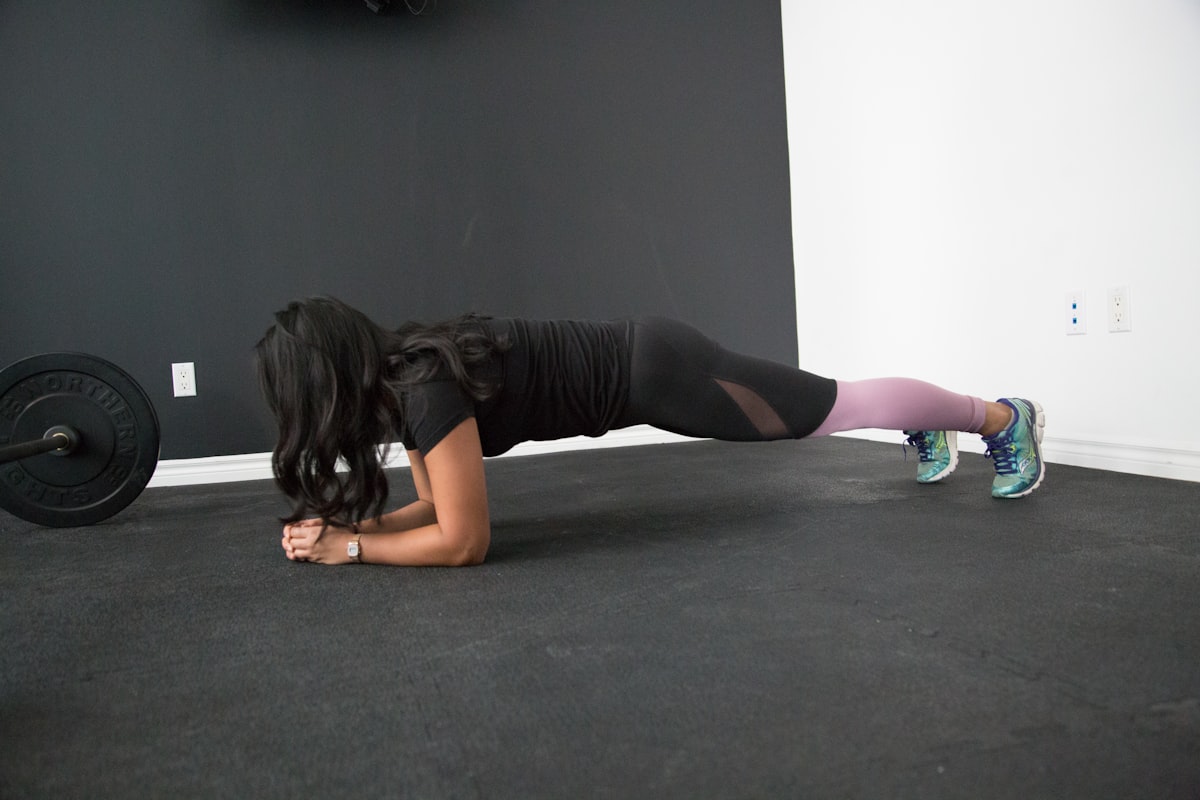
2. Plank. Forearms on the floor, elbows directly under shoulders, body in a straight line from head to heels. Do not let the hips sag or pike upward. Muscles worked: rectus abdominis, transverse abdominis, obliques, shoulders, hip flexors. Hold: 30 to 60 seconds. Progression: extend hold time or lift one foot off the floor for an anti-rotation challenge.
3. Side plank. Lie on one side, prop yourself on the forearm with elbow under shoulder, stack feet, and lift hips until the body forms a straight line. Muscles worked: obliques, quadratus lumborum, gluteus medius, shoulder stabilizers. Hold: 20 to 45 seconds per side. Progression: raise the top leg or add a hip dip (controlled lowering and lifting of the hips).
4. Glute bridge hold. Lie on your back, feet flat on the floor hip-width apart, drive hips toward the ceiling until your body forms a straight line from shoulders to knees, and hold. Muscles worked: glutes, hamstrings, lower back, core. Hold: 30 to 60 seconds. Progression: single-leg glute bridge hold (extend one leg straight while maintaining hip height).
5. Dead hang (if a pull-up bar is available). Grip the bar with both hands, shoulder-width apart, and hang with straight arms and relaxed shoulders pulled down from the ears. Muscles worked: forearm flexors, grip, lats, shoulder stabilizers. Hold: 20 to 45 seconds. Progression: single-arm dead hang or towel hang for added grip challenge. Grip strength carries significance beyond forearm development: Leong and colleagues (2015, PMID 25982160), in the PURE study of 139,691 participants across 17 countries, found that grip strength was inversely associated with all-cause mortality and cardiovascular death. Each 5 kg reduction in grip strength was associated with a 17 percent increase in cardiovascular mortality risk. As an observational study, these findings demonstrate a strong association rather than a proven causal link, but the consistency across diverse populations makes grip strength one of the most robust health indicators in exercise science.
6. Isometric push-up hold. Lower yourself into the bottom position of a push-up (elbows bent at roughly 90 degrees, chest a few inches from the floor) and hold. Muscles worked: pectorals, anterior deltoids, triceps, core. Hold: 15 to 30 seconds. Progression: elevate feet on a step or chair to increase the load.
7. Single-leg wall sit. Identical setup to the standard wall sit, but extend one leg straight forward, supporting your entire body weight on the working leg. Muscles worked: quadriceps (unilateral), glutes, core stabilizers. Hold: 15 to 30 seconds per leg. Progression: deepen the knee angle toward 90 degrees while maintaining back contact with the wall.
8. Isometric squat hold. Stand with feet shoulder-width apart, lower into a squat until thighs are parallel to the floor (no wall support), and hold. Arms can extend forward for counterbalance. Muscles worked: quadriceps, glutes, hamstrings, core, spinal erectors. Hold: 20 to 45 seconds. Progression: hold a weighted object (backpack, water jug) for added resistance.
A 10-minute isometric workout routine
This routine uses six of the eight exercises above, arranged in a circuit that alternates between upper body, lower body, and core to distribute fatigue. Perform it two to three times per week — consistent with the frequency recommendations outlined by Garber and colleagues (2011, PMID 21694556) in the ACSM position stand on exercise prescription for healthy adults.
Round 1 (approximately 5 minutes)
- Wall sit: 45 seconds. Rest: 15 seconds.
- Plank: 45 seconds. Rest: 15 seconds.
- Isometric push-up hold: 20 seconds. Rest: 15 seconds.
- Side plank (left): 30 seconds. Rest: 10 seconds.
- Side plank (right): 30 seconds. Rest: 15 seconds.
- Glute bridge hold: 45 seconds.
Round 2 (approximately 5 minutes)
Rest 30 seconds after Round 1, then repeat with these substitutions:
- Isometric squat hold replaces the wall sit: 40 seconds. Rest: 15 seconds.
- Plank: 45 seconds. Rest: 15 seconds.
- Isometric push-up hold: 20 seconds. Rest: 15 seconds.
- Side plank (left): 30 seconds. Rest: 10 seconds.
- Side plank (right): 30 seconds. Rest: 15 seconds.
- Wall sit: 45 seconds.
Execution notes
Breathe continuously throughout each hold. A common mistake is holding the breath during isometric contractions (the Valsalva maneuver), which spikes intra-thoracic pressure unnecessarily during submaximal holds. Inhale through the nose for 3 to 4 seconds, exhale through the mouth for the same duration, and maintain this rhythm for the entire set. If you cannot maintain controlled breathing, the hold is too intense — reduce the duration or modify the position.
Progression strategy
Weeks 1–2: Use the hold times above. Prioritize form — a sagging plank or a wall sit with knees drifting past the toes is a wasted hold.
Weeks 3–4: Add 10 seconds to each hold. Reduce rest periods from 15 to 10 seconds where manageable.
Weeks 5–6: Introduce single-leg wall sits and single-leg glute bridge holds in one of the two rounds. This shifts the routine from bilateral stability to unilateral strength development.
Weeks 7–8: Perform the full routine with single-leg variations throughout. Target total work time of 12 to 14 minutes as hold durations increase.
When isometrics should complement — not replace — dynamic training
Isometric training carries genuine advantages, but it also carries genuine limitations. The most important is joint-angle specificity. Strength gains from isometric training are largest at the specific joint angle where the contraction occurs, with transfer diminishing beyond roughly plus or minus 15 degrees. If you train a wall sit at 90 degrees of knee flexion, the carryover to deep squat strength (at 120 degrees or more) will be limited. Dynamic training, by contrast, loads the muscle through its entire range of motion, producing more broadly distributed strength gains.
The second limitation is hypertrophy. While isometric training can build muscle — the Oranchuk review (2019, PMID 30580468) confirmed meaningful structural adaptations occur, particularly at longer muscle lengths — the total mechanical work during a set of isometric holds is typically lower than an equivalent set of dynamic repetitions. Mechanical work is the product of force and displacement; with zero displacement, the equation changes fundamentally. If maximum muscle growth is your primary goal, dynamic training through full ranges of motion remains the more efficient tool.
The strongest case for isometric exercise is as a complement to a broader training program — not a replacement for one. A practical integration might look like this: three dynamic bodyweight sessions per week (push-ups, squats, lunges, pull-ups or rows) targeting strength and hypertrophy through progressive overload, plus two short isometric sessions (the 10-minute routine above) targeting tendon health, blood pressure regulation, and joint-angle-specific strength at positions that your dynamic training does not adequately load.
There is also a recovery case for isometric work. Because isometric contractions produce less muscle damage and less systemic fatigue than dynamic contractions — as the Lum and Barbosa review (2019, PMID 30943568) documented — they can serve as active recovery sessions between more demanding dynamic workouts. A 10-minute isometric circuit on an “off” day maintains neural drive to the muscles, promotes blood flow to tendons and connective tissue, and preserves the training habit without imposing a meaningful recovery debt.
The most effective home training program uses every available tool. Dynamic exercises build muscle through full ranges of motion. Isometric holds shore up tendons, manage blood pressure, and strengthen specific joint angles that dynamic movements skip. Together, they address the full spectrum of musculoskeletal and cardiovascular health — with nothing more than your body, a wall, and a patch of floor.
Related Articles
- Progressive Overload at Home: No-Gym Guide
- Does Bodyweight Training Build Muscle?
- Core Workout: Strong Abs Without Equipment
References
- Oranchuk, D.J., Storey, A.G., Nelson, A.R., & Cronin, J.B. (2019). Isometric training and long-term adaptations: Effects of muscle length, intensity, and intent: A systematic review. Scandinavian Journal of Medicine & Science in Sports, 29(4), 484–503. PMID: 30580468
- Lum, D., & Barbosa, T.M. (2019). Brief Review: Effects of Isometric Strength Training on Strength and Dynamic Performance. Journal of Sports Sciences, 37(6), 611–620. PMID: 30943568
- Edwards, J.J., Deenmamode, A.H.P., Griffiths, M., Arnold, O., Cooper, N.J., Wiles, J.D., & O’Driscoll, J.M. (2023). Exercise training and resting blood pressure: a large-scale pairwise and network meta-analysis of randomised controlled trials. British Journal of Sports Medicine, 57(20), 1317–1326. PMID: 37491419
- Rio, E., Kidgell, D., Purdam, C., Gaida, J., Moseley, G.L., Pearce, A.J., & Cook, J. (2015). Isometric exercise induces analgesia and reduces inhibition in patellar tendinopathy. British Journal of Sports Medicine, 49(19), 1277–1283. PMID: 25979840
- Leong, D.P., Teo, K.K., Rangarajan, S., et al. (2015). Prognostic value of grip strength: findings from the Prospective Urban Rural Epidemiology (PURE) study. The Lancet, 386(9990), 266–273. PMID: 25982160
- Goldring, N., Wiles, J.D., & Coleman, D. (2014). The effects of isometric wall squat exercise on heart rate and blood pressure in a normotensive population. Journal of Sports Sciences, 32(2), 129–136. PMID: 23879248
- Garber, C.E., Blissmer, B., Deschenes, M.R., et al. (2011). Quantity and quality of exercise for developing and maintaining cardiorespiratory, musculoskeletal, and neuromotor fitness in apparently healthy adults: guidance for prescribing exercise. Medicine & Science in Sports & Exercise, 43(7), 1334–1359. PMID: 21694556