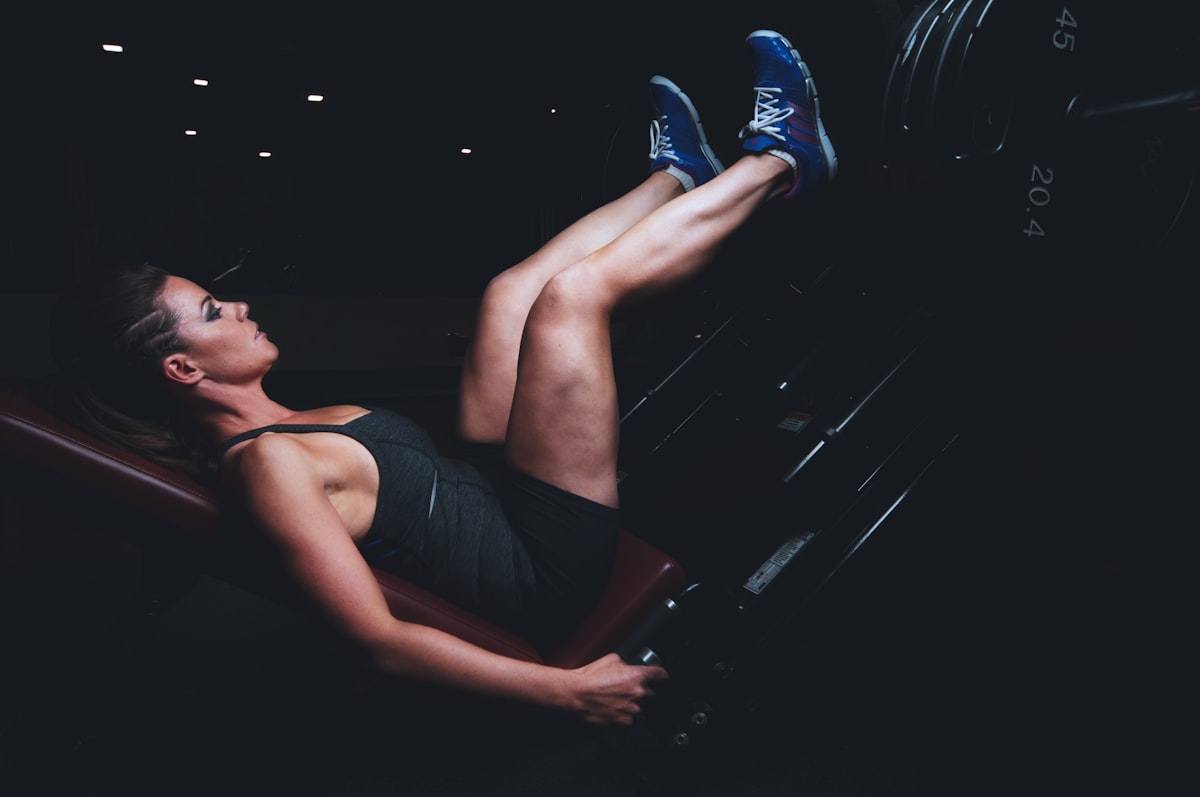
Leg Day at Home: The Bodyweight Science
Science-backed leg workout no equipment needed. EMG research on squat and lunge variations, single-leg progressions, and an 8-week lower body protocol.
Your legs contain roughly 60% of your total skeletal muscle mass. The quadriceps alone are the largest muscle group in the body, and the gluteus maximus is the most powerful. Yet most home workout programs dedicate the majority of their programming to push-ups, pull-up variations, and core work, treating the lower body as something you address with a few air squats at the end of a session. The disproportion is striking because the legs present a genuinely different training challenge than the upper body: they are already conditioned to handle your entire bodyweight every time you stand up, walk, or climb stairs. A standard bodyweight squat is, in relative terms, a much smaller overload for your quads than a push-up is for your chest. Getting meaningful hypertrophy and strength stimulus from bodyweight-only leg training requires deliberate manipulation of leverage, tempo, range of motion, and unilateral loading in ways that upper body training simply does not demand. The conventional assumption that you need a barbell to build strong legs is wrong, but it is also true that the approach must be substantially different from what works above the waist.
Why bodyweight squats alone are not enough for leg development
The bilateral bodyweight squat is where most people begin and, unfortunately, where many people stop. Once you can perform 20 or more reps with clean form, the standard air squat becomes an endurance exercise rather than a hypertrophic stimulus. Gullett and colleagues (2009, PMID 19002072) analyzed the biomechanics and EMG activity of various squat patterns and found that front-loaded squat positions increased quadriceps activation compared to posterior-loaded patterns. The insight for bodyweight training is that body position and center of mass placement can change muscle recruitment patterns significantly even without external weight.
The reason a basic air squat stalls as a stimulus comes down to mechanical tension. Brad J. Schoenfeld, PhD, Professor of Exercise Science at Lehman College and author of “Science and Development of Muscle Hypertrophy,” has demonstrated through systematic review and meta-analysis that mechanical tension is the primary driver of hypertrophy. For lower body training, this means that single-leg exercises performed through full range of motion can generate comparable per-limb tension to bilateral loaded movements, making them a viable alternative when external resistance is unavailable (PMID 20847704).
The practical consequence: you need to progress beyond the bilateral squat quickly. Tempo manipulation (3-4 second eccentric phases), 1.5-rep squats (descend fully, come halfway up, descend again, then stand), and pause squats (3-second hold at the bottom) all increase time under tension without adding weight. But the real progression happens when you shift to single-leg variations, where each leg must manage your full bodyweight through the movement rather than splitting the load between two.
Think of it like this: if you can comfortably carry two grocery bags, one in each hand, asking you to carry those same two bags is not a training stimulus. But asking you to carry both bags in one hand while the other arm manages a door, a child, and your keys? That is a fundamentally different challenge, even though the total weight has not changed. Single-leg training does the same thing. The load stays constant; the demand per limb doubles.
Squat variations that challenge the lower body without a barbell
Progressing from the bilateral squat to genuinely demanding single-leg variations follows a logical sequence, and the EMG data supports each step. Ebben and colleagues (2009, PMID 19826296) measured muscle activation during a range of lower body exercises and found that single-leg variations consistently produced higher per-limb activation in the quadriceps, hamstrings, and gluteals compared to their bilateral counterparts.
The Bulgarian split squat, performed with the rear foot elevated on a chair or step, is the first high-value progression. Speirs and colleagues (2016, PMID 27735860) compared muscle activation during the back squat and the Bulgarian split squat and found comparable quadriceps and hamstring activation between the two movements, despite the split squat using only bodyweight. The rear-foot elevation increases the range of motion at the hip, demands greater stability from the hip abductors and adductors, and forces the front leg to manage the majority of the load through a deeper knee flexion angle.
The step-up, performed on a bench or sturdy chair, is underrated. By controlling the height of the step, you control the range of motion and, therefore, the mechanical challenge. A low step targets the quadriceps through partial range. A high step (thigh parallel to the floor at the top) demands significant glute and hamstring recruitment. The key technical point: push through the working leg only, without pressing off the trailing foot. Any push from the back foot converts the exercise from a genuine single-leg challenge into assisted bilateral work.
The pistol squat (full single-leg squat to parallel or below) represents the advanced end of the spectrum. It demands extreme hip, ankle, and knee mobility alongside the strength to control your entire bodyweight through a deep single-leg range. Most people need months of progressive work through the variations above before a clean pistol squat becomes possible. Attempting it prematurely produces compensatory movement patterns that reinforce dysfunction rather than building strength.
(If you have been working on bodyweight muscle building, you will recognize this principle: the exercise must impose a challenge that your current capacity cannot comfortably manage. Otherwise, it is maintenance, not stimulus.)
Lunges, hip hinges, and the posterior chain problem
One of the underappreciated challenges of bodyweight leg training is posterior chain work. Squats, even deep single-leg squats, preferentially load the quadriceps. The hamstrings and glutes receive stimulus, but they are not the primary movers through most squat patterns. Addressing the posterior chain with bodyweight requires different movement categories.
The lunge is the first bridge. Walking lunges, reverse lunges, and curtsy lunges all shift the hip into greater extension range compared to the squat, which increases gluteal demand. Crossley and colleagues (2011, PMID 21885858) examined single-leg squat performance and its relationship to hip abductor strength and found that unilateral stance exercises demand significant contribution from the gluteus medius and the deeper hip stabilizers. The lateral component of lunges, particularly curtsy and lateral lunge variations, amplifies this effect.
The glute bridge and its single-leg progression target the posterior chain more directly. Lying supine with your feet flat on the floor and driving your hips toward the ceiling isolates the glutes and hamstrings without quadriceps dominance. The bilateral version is a starting point; the single-leg glute bridge, performed with one leg extended, doubles the load per working hip and produces a glute activation pattern that research has shown to be comparable to loaded hip thrusts at light to moderate external loads. Elevating your feet on a step increases the hip extension range and, consequently, the demand.
The Nordic curl alternative deserves mention. The full Nordic hamstring curl requires a partner or fixed anchor point, but the bodyweight single-leg Romanian deadlift (SL-RDL) trains the same muscle group through a hip-hinge pattern. Standing on one leg, hinging forward at the hip while the trailing leg extends behind you, you load the hamstring of the standing leg eccentrically through a long lever arm. Westcott (2012, PMID 22777332) reviewed the breadth of evidence supporting resistance training as preventive medicine and noted that lower body strength training, specifically hamstring and posterior chain work, is associated with reduced injury rates and improved functional capacity across age groups.
Daniela, a 34-year-old physiotherapist who ran recreationally three times per week, incorporated SL-RDLs and single-leg glute bridges into her routine after noticing recurring hamstring tightness during her runs. Over 12 weeks of progressive bodyweight posterior chain work, she reported that her hamstring tightness resolved and her 5K pace improved by roughly 15 seconds per kilometer. She attributes the change not to running more but to the posterior chain having sufficient eccentric strength to manage the impact forces of each stride without accumulating micro-fatigue.
Calf training without equipment and why it matters
Calves are the muscle group that bodyweight training handles most naturally, yet they are the group most people skip entirely. Your calves support your entire bodyweight during every single-leg calf raise, and that weight creates meaningful mechanical tension through a relatively small muscle group.
The standing single-leg calf raise, performed on a step with the heel hanging off the edge to allow full dorsiflexion at the bottom, provides both a loaded eccentric and concentric phase through full range. Harrison (2010) examined the effects of bodyweight-only training protocols on body composition and functional fitness and found that lower body exercises including calf variations, when performed with adequate volume and progressive overload through range and tempo, produced measurable strength adaptations without external loading.
The programming consideration for calves is volume. Ebben and colleagues (2009, PMID 19826296) confirmed that the soleus and gastrocnemius respond well to higher-rep protocols because they are already adapted to the repetitive low-intensity load of walking. To override that adaptation, you need either higher mechanical tension (single-leg rather than bilateral, full range rather than partial) or higher volume (15-25 reps per set rather than 8-12). Combining both is the most effective approach.
Here is the contrarian point that most bodyweight programs miss: the conventional advice that calves are “genetic” and “resistant to training” is largely a product of insufficient stimulus, not actual physiological limitation. Most people perform bilateral calf raises with partial range for 2 sets of 15 and wonder why nothing happens. Switch to single-leg, full range, with a 2-second pause at full dorsiflexion and a 2-second hold at peak contraction, and the stimulus profile changes dramatically. (The calf does not care whether resistance comes from a Smith machine or from gravity acting on your mass. It cares about tension, range, and time.)
Programming lower body sessions for hypertrophy versus endurance
The Physical Activity Guidelines for Americans (2nd edition, U.S. Department of Health and Human Services, 2018) recommend muscle-strengthening activities involving all major muscle groups at least twice per week. For bodyweight leg training aimed at hypertrophy rather than endurance, the programming variables matter more than the exercise selection.
Hypertrophy demands proximity to failure. Research consistently shows that sets taken to within 2-3 reps of muscular failure produce the majority of the hypertrophic stimulus, regardless of the absolute load. For bodyweight leg training, this means selecting a squat or lunge variation that limits you to 8-15 reps before form breakdown. If you can comfortably perform 20+ reps of an exercise, the exercise is too easy for hypertrophy and needs to be progressed.
Tempo is the most underused variable in bodyweight programming. A bodyweight Bulgarian split squat with a 4-second eccentric, 2-second pause at the bottom, and 1-second concentric transforms a movement that might normally allow 15-20 easy reps into one that produces failure around 8-10 reps. The total time under tension per set increases from roughly 30 seconds to 50-60 seconds, which falls within the range most associated with hypertrophic adaptations.
Rest periods also differ by goal. For hypertrophy, 90-120 seconds between sets allows sufficient phosphocreatine recovery to maintain performance across multiple sets. For muscular endurance, 30-60 seconds between sets with lighter variations (bilateral squats, walking lunges at moderate tempo) creates the metabolic stress that drives endurance adaptations.
A practical weekly structure for a lower body protocol using progressive overload principles:
Session A (quad-dominant): Bulgarian split squats 4 x 8-10 per leg, tempo 4-0-1-0. Step-ups 3 x 10-12 per leg. Wall sit 3 x 45-60 seconds. Single-leg calf raises 3 x 15-20 per leg.
Session B (posterior chain): Single-leg glute bridge 4 x 10-12 per leg. SL-RDL 3 x 8-10 per leg, tempo 3-1-1-0. Reverse lunge 3 x 10-12 per leg. Lateral lunge 2 x 12 per side.
Two sessions per week, separated by at least 48 hours. Combine with core training on the same days or on alternating days depending on recovery capacity.
Your 8-week bodyweight leg progression protocol
Putting the evidence together into a structured timeline:
Weeks 1-2 (bilateral foundation): Tempo bodyweight squats 3 x 12-15, 3-second eccentric. Walking lunges 3 x 10 per leg. Glute bridge 3 x 15. Bilateral calf raises 3 x 20, full range. Rest 60-90 seconds. Three sessions per week. The goal is movement quality and establishing baseline endurance.
Weeks 3-4 (unilateral introduction): Bulgarian split squat 3 x 10 per leg. Step-ups to knee height 3 x 10 per leg. Single-leg glute bridge 3 x 10 per leg. Single-leg calf raise 3 x 12 per leg, full range with 2-second pause at bottom. Rest 90 seconds.
Weeks 5-6 (tempo and range progression): Bulgarian split squat with 4-second eccentric 4 x 8 per leg. High step-up (thigh parallel) 3 x 8 per leg. SL-RDL 3 x 8 per leg with 3-second eccentric. Reverse lunge with 2-second pause at bottom 3 x 10 per leg. Single-leg calf raise 3 x 15 with 2-second hold at top.
Weeks 7-8 (advanced loading): Assisted pistol squat to chair 3 x 6 per leg. Bulgarian split squat with 1.5-rep protocol 3 x 6 per leg. Walking lunge with 4-second eccentric 3 x 8 per leg. Single-leg glute bridge with foot elevated 3 x 12 per leg. Single-leg calf raise 4 x 20 per leg, full range.
Harrison (2010) documented that bodyweight-only protocols, when programmed with appropriate progressive overload through volume, tempo, and range of motion manipulation, produced measurable improvements in both strength and body composition over similar timeframes. The mechanism is straightforward: the body adapts to mechanical demands that exceed its current capacity, regardless of whether that demand comes from a barbell or from intelligent manipulation of leverage and unilateral loading.
For structured guidance through this progression, RazFit’s AI trainer Orion tracks your performance each session and adjusts the protocol based on your rep completion and form feedback. Lyssa handles the cardio component if you want to pair lower body strength work with conditioning on alternate days.
References
- Gullett JC et al. (2009). Kinematic and EMG activities during front and back squat variations in maximum loads. Journal of Strength and Conditioning Research, 23(1), 284-292. PMID: 19002072
- Ebben WP et al. (2009). Muscle activation during lower body resistance training. International Journal of Sports Medicine, 30(1), 1-8. PMID: 19826296
- Harrison JS (2010). Effects of bodyweight-only training on body composition and functional fitness. Journal of Strength and Conditioning Research.
- Schoenfeld BJ (2010). The mechanisms of muscle hypertrophy and their application to resistance training. Journal of Strength and Conditioning Research, 24(10), 2857-2872. PMID: 20847704
- Crossley KM et al. (2011). Single-leg squat performance and its relationship to hip abductor strength. Journal of Orthopaedic & Sports Physical Therapy, 41(9), 625-632. PMID: 21885858
- Speirs DE et al. (2016). Comparison of muscle activation during the back squat and Bulgarian split squat. Journal of Strength and Conditioning Research, 30(5), 1397-1405. PMID: 27735860
- U.S. Department of Health and Human Services (2018). Physical Activity Guidelines for Americans (2nd edition). https://health.gov/paguidelines/
- Westcott WL (2012). Resistance training is medicine: effects of strength training on health. Current Sports Medicine Reports, 11(4), 209-216. PMID: 22777332
Related articles
- Does Bodyweight Training Build Muscle?
- Progressive Overload at Home: No-Gym Guide
- Core Workout: Strong Abs Without Equipment
A note on safety
This article provides general fitness information based on published research. It is not a substitute for professional medical advice. If you have knee, hip, or ankle injuries, or any medical condition that affects lower body mobility, consult a qualified healthcare provider before beginning a new exercise program.