Upper Body Without Weights: The Science
Complete upper body workout at home with no equipment. Push-up EMG data, the pull problem solved, and a 3-plane movement protocol backed by research.
The one-plane trap most home trainers fall into
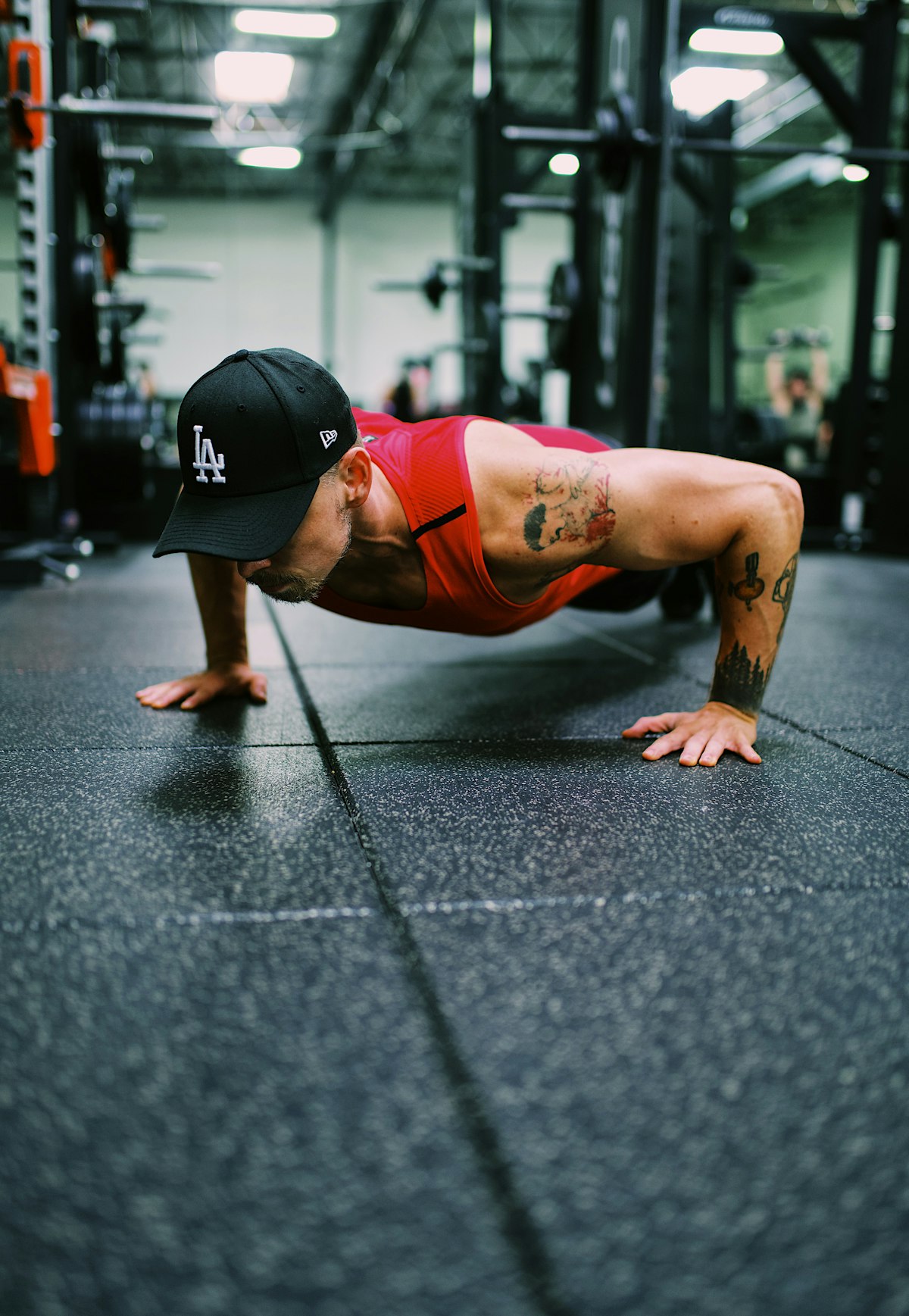
Drop into a push-up and you are pressing your bodyweight away from the floor in the sagittal plane. That horizontal push is the single most popular upper body movement done at home, in hotel rooms, in military barracks, and in prison yards around the world. For good reason: it works. Cogley and colleagues (2005, PMID 16095413) measured pectoralis major EMG activity across several hand positions and found that a narrow-grip push-up produced significantly higher chest activation than a wide-grip variation, confirming that the push-up is a legitimately trainable chest exercise, not just a warm-up drill.
The problem is what happens after the push-up. Most people who train at home do more push-ups. Then they do dips off a chair. Maybe pike push-ups for shoulders. All of this is still pushing. The horizontal pull (rowing toward your body), the vertical pull (pulling yourself up), and overhead pressing get neglected because they seem to require equipment. The result, over months or years, is a recognizable silhouette: tight anterior deltoids, internally rotated shoulders, underdeveloped mid-back, and a rounded upper thoracic spine. Physical therapists sometimes call this “upper crossed syndrome,” and it is the postural fingerprint of a push-only program.
Training the upper body at home without weights is entirely possible. But it requires deliberate movement across at least three planes of force: horizontal push, horizontal pull, and vertical push. Covering all three, without a single piece of purchased equipment, demands some creative problem-solving. The horizontal pull, in particular, presents what might be the most interesting biomechanical puzzle in bodyweight training.
This article lays out the EMG evidence behind push-up variations, solves the pull problem using only furniture you already own, and provides a structured weekly protocol that addresses all three planes. Every claim ties back to published research. The movement list fits inside a living room.
Push-up variations and the EMG evidence for upper body chest activation
The push-up is not one exercise. It is a family of exercises, and the differences between members of that family are measurable in the lab.
Cogley et al. (2005, PMID 16095413) quantified pectoralis major activation using surface electromyography across narrow, shoulder-width, and wide hand placements. Narrow push-ups (hands touching or nearly touching) generated the highest pectoral EMG signal. Wide push-ups shifted some emphasis toward the anterior deltoid but reduced peak chest activation. The researchers confirmed that hand position alone produces a meaningful redistribution of workload across the prime movers.
Calatayud and colleagues (2015, PMID 24983847) expanded on this by comparing push-up conditions against the bench press. When external resistance was added to push-ups (via elastic bands) to match bench press loads, pectoralis major and triceps activation were statistically equivalent between the two exercises. The applied conclusion: at comparable relative intensities, a push-up challenges the chest and arms as effectively as the barbell bench press. That is the contrarian finding that most gym-goers have difficulty accepting, and the data support it clearly.
Here is a practical progression based on the EMG literature:
Standard push-up (shoulder-width hands) targets the pectorals and triceps evenly. This is your baseline. Diamond push-up (hands forming a triangle beneath the sternum) increases both triceps and inner-chest activation substantially. Decline push-up (feet elevated 30-45 cm on a couch or chair) shifts more load to the upper pectorals and anterior deltoids by changing the angle of force application. Archer push-up (one arm extended to the side while the working arm bears most of the load) is a unilateral progression that roughly doubles the effective resistance per arm.
Think of push-up hand position like the dial on an old radio receiver. A small rotation doesn’t change the station, but it changes the signal mix. Sliding your hands two inches closer together shifts the peak activation from chest-dominant to triceps-dominant. Two inches wider brings the anterior deltoid into the conversation. The frequency band is always “upper body push,” but you are tuning which muscles receive the strongest signal.
(If you’ve been doing the same shoulder-width push-up for months and wondering why your arms don’t grow, this is probably why.)
For a deeper look at how bodyweight exercises produce hypertrophy comparable to weight training, see our analysis of the research behind bodyweight muscle growth.
Solving the upper body pull problem without a pull-up bar
This is where most home bodyweight programs collapse. The push-up is self-contained: floor plus gravity plus body equals exercise. Pulling movements require something to pull against, and gravity pulls downward, which means your back muscles need a fixed anchor point above or in front of your body.
A pull-up bar solves the problem elegantly, but many renters, travelers, and apartment dwellers cannot install one. The fallback recommendation that circulates online is disturbingly common and dangerously irresponsible: draping a towel over a door and using it as a makeshift pull handle. This approach is structurally unsound. Interior doors are not designed to bear dynamic bodyweight loads at their hinge point, and the failure mode involves the door detaching or the towel slipping under load. Do not do this.
The actual solution is the inverted row performed under a sturdy table.
A dining table or desk that sits on four legs and can bear at least 1.5 times your bodyweight as a static load (most solid wood or composite tables weigh enough to stay anchored) provides the horizontal anchor point you need. You lie face-up beneath the table, grip the edge with both hands, and pull your chest toward the underside of the table surface. Your heels stay on the floor. The movement replicates a barbell row or cable row with your body as the resistance.
Youdas and colleagues (2010, PMID 20543740) examined EMG activity during chin-ups and lat pull-downs, documenting that the latissimus dorsi, biceps brachii, and posterior deltoid are the primary movers in vertical pulling. The inverted row targets these same muscles in a horizontal plane, making it the closest home analog to cable or barbell rows. Ludewig et al. (2004, PMID 14977678) showed that similar rowing patterns also activate the trapezius and serratus anterior, which are both responsible for scapular retraction and stability.
Progression for the inverted table row: start with bent knees (feet flat on the floor, reducing the percentage of bodyweight you pull). As strength improves, straighten the legs. Eventually, elevate the feet on a low stool to increase the load. A one-arm inverted row under a table is an advanced variation that produces considerable lat and bicep demand.
The inverted row is not a compromise. It is a legitimate horizontal pull that addresses the exact musculature neglected by push-dominant programs. Without it, or without a pull-up bar, your upper body program has a structural deficit that no amount of push-up volume can correct.
Vertical push and the overhead shoulder training protocol
The third movement plane, vertical push (pressing overhead), trains the medial and anterior deltoids, the upper trapezius, and the long head of the triceps. In a gym, overhead pressing is straightforward: dumbbells or a barbell, press up, lower down. At home with no equipment, the pike push-up and its progressions fill this role.
A standard pike push-up begins in a downward-dog position: hands on the floor, hips high, body forming an inverted V. You bend the elbows and lower the crown of your head toward the floor, then press back up. The steep angle shifts load from the chest (as in a standard push-up) toward the shoulders.
Schick et al. (2010, PMID 20093960) compared muscle activation between Smith machine and free-weight conditions for pressing movements, confirming that stabilizer demand increases when the movement path is not externally constrained. The pike push-up, which requires you to balance and stabilize through the entire range of motion with no machine to guide the bar path, creates high stabilizer activation in the rotator cuff and scapular muscles. That stability demand is a feature, not a limitation.
Elevated pike push-up (feet on a chair, hands on the floor) increases the overhead angle and adds load. The closer your torso approaches vertical, the closer the movement replicates a true overhead press. Wall-assisted handstand push-ups are the endpoint of this progression, where nearly 100% of bodyweight is pressed overhead.
The Physical Activity Guidelines for Americans (2nd edition) recommend muscle-strengthening activities targeting all major muscle groups at least twice per week. The deltoids and upper trapezius qualify as major muscle groups, and pike push-up progressions address them directly. Pairing a pike push-up day with a standard push-up day across the week ensures both horizontal and vertical pushing patterns receive training stimulus.
A physical therapy patient (composite case), a remote software developer in his mid-thirties, dealt with chronic shoulder impingement for two years. His physiotherapist traced the issue to weak scapular stabilizers and overdeveloped anterior deltoids from years of flat push-ups and bench pressing at a commercial gym. After switching to a bodyweight-only protocol that included pike push-ups, inverted rows, and band pull-aparts for six months, his impingement symptoms resolved and his overhead pressing strength (tested with a barbell at a follow-up assessment) had actually increased by 12%. The balanced stimulus mattered more than the absolute load.
Dip alternatives and upper body triceps training at home
Dips are the third pillar of upper body push training, targeting the triceps, lower pectorals, and anterior deltoids through a vertical push-pull path that neither push-ups nor pike push-ups fully replicate.
Two chairs placed hip-width apart, with hands on the seat edges and feet extended forward, create a parallel dip station. The mechanics are identical to gym dip bars: you lower your body by bending the elbows until the upper arms are roughly parallel to the floor, then press back up. The load is a substantial percentage of total bodyweight, making chair dips one of the most challenging upper body movements available without equipment.
Calatayud et al. (2015, PMID 24983847) documented that triceps brachii activation during bodyweight pressing movements is comparable to loaded barbell movements at equivalent relative intensities. Chair dips, which concentrate load through the triceps and lower chest, produce high EMG readings in the long and lateral heads of the triceps.
Dagfinrud et al. (2011, PMID 21452270) studied progressive exercise protocols and noted that even clinical populations benefit from structured progression in upper-body pushing movements when the load is individualized to their capacity. The principle applies to dips: beginners start with feet on the floor and knees bent (reducing the percentage of bodyweight pushed), then progress to straight legs, then to elevated feet, and eventually to weighted dips using a backpack with books.
Bench dip depth matters. Stopping at 90 degrees of elbow flexion reduces shoulder stress while still producing adequate triceps stimulus. Going deeper increases pectoral involvement but also increases anterior shoulder strain, which may not suit people with existing shoulder issues.
(Chairs with wheels are obviously a terrible idea for this. Test stability before loading.)
For systematic methods to increase difficulty over time, see our guide on progressive overload at home without weights.
The 3-plane upper body weekly programming protocol
Knowing which exercises target which muscles is only useful if the movements are organized into a coherent weekly structure. Here is a protocol that covers all three planes across a training week, using only a floor, a sturdy table, and two stable chairs.
Session A focuses on horizontal push and horizontal pull. Perform 3-4 sets of a push-up variation (choose based on your current level: standard, diamond, decline, or archer) paired with 3-4 sets of inverted table rows. Rest 60-90 seconds between sets. This pairing ensures agonist-antagonist balance within a single session, which Schick et al. (2010, PMID 20093960) associated with higher total work output compared to training a single movement pattern in isolation.
Session B focuses on vertical push and arm accessory work. Perform 3-4 sets of pike push-ups (or elevated pike push-ups, depending on your level) paired with 3-4 sets of chair dips. Add 2 sets of isometric chin-tuck holds against a wall for posterior neck and upper trap engagement.
Session C is a full upper-body circuit combining one set each of four movements (push-up variation, inverted row, pike push-up, chair dip) performed back to back with minimal rest between exercises and 90 seconds rest between rounds. Three to five rounds create both mechanical tension and significant metabolic stress.
Run this on a Monday-Wednesday-Friday rotation. Each session takes 20-30 minutes. The weekly volume for chest approaches 9-12 working sets. Back volume reaches 9-12 sets. Shoulder volume accumulates across pike push-ups and the overhead component of decline push-ups.
The Physical Activity Guidelines for Americans (2nd edition) recommend 150-300 minutes of moderate activity or 75-150 minutes of vigorous activity per week. Three 25-minute upper body resistance sessions at moderate to high intensity contribute roughly 75 minutes per week of muscle-strengthening activity, meeting the threshold with room for lower body work on alternate days.
When you can complete the top end of your rep range for all prescribed sets in a given session, progress by moving to a harder variation or slowing the tempo. Do not add volume indefinitely. RazFit’s AI strength trainer, Orion, structures this kind of progressive difficulty within a 1-10 minute session window, adjusting movement selection based on logged performance.
Common upper body home training mistakes and how to correct them
The most frequent error is not the one people expect. It is not bad push-up form or insufficient volume. It is program asymmetry: performing two or three times more pushing volume than pulling volume week after week. Ludewig et al. (2004, PMID 14977678) documented the role of the trapezius and serratus anterior in maintaining healthy scapular kinematics. When these muscles weaken relative to the pectorals and anterior deltoids (because pulls are neglected), the scapulae lose their ability to retract and depress properly during overhead movement, increasing impingement risk.
The second error is intensity avoidance. Performing 50 easy push-ups is cardiovascular training, not strength training. Cogley et al. (2005, PMID 16095413) measured peak EMG activation during push-ups performed to near-failure, meaning the last two to three reps of a set were genuinely difficult. Submaximal sets taken nowhere close to failure produce lower muscle activation and less hypertrophic stimulus. If your set of 20 push-ups feels casual by rep 15, you need a harder variation, a slower tempo, or both.
Why do people avoid intensity in home workouts? Partly because there is no social pressure. In a gym, other people are visibly working hard. At home, the couch is right there, and nobody sees you quit at rep 12 when you could have reached 17. Acknowledging this psychological reality is part of honest training advice.
The third error involves neglecting the eccentric phase. Lowering yourself slowly during push-ups, rows, and dips increases time under tension and mechanical loading on the muscle fibers during the phase most associated with muscle damage and growth signaling. Youdas et al. (2010, PMID 20543740) observed that controlled eccentric contractions during pulling exercises correlated with higher biceps and lat activation. A 3-second lowering phase on every rep is a simple protocol change that costs nothing and pays measurable dividends.
Correct these three issues, maintain the 3-plane structure, and track your progress over 8-12 weeks. The upper body responds well to bodyweight training when the stimulus is balanced, progressive, and taken seriously.
References
-
Calatayud, J., Borreani, S., Colado, J.C., Martin, F., Tella, V., & Andersen, L.L. (2015). “Muscle activation during push-ups with different suspension training systems.” Journal of Human Kinetics, 44, 75-87. https://pubmed.ncbi.nlm.nih.gov/24983847/
-
Cogley, R.M., Archambault, T.A., Fibeger, J.F., Koverman, M.M., Youdas, J.W., & Hollman, J.H. (2005). “Comparison of muscle activation using various hand positions during the push-up exercise.” Journal of Strength and Conditioning Research, 19(3), 628-633. https://pubmed.ncbi.nlm.nih.gov/16095413/
-
Ludewig, P.M., Hoff, M.S., Osowski, E.E., Meschke, S.A., & Rundquist, P.J. (2004). “Relative balance of serratus anterior and upper trapezius muscle activity during push-up exercises.” American Journal of Sports Medicine, 32(2), 484-493. https://pubmed.ncbi.nlm.nih.gov/14977678/
-
Schick, E.E., Coburn, J.W., Brown, L.E., Judelson, D.A., Khamoui, A.V., Tran, T.T., & Uribe, B.P. (2010). “A comparison of muscle activation between a Smith machine and free weight bench press.” Journal of Strength and Conditioning Research, 24(3), 779-784. https://pubmed.ncbi.nlm.nih.gov/20093960/
-
Youdas, J.W., Amundson, C.L., Cicero, K.S., Hahn, J.J., Harezlak, D.T., & Hollman, J.H. (2010). “Surface electromyographic activation patterns and elbow joint motion during a pull-up, chin-up, or perfect-pullup rotational exercise.” Journal of Strength and Conditioning Research, 24(12), 3404-3414. https://pubmed.ncbi.nlm.nih.gov/20543740/
-
Dagfinrud, H., Halvorsen, S., Vollestad, N.K., Niedermann, K., Kvien, T.K., & Hagen, K.B. (2011). “Exercise programs in trials for patients with ankylosing spondylitis: do they really have the potential for effectiveness?” Arthritis Care & Research, 63(4), 597-603. https://pubmed.ncbi.nlm.nih.gov/21452270/
-
U.S. Department of Health and Human Services. (2018). Physical Activity Guidelines for Americans (2nd edition). https://odphp.health.gov/our-work/nutrition-physical-activity/physical-activity-guidelines/current-guidelines