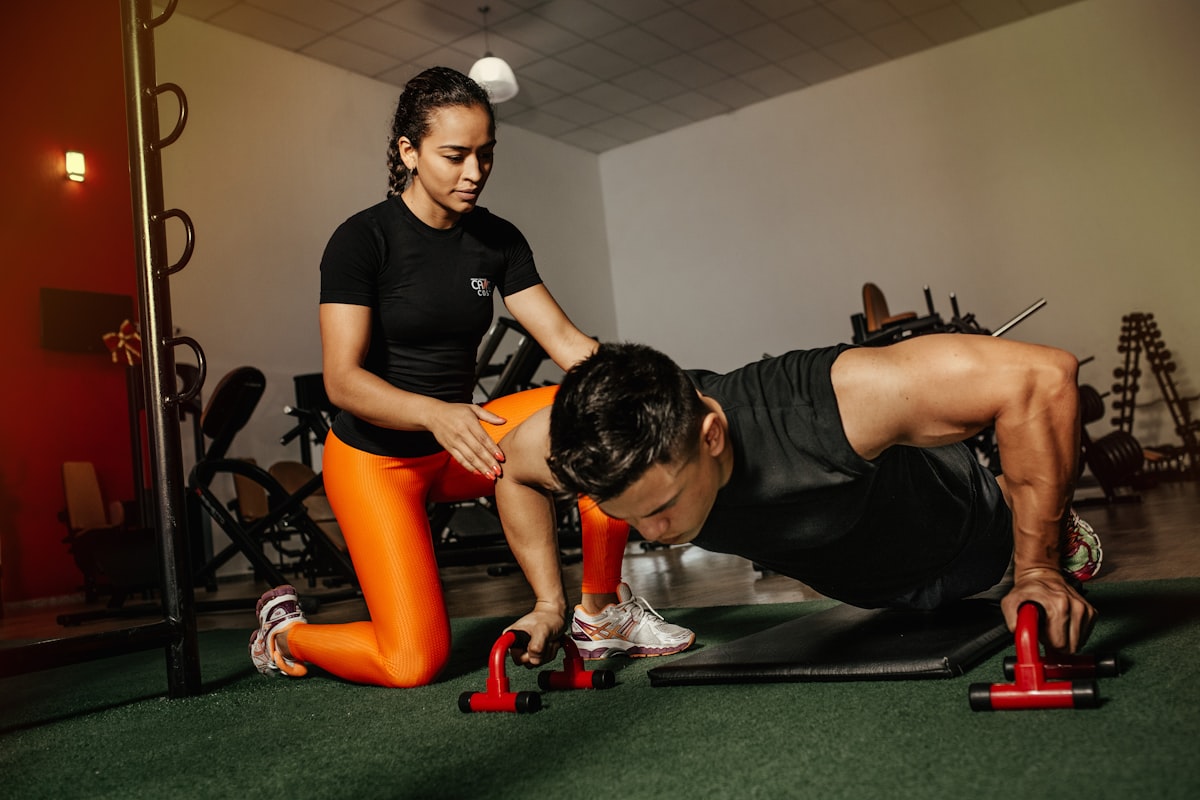
Your Calisthenics Progression System
A concrete progression system for bodyweight training. Research-backed skill trees for push-ups, squats, and pulling movements.
Gymnasts do not train with a linear barbell progression chart. They train with a skill tree. Every movement they master unlocks the prerequisites for the next one, and the system branches in multiple directions based on the athlete’s strengths, weaknesses, and goals. A planche is not simply a harder push-up; it sits at the end of a sequence that includes pseudo-planche lean, tuck planche, and straddle planche, each one building a specific combination of shoulder stability, straight-arm strength, and core compression. If a prerequisite is missing, the higher movement stays locked.
This architecture is what makes calisthenics differ from conventional gym training at a structural level. A barbell program is essentially linear: add weight, maintain form, repeat. A calisthenics progression system is a directed graph with branching paths, parallel routes, and prerequisite gates. You can progress the push pattern toward one-arm push-ups (strength branch), pike push-ups (vertical push branch), or planche variations (skill branch). Each branch develops distinct capabilities. Each demands different groundwork.
The problem is that most people who start bodyweight training never see the full map. They do push-ups until they stall, switch to diamond push-ups because someone online suggested it, and stall again with no idea what comes next or why. The progression system exists, but it is rarely presented as a coherent structure with clear branching logic, prerequisite requirements, and testable milestones. Kotarsky and colleagues (2018, PMID 29466268) demonstrated that progressive calisthenics produced strength gains and hypertrophy comparable to barbell training, but only when exercise selection was progressed systematically. The word “systematically” does all the work in that finding.
This article maps the full progression system for four fundamental movement patterns: push, squat, pull, and core. Each tree shows the regression-to-progression route, the branching points, the prerequisite gates, and the specific capacity each step develops. If you already train with bodyweight and feel stuck, the answer is almost certainly sitting in one of the branches you have not explored yet.
Why Complexity Is the Forgotten Overload Variable
Most calisthenics advice reduces progression to a single axis: make the exercise harder. That approach is technically correct and practically incomplete. It treats all forms of “harder” as equivalent, when research demonstrates they are not.
Suchomel, Nimphius, and Stone (2019, PMID 31354510) published a paper in the Journal of Strength and Conditioning Research that reframed how coaches should think about progression. Their argument: movement complexity is a distinct and underutilized load progression variable, separate from external load, volume, and intensity. A multi-segment exercise requiring simultaneous coordination across several body segments elevates stress on the neuromuscular and motor control systems in ways that simply adding repetitions does not. The implications for bodyweight training are direct, because calisthenics progression is built almost entirely on complexity manipulation.
Consider the difference between a standard push-up and an archer push-up. The load on the working arm increases, yes. But the coordination demand does too: one arm pushes while the other stabilizes in an extended position, the core must resist rotation, and the shoulder stabilizers on each side work asymmetrically. That complexity challenge is a separate training stimulus from the load increase alone.
Kraemer and Ratamess (2004, PMID 15233707) established that progressive overload is the central principle governing long-term strength adaptation. What the complexity framework adds is a taxonomy for how to achieve that overload without external weight. In a calisthenics context, you can progress along at least five distinct axes: leverage manipulation (changing body angle relative to gravity), unilateral loading (shifting from two limbs to one), tempo manipulation (increasing time under tension), volume (more sets or reps), and complexity (adding coordination demands, instability, or multiplanar movement). Each axis stresses different physiological systems. A well-designed progression system uses all five, not just the first.
The practical takeaway: if you have been stuck on the same calisthenics movements for months, adding reps or slowing the tempo may help, but the most likely unlock is advancing along a complexity axis you have been ignoring. The skill tree structure makes those axes visible.
The Push Pattern Skill Tree
The push pattern branches into three distinct paths after the standard push-up. Each path develops a different capacity, and each has its own prerequisite chain.
The base sequence (everyone starts here):
Wall push-up, then countertop push-up (hands at hip height), then incline push-up (hands on a low step), then standard push-up. Kikuchi and Nakazato (2017, PMID 29541130) demonstrated that push-ups performed at load-matched intensity produced the same pectoralis major hypertrophy (18.3% increase in cross-sectional area) and triceps gains as bench press over eight weeks. The base sequence adjusts effective load through hand elevation, which is the simplest leverage manipulation available.
Once you can perform 3 sets of 12 standard push-ups with controlled 2-1-1 tempo, the tree branches.
Branch A: Horizontal Strength leads toward the one-arm push-up. The sequence is: close-grip (diamond) push-up, then archer push-up (one arm extends laterally while the other pushes), then one-arm push-up with hand elevated on a step, then full one-arm push-up. This branch is pure strength progression through unilateral loading. The working arm handles progressively more of total bodyweight while the core must resist increasing rotational forces.
Branch B: Vertical Push leads toward the overhead press without a barbell. The sequence is: pike push-up (hips elevated, body forms an inverted V), then elevated pike push-up (feet on a chair or wall), then handstand push-up against a wall (heels against the wall, pressing the body upward), then freestanding handstand push-up. This branch develops the anterior deltoids and upper trapezius in a way that horizontal pushing does not. The prerequisite gate here is shoulder mobility: if you cannot reach a full overhead position with arms by your ears without compensating through the lower back, spend time on shoulder flexion mobility before entering this branch.
Branch C: Straight-Arm Strength is the skill-intensive path. The sequence is: pseudo-planche lean (hands by hips, leaning forward with straight arms), then tuck planche (knees to chest, body horizontal), then advanced tuck, then straddle planche, then full planche. This branch demands wrist conditioning, scapular protraction strength, and core compression that the other branches do not develop. Most people will train Branches A and B for a year or more before Branch C becomes accessible.
What the tree reveals is that “getting better at push-ups” is not a single goal. It is three different goals with overlapping but distinct foundations. An athlete who can do a one-arm push-up may not be able to do a pike push-up, and neither ability predicts planche readiness. The branches are parallel routes, not a single ladder.
The Squat Pattern Skill Tree
The squat tree has fewer branches but greater depth per branch. The primary split is between bilateral and unilateral paths, with a separate mobility track running alongside both.
The base sequence: assisted squat (holding a doorframe for balance), then bodyweight squat to parallel, then pause squat (3-second hold at the bottom), then full-depth bodyweight squat (hip crease well below the knee). Schoenfeld (2010, PMID 20847704) documented that accumulated mechanical tension during a set drives the hypertrophic signaling cascade. The pause squat extends time under tension at the mechanically most disadvantaged position, which is a tempo-based overload tool before any complexity increase.
Once full-depth squats for 3 sets of 15 are comfortable, the tree branches.
Branch A: Unilateral Strength leads toward the pistol squat. The sequence is: split squat (staggered feet, front leg takes the primary load), then Bulgarian split squat (rear foot elevated on a chair), then skater squat (rear knee hovers close to the ground without support), then assisted pistol squat (holding a doorframe for minimal balance help), then full pistol squat. Lee and colleagues (2021, PMID 33887761) found that the position of the non-stance limb significantly affects muscle activation patterns during unilateral squats, with the pistol position (leg extended forward) producing the greatest demand on the tensor fasciae latae and quadriceps. The pistol is not simply a single-leg squat; it is a specific variant that maximizes anterior chain loading.
The prerequisite gate for the pistol squat is ankle dorsiflexion. If your heels lift off the ground during a deep bodyweight squat, the pistol will be physically impossible regardless of your leg strength. The mobility track addresses this directly.
Branch B: Power adds an explosive component. The sequence is: jump squat (from bodyweight squat, explode upward), then tuck jump, then single-leg box jump, then depth jump (step off a box, absorb the landing, jump immediately). This branch develops rate of force production, a quality distinct from maximal strength. The prerequisite is reliable bilateral squat mechanics; jumping with poor form amplifies ankle and knee injury risk.
Mobility track (runs parallel to both branches): ankle dorsiflexion mobilizations (wall ankle stretch, 2 minutes per side daily), hip flexor lengthening (half-kneeling stretch with posterior pelvic tilt), and deep squat holds (accumulate 5 minutes daily in the bottom position, holding a doorframe if needed). This track is not optional for the unilateral branch. Schoenfeld’s meta-analysis on training volume (2017, PMID 27433992) confirmed that hypertrophy responds to volume dose, but range of motion is the frequently overlooked prerequisite that determines how much mechanical tension each rep actually produces. A quarter-range pistol squat produces a fraction of the stimulus of a full-range one.
The Pull Pattern Skill Tree
The pull pattern has the steepest entry barrier in calisthenics. Many people who begin bodyweight training cannot complete a single pull-up, and the gap between “zero pull-ups” and “one pull-up” is the widest jump in any calisthenic movement pattern. The tree addresses this with an extended base sequence.
The base sequence: active hang (dead hang with scapulae retracted, shoulders down and back), then scapular pulls (hanging, pull shoulder blades together without bending elbows), then inverted row at 45 degrees (body under a table or low bar, feet on the floor, pull chest to bar), then near-horizontal inverted row, then band-assisted or negative pull-up (jump to the top, lower slowly over 5 seconds), then full pull-up. The ACSM Position Stand (Garber et al., 2011, PMID 21694556) recommends multi-joint resistance exercises for major muscle groups 2-3 days per week. The pull-up is the bodyweight exercise that most directly loads the latissimus dorsi, biceps brachii, and posterior deltoids simultaneously.
The key insight for beginners: inverted rows are not a lesser exercise. They develop the scapular retractors (rhomboids, middle trapezius) and teach the pulling motor pattern at a manageable load. Skipping rows and going straight to assisted pull-ups often fails because the scapular stabilizers are not ready to hold position under full bodyweight load.
Once you can perform 3 sets of 8 strict pull-ups, the tree branches.
Branch A: Strength progresses toward the one-arm pull. The sequence is: close-grip chin-up, then L-sit pull-up (legs held horizontal, adding core demand and changing the leverage), then archer pull-up (one arm grips the bar wide while the other presses a band or slides along the bar), then one-arm chin-up negative (lower slowly with one arm), then full one-arm chin-up. This is the longest and most demanding branch in any calisthenics skill tree. Most recreational practitioners will train for two to three years before achieving a clean one-arm chin-up.
Branch B: Muscle-up combines pull and push in a single movement. The sequence is: high pull-up (pull until the bar reaches sternum level), then banded muscle-up, then strict bar muscle-up, then ring muscle-up. The prerequisite gate is explosive pulling power: if your pull-up does not reach chest height, the transition phase of the muscle-up will be impossible. Training high pulls specifically, not simply regular pull-ups faster, builds this capacity.
How to Use the Skill Trees in Practice
Knowing the progressions is necessary. Knowing how to program them across a training week is what produces results. The following framework applies the research on training volume and frequency to the skill tree structure.
Schoenfeld, Ogborn, and Krieger (2017, PMID 27433992) conducted a meta-analysis on the dose-response relationship between weekly resistance training volume and muscle hypertrophy. The finding: there is a graded dose-response relationship, with higher weekly set volumes associated with greater hypertrophy, up to a practical ceiling. For calisthenics practitioners, this means distributing skill tree work across the week matters more than cramming it into a single session.
A practical weekly template:
Session A (push + squat focus): work on the primary push branch you are progressing (for example, pike push-ups if you are on the vertical push path) for 3-4 working sets, plus squat branch work for 3-4 sets. Total session: 25-35 minutes.
Session B (pull + core focus): pulling progression work for 3-4 sets, plus a secondary push variation from a different branch for 2-3 sets. Core work: 2-3 sets of an appropriate progression. Total session: 25-35 minutes.
Session C (skill + mobility): practice the most complex movement you are currently working on (handstand holds, pistol squat negatives, one-arm push-up progressions) for 3-5 sets of low reps with full recovery. Spend 10-15 minutes on the mobility track. This session is lower intensity but develops the coordination and range of motion that gate progression on the upper branches.
The advancement rule stays consistent across all trees: when you complete all prescribed sets at the target rep range with controlled mechanics for two consecutive sessions, move to the next step on that branch. If a step takes four weeks to master, that is normal. If it takes eight weeks, that is also normal. Progression speed varies enormously across branches. The push base sequence might take four weeks. A single step on the pull strength branch can take three months.
A common mistake with the three-session template: treating every session as maximal effort. Suchomel and colleagues (2019, PMID 31354510) noted that complexity-based progression is inherently self-limiting, because a movement you cannot yet coordinate will not allow you to generate maximal force regardless of effort. Session C, the skill day, works best at 70-80% of maximal effort, focusing on movement quality and motor learning rather than grinding out difficult reps. Treat skill work the way a musician treats a new passage: slow, controlled repetitions that build the motor pattern, not exhausting attempts that reinforce sloppy mechanics.
The Uncomfortable Truth About Calisthenics Skill Trees
Here is the uncomfortable reality that typical progression charts leave out: most people do not need most of the branches. The full tree is a map of everything that is possible. Your actual training should use perhaps 20-30% of it at any given time.
A person whose goal is general strength and muscle for health needs the base sequences, one push branch (probably horizontal strength), the unilateral squat path, and the pull foundation up through strict pull-ups. That covers major muscle groups, provides years of progressive overload capacity, and aligns with both the ACSM and WHO resistance training guidelines. Chasing the muscle-up or the planche because they exist on the tree is a goal mismatch for most recreational trainees.
The analogy that fits: a road atlas shows every highway in the country, but a useful road trip plan uses three of them. The atlas is valuable because it shows connections and alternatives when your current route gets blocked (a plateau on one branch means you can switch to a parallel path), not because you should drive every road.
Think of your calisthenics progression system as a diagnostic tool, not a checklist. When progress stalls on one branch, the tree shows you exactly where a parallel path or a skipped prerequisite might be the bottleneck. Stuck on the archer push-up? The vertical push branch develops shoulder stability that transfers directly. Stuck on the pistol squat? The mobility track may be the gate you have not opened. Stuck on pull-ups? The scapular pulling foundation may be incomplete. The tree does not tell you to do everything. It tells you what to try next.
RazFit’s library of 30 bodyweight movements maps directly onto these progression trees. Orion, the AI strength trainer, tracks your performance across sessions and identifies when you have met the advancement criteria for the next step on your active branch. Lyssa, the cardio trainer, handles conditioning on off days without interfering with strength recovery. The combination of structured skill trees and automated progression tracking removes the most common failure mode in calisthenics training: knowing the system exists but not executing the decisions consistently.
References
-
Kotarsky CJ et al. (2018). Effect of progressive calisthenics push-up training on muscle strength and thickness. Journal of Strength and Conditioning Research. PMID 29466268
-
Kikuchi N, Nakazato K (2017). Low-load bench press and push-up induce similar muscle hypertrophy and strength gain. Journal of Exercise Science and Fitness. PMID 29541130
-
Suchomel TJ, Nimphius S, Bellon CR, Stone MH (2019). Complexity: a novel load progression strategy in strength training. Journal of Strength and Conditioning Research. PMID 31354510
-
Kraemer WJ, Ratamess NA (2004). Fundamentals of resistance training: progression and exercise prescription. Medicine & Science in Sports & Exercise. PMID 15233707
-
Schoenfeld BJ (2010). The mechanisms of muscle hypertrophy and their application to resistance training. Journal of Strength and Conditioning Research. PMID 20847704
-
Schoenfeld BJ, Ogborn D, Krieger JW (2017). Dose-response relationship between weekly resistance training volume and increases in muscle mass. Journal of Sports Sciences. PMID 27433992
-
Lee J et al. (2021). Muscle activation during unilateral squat is affected by the position of the non-stance limb. Journal of Sport Rehabilitation. PMID 33887761
-
Garber CE et al. (2011). Quantity and quality of exercise for developing and maintaining fitness in apparently healthy adults. Medicine & Science in Sports & Exercise. PMID 21694556