How AI Workout Apps Personalize Training
AI workout personalization relies on feedback loops, effort data, and adaptation logic rather than one-time onboarding quizzes.
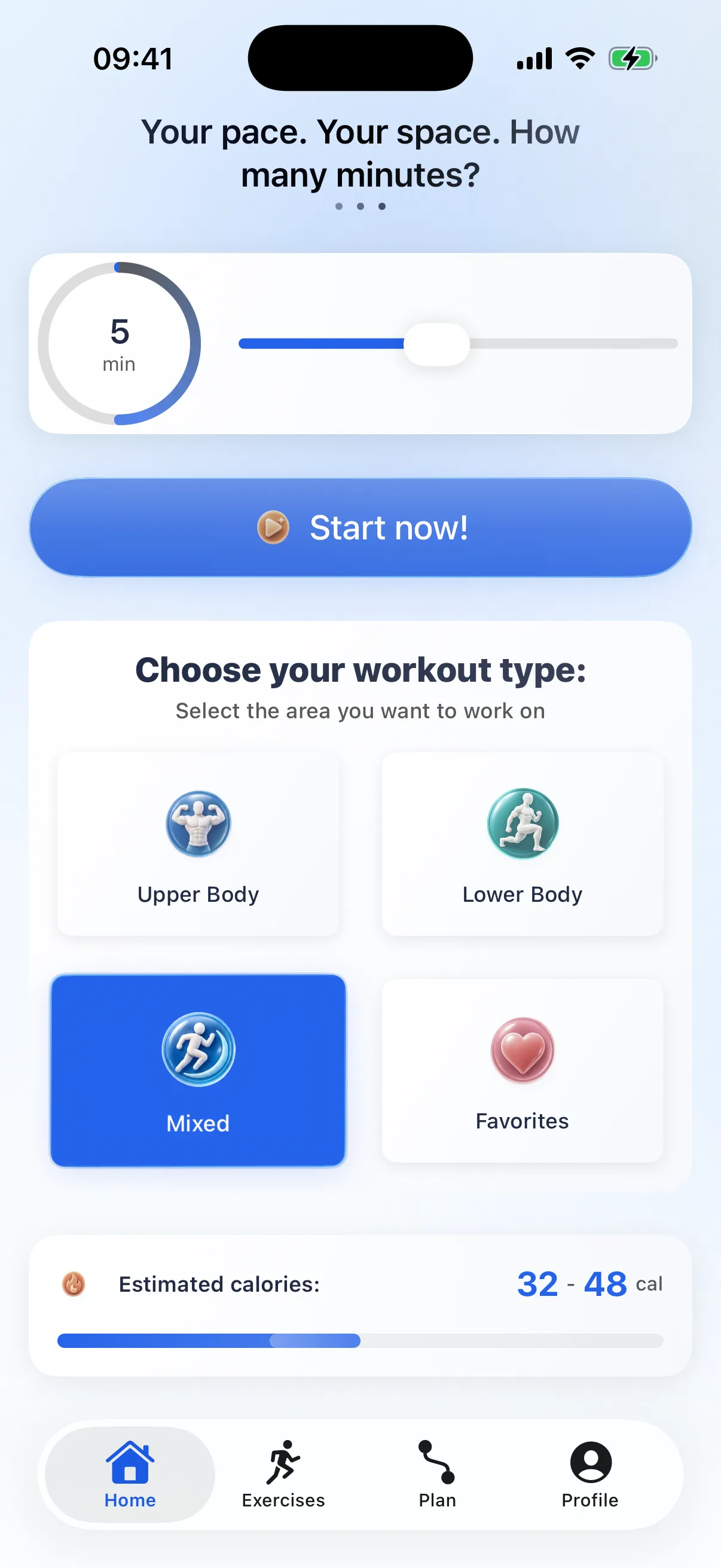
Most “personalized” workout apps are not especially personalized. They ask a few onboarding questions, sort you into a bucket, and deliver a template built for people vaguely like you.
Real personalization starts later, once the system has seen how you actually behave.
What an adaptive app is really doing
(Sources: An evaluation of the effect of app-based exercise prescription using reinforcement learning on satisfaction and exercise intensity: randomized crossover trial; Effectiveness of a digital health intervention leveraging reinforcement learning: results from the DIAMANTE randomized clinical trial; Enhancing digital health services: a machine learning approach to personalized exercise goal setting) (Source 1; Source 2; Source 3; Source 4; Source 5; Source 6)
(Sources: An evaluation of the effect of app-based exercise prescription using reinforcement learning on satisfaction and exercise intensity: randomized crossover trial; Effectiveness of a digital health intervention leveraging reinforcement learning: results from the DIAMANTE randomized clinical trial; Enhancing digital health services: a machine learning approach to personalized exercise goal setting) An AI workout system usually works with a simple loop:
- it sees what you completed
- it measures or infers how hard it felt
- it notices patterns in timing, skips, and consistency
- it adjusts what comes next
That is a more meaningful version of personalization than a one-time quiz because it responds to evidence rather than self-description.
Foster’s session-RPE work matters here. Internal load is often more informative than raw duration or rep count. If an app learns that a certain volume consistently drives fatigue too high, or that certain sessions are skipped more often than others, it can change the plan in ways a static app cannot.
The research signal worth paying attention to
(Sources: Quantity and quality of exercise for developing and maintaining cardiorespiratory, musculoskeletal, and neuromotor fitness in apparently healthy adults; A new approach to monitoring exercise training; Systematic review exploring human, AI, and hybrid health coaching in digital health interventions: trends, engagement, and lifestyle outcomes) (Source 1; Source 2; Source 3; Source 4; Source 5; Source 6)
(Sources: Quantity and quality of exercise for developing and maintaining cardiorespiratory, musculoskeletal, and neuromotor fitness in apparently healthy adults; A new approach to monitoring exercise training; Systematic review exploring human, AI, and hybrid health coaching in digital health interventions: trends, engagement, and lifestyle outcomes) Doherty et al. found that reinforcement-learning-based exercise prescription improved both satisfaction and exercise intensity compared with a standard algorithm in a crossover trial. That is useful because it gets at a core challenge in app design: pushing hard enough to create a training signal without making the program feel punishing or clumsy.
Aguilera’s DIAMANTE trial also matters, even though it focused on message timing and activity support more broadly. It showed that reinforcement-learning systems can improve behavioral outcomes by adapting interventions to the individual over time rather than treating every user the same way.
The practical meaning is simple: better AI systems do not just select exercises. They learn how and when a person is most likely to respond well.
What the best apps personalize
(Sources: An evaluation of the effect of app-based exercise prescription using reinforcement learning on satisfaction and exercise intensity: randomized crossover trial; Effectiveness of a digital health intervention leveraging reinforcement learning: results from the DIAMANTE randomized clinical trial; Enhancing digital health services: a machine learning approach to personalized exercise goal setting) (Source 1; Source 2; Source 3; Source 4; Source 5; Source 6)
(Sources: An evaluation of the effect of app-based exercise prescription using reinforcement learning on satisfaction and exercise intensity: randomized crossover trial; Effectiveness of a digital health intervention leveraging reinforcement learning: results from the DIAMANTE randomized clinical trial; Enhancing digital health services: a machine learning approach to personalized exercise goal setting) The strongest personalization usually happens across three variables:
1. Volume
How much total work the session includes.
2. Difficulty
Whether the movements, rest periods, or pace should get harder or easier.
3. Selection
Which exercises are more likely to be completed well and repeated consistently.
That third point matters more than it seems. A technically “perfect” exercise choice is not perfect if the user always skips it. Good personalization is not just physiology. It is behavior plus physiology.
That is also what separates strong products in the best AI fitness apps category from apps that mainly market AI as a headline. Short-session apps that actually keep the week moving sit on best 5-minute workout apps. Bodyweight-first libraries without a gym commute are best bodyweight training apps.
What AI still cannot fully do
(Sources: Quantity and quality of exercise for developing and maintaining cardiorespiratory, musculoskeletal, and neuromotor fitness in apparently healthy adults; A new approach to monitoring exercise training; Systematic review exploring human, AI, and hybrid health coaching in digital health interventions: trends, engagement, and lifestyle outcomes) (Source 1; Source 2; Source 3; Source 4; Source 5; Source 6)
(Sources: Quantity and quality of exercise for developing and maintaining cardiorespiratory, musculoskeletal, and neuromotor fitness in apparently healthy adults; A new approach to monitoring exercise training; Systematic review exploring human, AI, and hybrid health coaching in digital health interventions: trends, engagement, and lifestyle outcomes) It does not see everything.
It may miss subtle form breakdown.
It may misunderstand why a session was skipped.
It may interpret life stress as lack of motivation or vice versa.
And unless the product has unusually strong context capture, it is still weaker than a thoughtful human coach at integrating injury history, emotional state, and movement nuance into the same decision.
Bottom line
(Sources: An evaluation of the effect of app-based exercise prescription using reinforcement learning on satisfaction and exercise intensity: randomized crossover trial; Effectiveness of a digital health intervention leveraging reinforcement learning: results from the DIAMANTE randomized clinical trial; Enhancing digital health services: a machine learning approach to personalized exercise goal setting) (Source 1; Source 2; Source 3; Source 4; Source 5; Source 6)
(Sources: An evaluation of the effect of app-based exercise prescription using reinforcement learning on satisfaction and exercise intensity: randomized crossover trial; Effectiveness of a digital health intervention leveraging reinforcement learning: results from the DIAMANTE randomized clinical trial; Enhancing digital health services: a machine learning approach to personalized exercise goal setting) AI personalizes workouts best when it is allowed to learn from real usage, not just onboarding answers.
That means the app needs enough feedback data, enough consistency, and enough good design to keep the loop alive.
The headline promise is personalization.
The real mechanism is adaptation.
References
Sources
Expert perspective
Doherty and colleagues found that reinforcement-learning-based exercise prescription improved satisfaction and exercise intensity compared with a standard algorithm in a randomized crossover trial.
C. Doherty and colleagues · Digital exercise prescription researchers · JMIR mHealth and uHealth · Source: https://pubmed.ncbi.nlm.nih.gov/39622712/