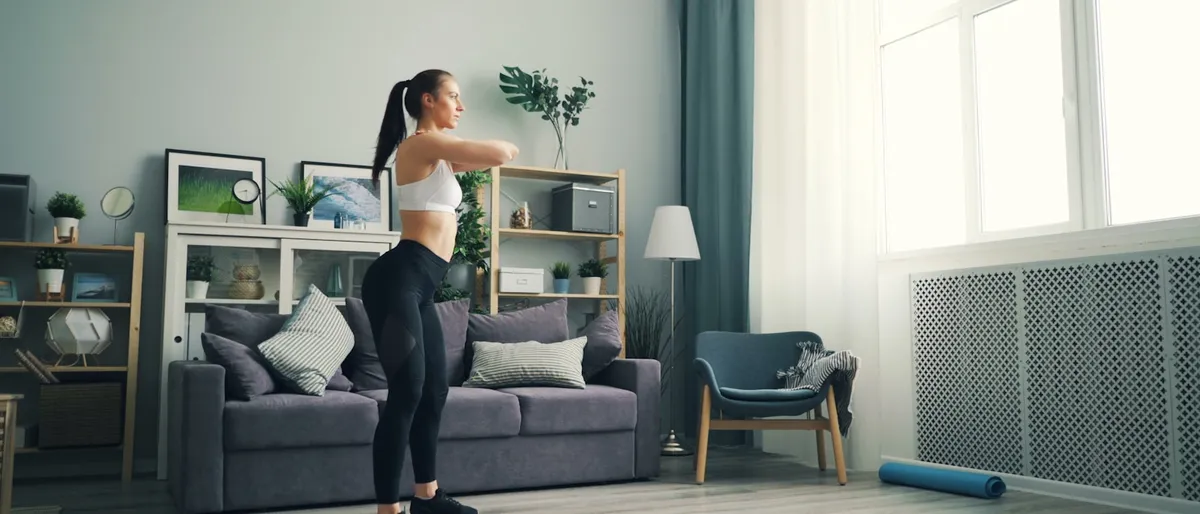
Standing Home Workout: No Mat, No Floor, Still a Real Session
A standing-only home workout for days when the floor is unavailable, with rhythm, load, mobility, and balance in a short plan.
Standing is not a workout.
That sounds annoying if you searched for a standing workout because the floor is off-limits. But it is the useful distinction. Standing still is a posture. A standing workout starts when posture turns into repeated movement: rhythm, load, mobility, and balance arranged tightly enough to create a training signal.
Bailey and Locke made the point neatly in a crossover study: interrupting sitting with two-minute light walking bouts improved post-meal glucose, while standing breaks did not show the same effect (PMID 24704421). The lesson is not that standing is useless. It is that the body responds to moving, not merely being vertical.
Use this session when you have no mat, no clean floor, no space to lie down, or you simply want a quick upright circuit. For a broader short-session framework, pair it with micro-workouts and exercise order for short home workouts.
The Four-Part Rule for a Real Standing Workout
Evidence sources: World Health Organization; American College of Sports Medicine; Peer-reviewed journal.
A useful standing-only session needs four ingredients.
First, rhythm. Marching, step-outs, cross-body knee drives, and fast hands raise breathing because they repeat quickly enough to become cardiorespiratory work. The WHO 2020 guideline emphasizes that adults benefit from regular moderate-to-vigorous physical activity and from replacing sedentary time with activity of any intensity (PMID 33239350). In practice, cadence matters: a lazy march is movement; a crisp march with arm drive becomes training.
Second, load. Bodyweight squats, split-stance hinges, calf raises, and wall-supported single-leg work create muscular tension. If you have a backpack, two water bottles, or a towel you can pull apart, add them. Load does not have to mean gym equipment.
Third, mobility. A standing session can still train ankles, hips, shoulders, and thoracic rotation. Think heel-toe rocks, hip circles, reach-and-rotate patterns, and overhead reaches. This is the part people skip, then wonder why the workout feels like marching in place with better branding.
Fourth, balance. Lesinski and colleagues found that balance training improves balance performance in healthy older adults (PMID 26325622). That population is specific, so do not overgeneralize it. The useful principle is simpler: balance improves when it is trained on purpose. A standing workout gives you that chance without needing the floor.
According to Carol Ewing Garber, PhD, FACSM, and the ACSM position stand, an exercise prescription should address cardiorespiratory, resistance, flexibility, and neuromotor fitness, not just one category (PMID 21694556). That is the blueprint here.
The 10-Minute No-Floor Circuit
Evidence sources: Peer-reviewed journal; Peer-reviewed journal; Peer-reviewed journal.
Set a timer for 45 seconds of work and 15 seconds to transition. Move at a pace where speaking full sentences becomes difficult by the second half, but your joints still feel controlled.
| Minute | Exercise | Coaching cue |
|---|---|---|
| 1 | March and reach | Drive the arms; keep the ribs stacked over the hips. |
| 2 | Squat to calf raise | Sit back, stand tall, rise onto the toes. |
| 3 | Standing hinge with row squeeze | Hinge from the hips and pull elbows back. |
| 4 | Reverse lunge tap | Step back lightly; keep the front foot planted. |
| 5 | Cross-body knee drive | Bring knee toward opposite hand without collapsing forward. |
| 6 | Lateral step with overhead press | Use bottles or press empty hands hard overhead. |
| 7 | Split-stance good morning | Hips back, spine long, switch sides halfway. |
| 8 | Standing wood chop | Rotate through the upper back, not the knees. |
| 9 | Single-leg balance reach | Reach forward, side, and back with the free foot. |
| 10 | Fast feet or shadow boxing | No jumping; quick rhythm, soft knees. |
If knees are sensitive, keep the reverse lunge as a toe tap and use the ideas in knee-friendly bodyweight workouts. If the circuit feels too easy, repeat it twice, hold bottles during squats and hinges, or reduce the transition to 10 seconds.
How Hard Should It Feel?
Evidence sources: Peer-reviewed journal; Peer-reviewed journal; World Health Organization.
Use effort, not sweat, as the truth test.
The Ainsworth Compendium assigns activities metabolic equivalent values so researchers can compare energy cost across movement types (PMID 21681120). That matters here because “standing” can mean almost nothing metabolically, while brisk stepping, squatting, loaded hinges, and fast punches change the category of effort.
Aim for a 6 to 8 out of 10 by the end of the circuit. Your breathing should be elevated. Your legs should feel warm. Balance drills should make you pay attention, not panic. If the session never rises above a 4, add speed to the rhythmic moves or load to the strength moves. If it jumps to a 9 in the first three minutes, slow the tempo and remove the overhead work until breathing settles.
Murphy and colleagues found in a meta-analysis that accumulated exercise bouts can produce similar health effects to continuous exercise when the total duration, mode, and intensity are comparable (PMID 31267483). That supports the practical use of short upright sessions, with one caveat: the bout has to be actual exercise. Standing near your timer does not count. Moving with intent does.
Make It Progress Without Going to the Floor
Evidence sources: World Health Organization; American College of Sports Medicine; Peer-reviewed journal.
Progress this workout with one change at a time.
Add rhythm first: increase march speed, punch speed, or step-out tempo. Add load second: bottles, a backpack, or slower squats. Add mobility third: deeper hinges, bigger reaches, and controlled rotation. Add balance last: longer single-leg holds, slower reaches, or less wall support.
This order keeps the session useful without turning it into a random list of upright exercises. A good standing workout should feel like a small, complete training session, not a compromise.
References
- Bull FC et al. (2020). World Health Organization 2020 guidelines on physical activity and sedentary behaviour. PMID: 33239350
- Garber CE et al.; American College of Sports Medicine (2011). Quantity and Quality of Exercise for Developing and Maintaining Cardiorespiratory, Musculoskeletal, and Neuromotor Fitness in Apparently Healthy Adults. PMID: 21694556
- Murphy MH et al. (2019). The Effects of Continuous Compared to Accumulated Exercise on Health: A Meta-Analytic Review. PMID: 31267483
- Bailey DP and Locke CD (2015). Breaking up prolonged sitting with light-intensity walking improves postprandial glycemia, but breaking up sitting with standing does not. PMID: 24704421
- Ainsworth BE et al. (2011). 2011 Compendium of Physical Activities: a second update of codes and MET values. PMID: 21681120
- Lesinski M et al. (2015). Effects of Balance Training on Balance Performance in Healthy Older Adults. PMID: 26325622
Related Articles
References
Sources
Expert perspective
Garber and the ACSM coauthors describe a complete exercise prescription as more than cardio minutes: it should combine cardiorespiratory work, resistance training, flexibility, and neuromotor training. A standing workout is strongest when it borrows from all four.
Carol Ewing Garber, PhD, FACSM · Lead author of the ACSM position stand on exercise quantity and quality · American College of Sports Medicine · Source: https://pubmed.ncbi.nlm.nih.gov/21694556/