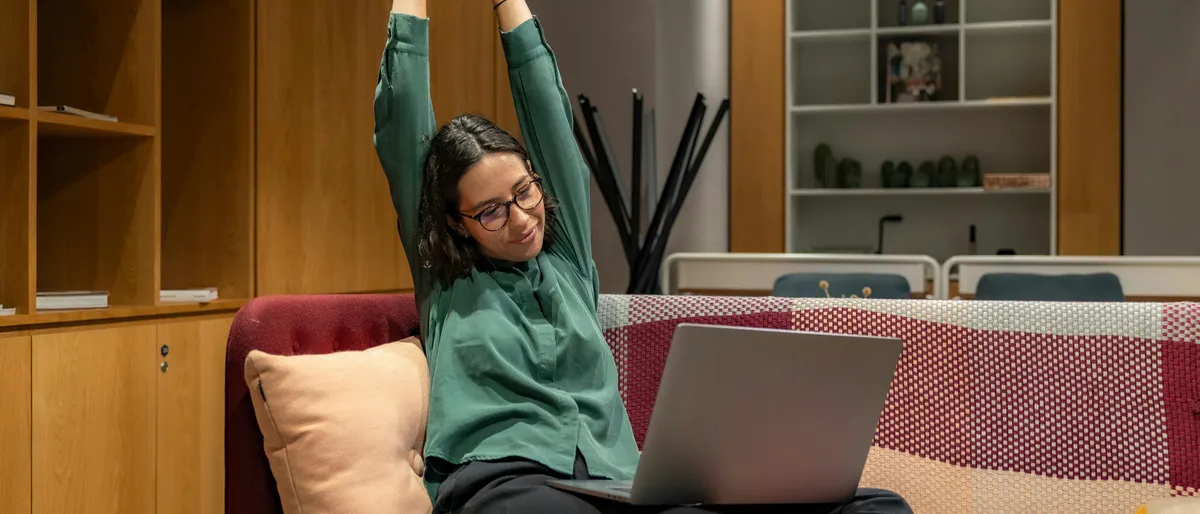
Meeting-Break Workouts for Remote Workers
Use short movement breaks between calls to reduce sitting time, protect energy, and build repeatable fitness without pretending snacks erase sitting risk.
The most useful remote-work workout may be the one that never appears on your calendar.
Not the heroic 45-minute session you keep trying to protect. The 4-minute gap after a call ends early. The camera-off minute while everyone is joining. The space between a strategy meeting and the next Slack wave. Remote work creates strange fragments of time, and those fragments are often where movement fits best.
The catch is honesty. A few squats between meetings do not erase a day of sitting. WHO guidance separates physical activity from sedentary behavior for a reason: adults benefit from more movement and from less uninterrupted sitting (PMID 33239350). Meeting-break workouts work best when you treat them as a frequency tool, not a magic eraser.
Why meeting gaps are better than perfect workout windows
(Sources: World Health Organization 2020 guidelines on physical activity and sedentary behaviour; The Effects of Continuous Compared to Accumulated Exercise on Health: A Meta-Analytic Review; Association of wearable device-measured vigorous intermittent lifestyle physical activity with mortality) (Source 1; Source 2; Source 3; Source 4; Source 5; Source 6; Source 7)
(Sources: World Health Organization 2020 guidelines on physical activity and sedentary behaviour; The Effects of Continuous Compared to Accumulated Exercise on Health: A Meta-Analytic Review; Association of wearable device-measured vigorous intermittent lifestyle physical activity with mortality) Remote workers often wait for a clean block of time. That is understandable. It is also fragile.
Accumulated exercise has stronger evidence than many people expect. Murphy and colleagues reviewed continuous versus accumulated exercise and found that shorter bouts can improve several health markers when total work is similar (PMID 31267483). Stamatakis and colleagues later found that brief vigorous lifestyle activity captured by wearables was associated with lower mortality risk among adults who did not report structured exercise (PMID 36482104). That study was observational, so it should not be stretched into a guarantee. It does support a practical idea: small bouts are not automatically trivial.
Meeting gaps also solve the behavioral problem. A workout that starts at 6 p.m. competes with dinner, errands, fatigue, and family logistics. A 3-minute break at 10:27 a.m. competes with almost nothing. That matters if your real barrier is not knowledge, but repeatability.
Think of the workday like a browser with too many tabs open. A meeting-break workout is not a full system reboot. It is closing one heavy tab before the fan starts screaming.
The 3-part meeting-break template
(Sources: Do stair climbing exercise “snacks” improve cardiorespiratory fitness?; Impact of Booster Breaks and Computer Prompts on Physical Activity and Sedentary Behavior Among Desk-Based Workers: A Cluster-Randomized Controlled Trial; Breaking up prolonged sitting reduces postprandial glucose and insulin responses) (Source 1; Source 2; Source 3; Source 4; Source 5; Source 6; Source 7)
(Sources: Do stair climbing exercise “snacks” improve cardiorespiratory fitness?; Impact of Booster Breaks and Computer Prompts on Physical Activity and Sedentary Behavior Among Desk-Based Workers: A Cluster-Randomized Controlled Trial; Breaking up prolonged sitting reduces postprandial glucose and insulin responses) Use three movement types across the day instead of doing the same push-ups every time.
Break 1: circulation. Walk the hallway, climb one flight of stairs, or march in place for 2-4 minutes. Jenkins et al. studied brief stair-climbing “exercise snacks” and found improvements in cardiorespiratory fitness markers (PMID 30649897). If stairs are nearby, they are the cleanest option.
Break 2: strength. Do 6-12 chair squats, incline push-ups on a desk, or slow split squats. Stop before your breathing makes the next call awkward. The goal is a crisp muscle signal, not a sweat emergency.
Break 3: posture and mobility. Try wall slides, hip hinges or a floor glute bridge, a standing calf raise between calls, or thoracic rotations. This pairs well with desk workouts and office exercises when your setup keeps your shoulders rounded and hips still.
According to Carol Ewing Garber, Professor of Movement Sciences at Columbia University and lead author of the ACSM exercise prescription position stand, adult fitness is built from several qualities: cardiorespiratory work, resistance training, flexibility, and neuromotor exercise (PMID 21694556). A remote-work break plan should borrow that same mix in miniature.
How often should you move?
(Sources: American College of Sports Medicine position stand. Quantity and quality of exercise for developing and maintaining fitness in apparently healthy adults; World Health Organization 2020 guidelines on physical activity and sedentary behaviour; The Effects of Continuous Compared to Accumulated Exercise on Health: A Meta-Analytic Review) (Source 1; Source 2; Source 3; Source 4; Source 5; Source 6; Source 7)
(Sources: American College of Sports Medicine position stand. Quantity and quality of exercise for developing and maintaining fitness in apparently healthy adults; World Health Organization 2020 guidelines on physical activity and sedentary behaviour; The Effects of Continuous Compared to Accumulated Exercise on Health: A Meta-Analytic Review) The most defensible rule is simple: break up long sitting before you try to “make up for” it later.
Dunstan and colleagues found that interrupting prolonged sitting reduced post-meal glucose and insulin responses in a controlled trial (PMID 22374636). Taylor’s desk-worker trial tested booster breaks and computer prompts, directly addressing the environment remote workers now recreate at home (PMID 27854422). Neither result means a few breaks neutralize every risk of sedentary work. They do suggest that interruptions are physiologically meaningful.
Start with one movement break every 60-90 minutes. If that sticks, shorten the interval. If your calendar is packed, anchor movement to transitions rather than clock time:
- after any call longer than 45 minutes
- before lunch
- before the first afternoon meeting
- after the final meeting of the day
For a deeper short-session framework, read Micro-Workouts: Why Short Exercise Works and Fitness for Busy Professionals. A protected midday block is the lunch break workout. Scattered crumbs between calls are micro-workouts throughout the day.
A sample remote-work day
(Sources: Association of wearable device-measured vigorous intermittent lifestyle physical activity with mortality; Do stair climbing exercise “snacks” improve cardiorespiratory fitness?; Impact of Booster Breaks and Computer Prompts on Physical Activity and Sedentary Behavior Among Desk-Based Workers: A Cluster-Randomized Controlled Trial) (Source 1; Source 2; Source 3; Source 4; Source 5; Source 6; Source 7)
(Sources: Association of wearable device-measured vigorous intermittent lifestyle physical activity with mortality; Do stair climbing exercise “snacks” improve cardiorespiratory fitness?; Impact of Booster Breaks and Computer Prompts on Physical Activity and Sedentary Behavior Among Desk-Based Workers: A Cluster-Randomized Controlled Trial) Here is a realistic day that does not require workout clothes:
| Workday moment | Movement |
|---|---|
| Before first call | 2 minutes easy walking |
| After long meeting | 8 chair squats, 8 desk push-ups |
| Pre-lunch | 3 minutes stairs or marching |
| Afternoon slump | 6 reverse lunges per side |
| Shutdown ritual | 5 minutes mobility |
This is not a replacement for structured training. It is the scaffolding that keeps your body from experiencing the workday as one long chair session. For specific desk-friendly movement ideas, the programmatic guide to exercises for desk workers gives more options.
Keep the claim honest
(Sources: Breaking up prolonged sitting reduces postprandial glucose and insulin responses; American College of Sports Medicine position stand. Quantity and quality of exercise for developing and maintaining fitness in apparently healthy adults; World Health Organization 2020 guidelines on physical activity and sedentary behaviour) (Source 1; Source 2; Source 3; Source 4; Source 5; Source 6; Source 7)
(Sources: Breaking up prolonged sitting reduces postprandial glucose and insulin responses; American College of Sports Medicine position stand. Quantity and quality of exercise for developing and maintaining fitness in apparently healthy adults; World Health Organization 2020 guidelines on physical activity and sedentary behaviour) The common mistake is to frame exercise snacks as a loophole: sit all day, do a few bursts, solved. The evidence is not that neat.
The better claim is smaller and stronger. Meeting-break workouts can help you accumulate movement, interrupt sitting, improve consistency, and make formal workouts easier to protect. They are most useful when paired with a weekly plan that includes dedicated strength and cardio sessions.
Start with tomorrow’s calendar. Find three gaps. Put one movement type in each gap. Then stop negotiating with the fantasy version of your schedule.
Related Articles
- Micro-Workouts: Why Short Exercise Works
- Desk Workouts: Office Exercises
- Fitness for Busy Professionals
References
-
Bull, F.C., et al. (2020). “World Health Organization 2020 guidelines on physical activity and sedentary behaviour.” British Journal of Sports Medicine. PMID 33239350. https://pubmed.ncbi.nlm.nih.gov/33239350/
-
Murphy, M.H., et al. (2019). “The Effects of Continuous Compared to Accumulated Exercise on Health: A Meta-Analytic Review.” Sports Medicine. PMID 31267483. https://pubmed.ncbi.nlm.nih.gov/31267483/
-
Stamatakis, E., et al. (2022). “Association of wearable device-measured vigorous intermittent lifestyle physical activity with mortality.” Nature Medicine. PMID 36482104. https://pubmed.ncbi.nlm.nih.gov/36482104/
-
Jenkins, E.M., et al. (2019). “Do stair climbing exercise ‘snacks’ improve cardiorespiratory fitness?” Applied Physiology, Nutrition, and Metabolism. PMID 30649897. https://pubmed.ncbi.nlm.nih.gov/30649897/
-
Taylor, W.C., et al. (2016). “Impact of Booster Breaks and Computer Prompts on Physical Activity and Sedentary Behavior Among Desk-Based Workers.” Preventing Chronic Disease. PMID 27854422. https://pubmed.ncbi.nlm.nih.gov/27854422/
-
Dunstan, D.W., et al. (2012). “Breaking up prolonged sitting reduces postprandial glucose and insulin responses.” Diabetes Care. PMID 22374636. https://pubmed.ncbi.nlm.nih.gov/22374636/
-
Garber, C.E., et al. (2011). “American College of Sports Medicine position stand. Quantity and quality of exercise for developing and maintaining fitness in apparently healthy adults.” Medicine & Science in Sports & Exercise. PMID 21694556. https://pubmed.ncbi.nlm.nih.gov/21694556/