Exercise Snacks for Blood Sugar: Short Bouts Around Meals
Use brief exercise snacks around meals to break up sitting and support postprandial glucose, with safe home options and diabetes caveats.
The most useful exercise snack is not always the hardest one. Around meals, the target is different: you are not trying to prove fitness, burn off food, or turn lunch into a punishment ritual. You are trying to interrupt sitting at the moment your body is handling incoming fuel.
That distinction matters.
A 45-minute workout later in the day can still be valuable. A short walk after dinner can still be the simplest option, which is why we already have a separate guide to walking after meals. Exercise snacks sit in the narrow space between those two ideas: brief, intentional bouts of movement placed before, during, or after long seated meal windows.
The evidence is promising, but it is not magic. Some trials show lower post-meal glucose or insulin responses. Some show benefits only in specific groups. Some show glycaemic variability improving even when mean glucose does not clearly change. That is exactly why the practical version should be modest, repeatable, and safe enough to do in a kitchen, hallway, or living room.
Why meals change the exercise-snack question
Evidence sources: Frontiers in Nutrition; Diabetes Care; Diabetologia.
Most short-workout advice asks, “Can this tiny session improve fitness?” Around meals, the better question is, “Can this tiny session change what happens during the post-meal window?”
After a meal, glucose and insulin rise as the body digests carbohydrate and moves fuel into tissues. Muscle contractions give glucose somewhere useful to go. That does not mean a few squats erase a meal. It means active muscle is metabolically different from parked muscle.
Dunstan and colleagues tested this idea in overweight and obese adults aged 45-65. Participants completed uninterrupted sitting, sitting interrupted by 2-minute light walking breaks every 20 minutes, and sitting interrupted by 2-minute moderate walking breaks every 20 minutes. Compared with uninterrupted sitting, both walking-break conditions lowered postprandial glucose and insulin responses after a standardized test drink.
That is the important signal: the benefit came from breaking sitting with small repeated movement, not from a dramatic workout.
What brief bouts can actually change
Evidence sources: Diabetologia 2014; Medicine & Science in Sports & Exercise; Frontiers in Nutrition.
The evidence is strongest when the claim stays specific: brief bouts can improve some postprandial glucose or insulin markers in some populations, especially when they interrupt prolonged sitting or cluster near meals.
Francois and colleagues studied nine people with insulin resistance. Their exercise-snack condition used six 1-minute intense incline-walking intervals 30 minutes before each main meal. Compared with a traditional continuous exercise condition, the snack approach improved several glycaemic outcomes, including 24-hour mean glucose. That sample was small, but the design helped establish the idea that small pre-meal doses could matter.
Rafiei and colleagues tested a different pattern: stair-climbing snacks during a long sitting day. In adults with overweight or obesity, eight hourly bouts of 15-30 seconds of stair climbing lowered total insulin area under the curve and nonesterified fatty acid response compared with sitting. The same study did not find significant total glucose differences in that group, and the healthy-weight young men did not show the same metabolic changes.
That mixed result is useful, not disappointing. It keeps the recommendation honest.
The best home-safe exercise snacks are boring on purpose
Evidence sources: Diabetes Care; Frontiers in Nutrition; Medicine & Science in Sports & Exercise.
The internet loves explosive exercise snacks: burpees, sprint stairs, jump squats, mountain climbers. Around meals, boring is usually smarter.
Post-meal movement should be easy to start, easy to stop, and low enough impact that it does not fight digestion or create a fall risk. That is why walking keeps appearing in the research. It uses a lot of muscle, scales naturally, and does not require a warm-up speech in your hallway.
For most healthy adults, the safest home menu looks like this:
- 2-5 minutes of easy walking around the home
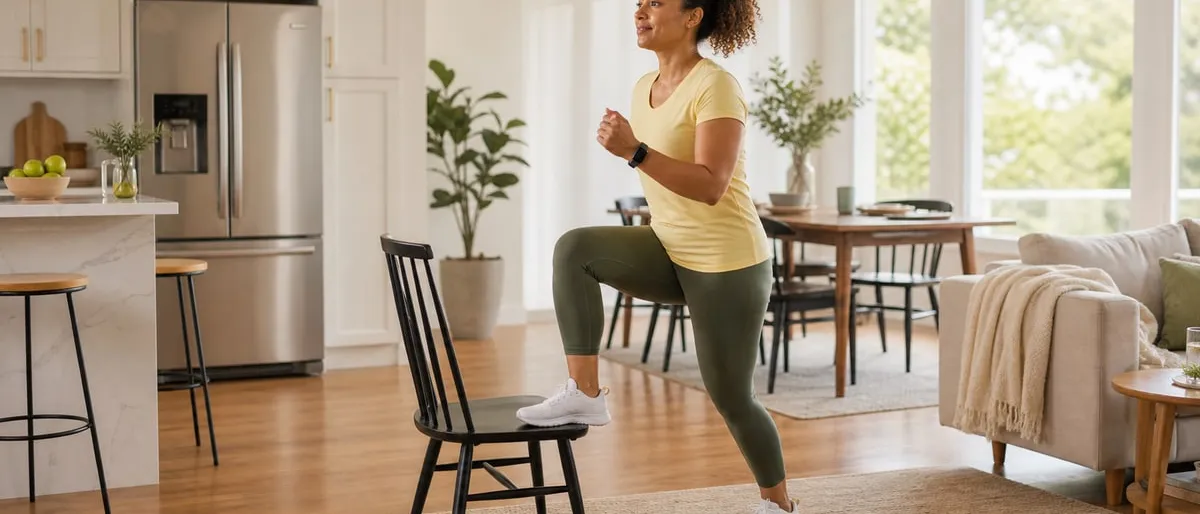
- slow step-ups on a stable stair
- sit-to-stand reps from a chair
- counter-supported calf raises
- gentle marching in place
- wall push-ups paired with slow squats
If you want the broader short-session training case, read Micro-Workouts: Why Short Exercise Works. For this article, the priority is narrower: make the post-meal sitting block less passive.
How to place snacks around meals without copying a lab protocol
Evidence sources: Diabetologia 2014; Diabetes Care; Frontiers in Nutrition.
The lab protocols are useful, but they should not be copied blindly into normal life.
Francois used intense intervals before meals. Dunstan used 2-minute walking breaks every 20 minutes during a long sitting condition. The Frontiers review found that frequent short interruptions, often every 30 minutes or less, looked promising in adults with obesity. Those are research designs. Your day has dishes, calls, kids, stairs, weather, and a sofa that gets suspiciously persuasive after dinner.
Start with one of three patterns:
| Pattern | How to use it |
|---|---|
| Pre-meal primer | 2-4 minutes of easy-to-moderate movement 10-30 minutes before eating |
| Post-meal reset | 5-10 minutes of easy movement early in the post-meal window |
| Sitting-break chain | Two or three 2-minute movement breaks across the next 90 minutes |
You do not need all three. Pick the one that fits the meal most likely to flatten your energy.
Where diabetes changes the rules
Evidence sources: Sports Medicine; Diabetologia 2026; Diabetologia 2014.
Exercise snacks are especially interesting for people with impaired glucose regulation, but that is also where the caveats matter most.
Borror and colleagues reviewed postprandial exercise studies in people with type 2 diabetes. Twelve studies met their criteria, involving 135 participants. Postprandial aerobic exercise generally lowered short-term glucose area under the curve, and the most consistent benefits appeared with longer moderate-intensity aerobic exercise of at least 45 minutes. Resistance exercise also appeared useful, but the authors emphasized that more research was needed before giving precise clinical prescriptions.
The newer 2026 Diabetologia randomized crossover study tested a more snack-like real-world protocol in non-insulin-treated adults with well-controlled type 2 diabetes. Participants completed four 1-minute vigorous bodyweight exercise snacks per day over two consecutive days. Mean glucose over 48 hours did not reach statistical significance compared with the no-exercise condition. However, several glycaemic variability measures improved, and 2-hour postprandial glucose responses after breakfast and dinner were significantly lower.
Medical disclaimer
If you have diabetes, use insulin, take medications that can cause hypoglycaemia, have cardiovascular disease, neuropathy, retinopathy, balance limitations, kidney disease, pregnancy-related glucose issues, or unexplained symptoms with exercise, ask your clinician how to use meal-timed movement safely. Do not use exercise snacks to replace medication, glucose monitoring, nutrition guidance, or your care plan.
A two-week plan for testing the habit
Evidence sources: Frontiers in Nutrition; Diabetes Care; Medicine & Science in Sports & Exercise.
Do not start with the most intense version. Start with the version you will actually repeat.
For two weeks, choose one meal. Lunch or dinner usually works best because those meals are more likely to be followed by sitting. Then use this progression:
- Days 1-3: after the meal, walk or march for 5 minutes.
- Days 4-7: keep the 5-minute post-meal movement and add one 2-minute sitting break 30-60 minutes later.
- Days 8-10: test a slightly stronger snack, such as slow chair squats plus counter push-ups for 2-3 minutes.
- Days 11-14: choose the best version and repeat it after the same meal.
Track the habit, not perfection. Write down three things: meal, movement, and how the next hour felt. If you use a glucose monitor, follow your clinician’s instructions rather than inventing your own thresholds.
This also pairs well with broader daily movement. NEAT, or non-exercise activity thermogenesis, is the background movement of your day; exercise snacks are the intentional little bouts. If that distinction feels blurry, read NEAT Exercise for Busy People.
The contrarian point is simple: the best blood-sugar exercise snack may feel too small to brag about. That is fine. Around meals, the goal is not drama. It is a repeatable muscle signal at the right time.
References
Sources
Expert perspective
Little and colleagues found that four 1-minute vigorous bodyweight exercise snacks per day did not significantly lower mean glucose over 48 hours, but did improve several glycaemic variability markers and postprandial glucose responses after breakfast and dinner in non-insulin-treated adults with type 2 diabetes.
Jonathan P. Little · Professor, School of Health and Exercise Sciences · University of British Columbia Okanagan · Source: https://pubmed.ncbi.nlm.nih.gov/42029706/