No-Equipment Shoulder Workout: Build Strength Safely
Build shoulders at home with no equipment: a practical routine for delts, rotator cuff, scapular control, progression, and joint-friendly form.
A no-equipment shoulder workout fails when it becomes a push-up workout wearing a different shirt.
That is the trap. Push-ups train the shoulders, yes, especially the anterior deltoids. Pike push-ups train them even more directly. But shoulders are not one muscle and one movement. They are a mobile joint complex that needs pressing strength, side-deltoid work, rear-deltoid control, rotator cuff capacity, and shoulder blade coordination.
So the useful question is not “Can you train shoulders without dumbbells?” You can. The better question is: can you train them without overloading the front of the shoulder while ignoring the pieces that keep the joint moving well?
This guide gives you a practical shoulder session you can do at home with no equipment, then shows how to progress it over four weeks. It is designed to complement the broader upper-body workout at home and the push-pull balance guide, not duplicate a list of isolated exercises.
What a complete no-equipment shoulder workout has to cover
Evidence sources: Peer-reviewed journal; Peer-reviewed journal; Peer-reviewed journal.
The shoulder has three deltoid heads: anterior, lateral, and posterior. The anterior deltoid helps raise the arm forward and contributes heavily to push-ups, dips, and pike push-ups. The lateral deltoid raises the arm out to the side. The posterior deltoid helps pull the arm back and supports upper-back control.
Then there is the rotator cuff and scapular system. The rotator cuff helps keep the humeral head centered in the shoulder socket. The scapula, or shoulder blade, has to upwardly rotate, posteriorly tilt, retract, protract, and stabilize as the arm moves. Ludewig and Reynolds reviewed scapular kinematics in shoulder pathologies and noted altered scapular motion and muscle activation patterns in several shoulder conditions (PMID 19194022). That does not mean every home exerciser has a shoulder problem. It means a shoulder plan should train motion and control, not only pressing.
The contrarian point: pike push-ups are important, but they are not a complete shoulder program. They bias the front delts and triceps. You still need lateral and posterior work, even if that work is lighter and slower.
Think of the shoulder like a camera gimbal. The pressing muscles create the big movement. The smaller stabilizers keep the image from shaking. If the stabilizers lag, the movement may still happen, but it looks and feels less controlled.
The 15-minute no-equipment shoulder session
Evidence sources: Peer-reviewed journal; Peer-reviewed journal; American College of Sports Medicine.
Use this session two times per week, leaving at least one day between shoulder-focused workouts. The WHO guidelines recommend regular muscle-strengthening activity, and the U.S. Physical Activity Guidelines use the same broad two-days-per-week threshold for major muscle groups. This routine fits that minimum while staying realistic for short home sessions.
| Block | Exercise | Dose | Main focus |
|---|---|---|---|
| 1 | Arm circles to wall slides | 60-90 seconds | Warm-up, overhead motion |
| 2 | Pike push-up or incline pike push-up | 3 sets of 5-10 | Anterior delts, triceps |
| 3 | Prone Y-T-W raise | 2 sets of 6-8 each shape | Rear delts, lower traps, rotator cuff control |
| 4 | Lean-away lateral raise without load | 2 sets of 10-15 per side | Lateral delts, shoulder control |
| 5 | Shoulder taps or incline shoulder taps | 2 sets of 8-12 per side | Scapular stability, anti-rotation |
| 6 | Reverse snow angel | 1-2 sets of 8-12 | Posterior shoulder, upper-back endurance |
If pike push-ups bother your wrists, do them with hands on firm push-up handles if available, or switch to an incline pike position using a sturdy countertop. If the wrist is the limiting factor rather than the shoulder, use the wrist-friendly home workout guide before forcing floor work.
The goal is not exhaustion. It is high-quality shoulder loading in several directions. Stop each set with one to three reps in reserve unless the exercise is very light, such as arm circles or snow angels.
How to do the key exercises well
Evidence sources: American College of Sports Medicine; World Health Organization; Peer-reviewed journal.
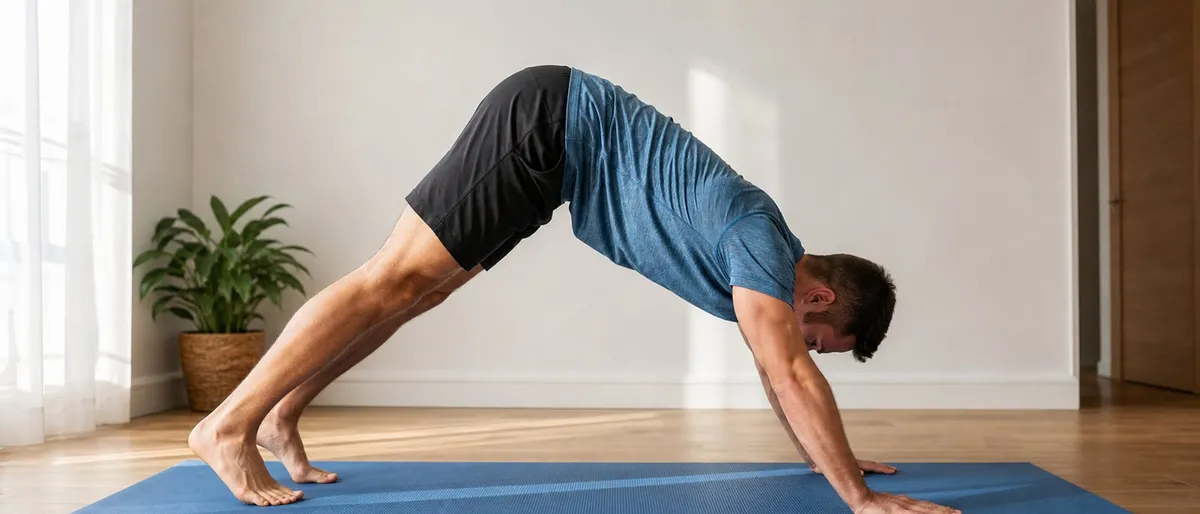
For the pike push-up, start in an inverted V position with hands on the floor and hips high. Bend the elbows and lower the top of your head toward the floor, slightly in front of your hands. Press back up without shrugging hard into the neck. Shorten the distance between hands and feet to make it harder. Raise the hands on a counter to make it easier.
Kotarsky and colleagues found that progressive calisthenic push-up training improved upper-body strength and thickness in a structured program (PMID 29466268). That matters here because pike push-ups are not a random bodyweight trick. They are part of the same progressive calisthenics logic: adjust leverage, angle, range, and difficulty over time.
For prone Y-T-W raises, lie face-down with arms overhead in a Y shape, then out to a T, then bent into a W. Lift the arms only as high as you can without turning the move into a lower-back extension drill. Keep the neck long. Think “move the shoulder blades smoothly,” not “yank the arms higher.”
For lean-away lateral raises without load, stand tall, lean slightly away from a wall or doorway for balance if needed, and raise one straight arm out to the side with the thumb slightly up. Without dumbbells, the load is small. That is fine. Slow the lowering phase to three seconds and pause near shoulder height. Schoenfeld and colleagues found that low-load resistance training can still support hypertrophy when sets are taken close enough to failure (PMID 25853914). In a home shoulder workout, that supports using strict, controlled, higher-rep lateral work instead of pretending only heavy dumbbells count.
For shoulder taps, use a plank or incline plank. Tap the opposite shoulder without letting the hips rock side to side. If you cannot control the trunk, widen the feet or use an incline. This is a shoulder stability drill, not a speed test.
Progression: make the workout harder without adding equipment
Evidence sources: Peer-reviewed journal; Peer-reviewed journal; Peer-reviewed journal.
Progress one variable at a time. That is the quiet rule that keeps home workouts from becoming chaos.
Week 1: learn the shapes. Use incline pike push-ups if needed. Keep every rep smooth.
Week 2: add range. Bring the head a little closer to the floor on pike push-ups, and hold the top of Y-T-W raises for one second.
Week 3: add tempo. Use a 3-second lowering phase on pike push-ups and lateral raises. The tempo training guide explains why slow reps are useful as a progression tool, not a magic trick.
Week 4: add density. Keep the same exercises, but reduce rest slightly or add one set to the exercise that still looks clean.
Schoenfeld, Ogborn, and Krieger’s meta-analysis found that training a muscle group at least twice weekly was associated with greater hypertrophy outcomes than once-weekly training when volume was not matched (PMID 27102172). For a no-equipment shoulder routine, the practical reading is simple: two focused exposures per week beats one heroic shoulder day that leaves your form worse by the end.
A good progression marker is not soreness. It is control. Can you lower through the pike push-up without collapsing? Can you complete Y-T-W raises without shrugging? Can shoulder taps stay quiet through the hips? Those are better signals than chasing a burn in the front delts.
Common mistakes that make shoulders cranky
Evidence sources: Peer-reviewed journal; Peer-reviewed journal; American College of Sports Medicine.
The first mistake is doing only front-delt work. Pike push-ups, decline push-ups, dips, burpees, and plank variations all ask a lot from the anterior shoulder. Useful, yes. Complete, no. Balance every hard pressing block with rear-delt or scapular-control work.
The second mistake is treating shoulder mobility as a stretch contest. Wall slides, arm circles, and controlled overhead reaches are warm-up patterns, not auditions for extreme range. Move through a range you can control.
The third mistake is ignoring pain signals. Muscle effort is normal. Sharp pain, numbness, tingling, sudden weakness, or a feeling that the shoulder is slipping is not a normal training signal. Modify the exercise or get qualified help.
The fourth mistake is progressing because the workout feels boring. Boredom is not evidence that the tissue is ready. If your pike push-up still shortens at the bottom or your shoulder taps rotate like a plank twist, the next progression is cleaner control, not a harder variation.
A simple weekly plan
Evidence sources: American College of Sports Medicine; World Health Organization; Peer-reviewed journal.
Use the shoulder session on Tuesday and Friday, or place it after lower-body days when your upper body is fresh.
| Day | Focus |
|---|---|
| Monday | Lower body or full-body strength |
| Tuesday | No-equipment shoulder session |
| Wednesday | Cardio, mobility, or rest |
| Thursday | Push-up progression or upper body |
| Friday | No-equipment shoulder session |
| Weekend | Easy activity, recovery, or a short full-body workout |
If you already follow a full upper-body routine, do not simply stack this on top. Replace part of your pressing volume with it. For example, if you do push-ups three times per week, swap one push-up finisher for Y-T-W raises, reverse snow angels, and shoulder taps.
RazFit users can treat this as a weekly shoulder check. If Orion gives you a push-heavy day, add a short rear-delt or scapular finisher. If Lyssa gives you a fast circuit with burpees and mountain climbers, do not count that as complete shoulder training just because your shoulders feel tired.
When to choose an easier version
Evidence sources: Peer-reviewed journal; Peer-reviewed journal; Peer-reviewed journal.
Choose incline pike push-ups if your head cannot approach the floor with control. Choose incline shoulder taps if your wrists or trunk limit the plank version. Choose smaller arm circles if the warm-up irritates the joint. Choose prone W raises instead of full Y-T-W raises if overhead positions feel pinchy.
This is not making the workout easier in the lazy sense. It is matching the exercise to the joint position you can own today.
The ACSM position stand emphasizes individualized exercise prescription and gradual progression (PMID 21694556). That principle is especially useful for shoulders because the joint has enormous freedom of movement. More freedom means more ways to compensate. Your job is to make the reps honest enough that the right muscles do the work.
References
-
Kotarsky CJ, Christensen BK, Miller JS, Hackney KJ. (2018). “Effect of Progressive Calisthenic Push-up Training on Muscle Strength and Thickness.” PMID 29466268. DOI 10.1519/JSC.0000000000002345.
-
Schoenfeld BJ, Peterson MD, Ogborn D, Contreras B, Sonmez GT. (2015). “Effects of Low- vs. High-Load Resistance Training on Muscle Strength and Hypertrophy in Well-Trained Men.” PMID 25853914. DOI 10.1519/JSC.0000000000000958.
-
Schoenfeld BJ, Ogborn D, Krieger JW. (2016). “Effects of Resistance Training Frequency on Measures of Muscle Hypertrophy: A Systematic Review and Meta-Analysis.” PMID 27102172. DOI 10.1007/s40279-016-0543-8.
-
Ludewig PM, Reynolds JF. (2009). “The Association of Scapular Kinematics and Glenohumeral Joint Pathologies.” PMID 19194022. DOI 10.2519/jospt.2009.2808.
-
Garber CE et al.; American College of Sports Medicine. (2011). “Quantity and Quality of Exercise for Developing and Maintaining Cardiorespiratory, Musculoskeletal, and Neuromotor Fitness in Apparently Healthy Adults.” PMID 21694556. DOI 10.1249/MSS.0b013e318213fefb.
-
World Health Organization. (2020). WHO Guidelines on Physical Activity and Sedentary Behaviour. PMID 33239350. https://www.who.int/publications/i/item/9789240015128