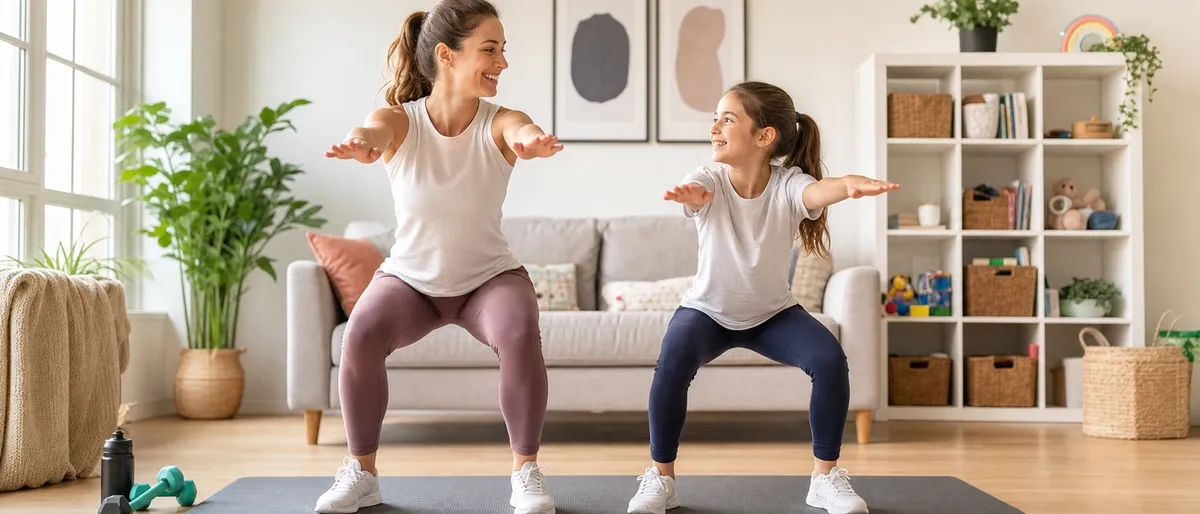
Family Workout at Home: A 10-Minute Parent-Child Plan
A 10-minute family workout at home for parents and kids, with safe exercise swaps, evidence-backed structure, and ways to keep it playful.
The most realistic family workout is not the quiet one.
It has someone asking whether frog jumps are allowed. It has a child counting reps too fast. It has a parent trying to make squats feel like play while still getting enough effort to count as training. That is not a problem with the workout. That is the workout.
A good family workout at home has two jobs. It gives the parent a real movement dose, and it lets the child participate without turning exercise into another adult chore. The mistake is trying to run a tiny bootcamp in the living room. Children do not need a strict fitness class at home. They need active play, simple rules, and a parent who makes movement normal.
That fits the public-health guidance. The CDC says children ages 3 to 5 should be active throughout the day, while ages 6 to 17 need at least 60 minutes of moderate-to-vigorous activity daily, including aerobic, muscle-strengthening, and bone-strengthening activity. ODPHP’s Physical Activity Guidelines also make a parent-friendly point: adults benefit from small amounts of moderate-to-vigorous activity throughout the day, and the old 10-minute minimum bout requirement was removed.
Use this 10-minute parent child workout when everyone is home, space is limited, and you want movement that feels more like a game than a lecture.
For a broader parent schedule strategy, start with fitness for busy parents. For the science behind short sessions, see micro-workouts.
The Rule: Parent Trains, Child Plays
(Source 1; Source 2; Source 3; Source 4; Source 5; Source 6; Source 7)
The child version of the workout should be playful. The parent version should be intentional.
That difference matters. A six-year-old doing bear crawls across the room is exploring coordination, balance, and rhythm. A parent doing the same bear crawl can focus on braced ribs, controlled hand placement, and steady breathing. Same exercise. Different dose.
Brown and colleagues reviewed 47 family-based physical activity intervention studies involving children ages 5 to 12. Their meta-analysis of 19 studies found a small positive effect for family-based interventions, with a standardized mean difference of 0.41 in the main analysis and 0.29 after removing one outlier (PMID 26756281). That is useful, but not magical. Family involvement can help. It still needs to fit the family.
Petersen and colleagues add the same caution from another angle. Their 2020 systematic review included 39 studies of parent-child physical activity, with parent-child dyad sample sizes ranging from 15 to 1,267. Most studies showed a positive relationship, but the average correlation was weak, around 0.13 overall (PMID 32423407). In plain English: active parents tend to have more active children, but modeling alone is not enough.
So the goal is not to prove that your child will copy your workout forever because they saw one good lunge. The goal is smaller and more reliable: make movement visible, easy to join, and low-pressure today.
According to Helen E. Brown, lead author of the family-based intervention review, the practical lesson is that interventions have to account for family constraints, parental motivation, goal setting, and reinforcement. That maps neatly onto a 10-minute living-room session. Keep the rules simple. Let the child win some rounds. Give the parent enough structure to train.
The 10-Minute Family Workout at Home
(Source 1; Source 2; Source 3; Source 4; Source 5; Source 6; Source 7)
Set a timer for 10 rounds: 40 seconds of movement, 20 seconds to reset. Keep shoes on if the floor is slippery. Move furniture, toys, mugs, and cords out of the way first. Yes, the mug matters.
Use a parent version and a child version for each minute:
| Minute | Parent version | Child version | Coaching cue |
|---|---|---|---|
| 1 | March and reach | Parade march | Start easy and get everyone breathing. |
| 2 | Squat to chair tap | Frog squat | Sit back; child can ribbit or count. |
| 3 | Incline push-up on sofa | Wall push-up | Hands stable; no diving onto cushions. |
| 4 | Reverse lunge tap | Step-back statue | Step softly and freeze for balance. |
| 5 | Bear crawl forward and back | Animal crawl | Small space, slow hands, soft knees. |
| 6 | Side step with fast arms | Side shuffle | Stay low without bumping furniture. |
| 7 | Hip hinge with backpack row | Toy pickup hinge | Hips back; long spine. |
| 8 | Plank shoulder tap on sofa | High-five plank on wall | Control the trunk before adding speed. |
| 9 | Squat, reach, calf raise | Rocket launch | Reach tall, land quiet. |
| 10 | Dance sprint or shadow boxing | Freeze dance | Finish breathy, not chaotic. |
The child does not need perfect reps. The parent should keep form honest. Those ten minutes are a short shared full-body workout with no equipment. If a movement becomes wild, switch to marching, step taps, or freeze-dance holds.
For toddlers, shorten each work interval to 20 seconds and treat the rest as play. For school-age children, let them choose the animal crawl or the final dance song. For teens, drop the animal names and make it a fast bodyweight circuit. Nothing kills participation quite like forcing a 13-year-old to pretend to be a frog.
How Hard Should the Parent Work?
(Source 1; Source 2; Source 3; Source 4; Source 5; Source 6; Source 7)
The parent should finish at a 6 to 8 out of 10 effort. Breathing should be up. Legs should feel warm. You should still be able to supervise.
The child should finish smiling, a little breathless, and interested enough to do it again another day. That is the win.
This split keeps the workout honest. The CDC guidance for children emphasizes activity that is age-appropriate and enjoyable, with muscle- and bone-strengthening built into play such as climbing, jumping, and push-up-style movements. The adult guidance is different. The WHO guideline and ACSM position stand both treat exercise prescription as a combination of frequency, intensity, time, and type, with adults needing regular aerobic and muscle-strengthening work (PMIDs 33239350 and 21694556).
In practice, parents can make the same 10 minutes harder without making the child’s version more intense:
- Use a slower squat on the way down.
- Hold the bottom of the lunge tap for one breath.
- Add a backpack row while the child does toy pickups.
- Keep the final minute low-impact but faster.
- Repeat the circuit twice later in the day instead of forcing 20 minutes at once.
That last option has evidence behind it. Murphy and colleagues reviewed continuous versus accumulated exercise and found that accumulated bouts can improve health outcomes when total work is comparable (PMID 31267483). For a family workout, that means one 10-minute circuit after school and another after dinner can be a legitimate structure, not a consolation prize.
Make It Safe Without Making It Boring
(Source 1; Source 2; Source 3; Source 4; Source 5; Source 6; Source 7)
Family workouts fail when safety rules sound like scolding. Make the rules part of the game.
Try these:
- Quiet feet win the round.
- Furniture is lava unless it is the planned push-up station.
- Everyone gets one “switch move” if an exercise feels wrong.
- The smallest person chooses the final 40-second song.
- The parent controls loaded moves; children use bodyweight only.
The “quiet feet” rule is especially useful. It turns impact control into a challenge. Children naturally jump, run, and bounce, which can be part of bone-strengthening activity, but indoor space changes the risk. Quiet landings protect knees, ankles, downstairs neighbors, and the lamp you forgot was too close.
For parents, the main safety issue is distraction. Do not use complex moves that require deep focus while supervising a child. Skip burpees if they turn the room into a collision course. Skip loaded overhead work unless the child is out of the path. Use simple bodyweight patterns you can stop instantly.
If you are pregnant, postpartum, recovering from injury, managing pelvic floor symptoms, or dealing with pain, use clinician guidance before turning family play into a workout. This article is fitness education for generally healthy families, not medical advice.
How to Keep Kids Interested
(Source 1; Source 2; Source 3; Source 4; Source 5; Source 6; Source 7)
Children do not need novelty every 15 seconds, but they do need ownership.
Give them controlled choices:
- Animal crawl or side shuffle?
- Blue toy pickup or red toy pickup?
- Freeze dance or shadow boxing?
- Count in English or silly robot voice?
That last one sounds ridiculous until it gets the workout done.
The family-based intervention literature supports this practical instinct. Brown and colleagues noted that context, family constraints, parental motivation, goal setting, and reinforcement all shaped intervention usefulness. At home, reinforcement does not have to mean rewards. It can mean letting the child lead one round, celebrating quiet landings, or tracking “family movement days” on a fridge calendar.
RazFit’s short-session format fits this because the commitment is small enough to repeat. A parent can start a 10-minute session with Orion for strength or Lyssa for cardio, then adapt the movements into parent-and-child versions. The app gives the adult structure; the child gets the game.
If the session keeps getting interrupted, use the same block logic from interrupted workouts for caregivers: finish the current minute later, or move to the next block instead of restarting from the beginning.
A Simple Weekly Plan
(Source 1; Source 2; Source 3; Source 4; Source 5; Source 6; Source 7)
Use this family workout two or three times per week.
Keep the first session easy. On the second session, add one parent progression: slower squats, deeper hinges, stronger arm drive, or one more circuit later in the day. On the third session, let the child choose two moves and keep the parent effort steady.
A simple week could look like this:
| Day | Family movement |
|---|---|
| Monday | 10-minute parent-child circuit |
| Wednesday | Family walk or playground time |
| Friday | 10-minute circuit with one new move |
| Sunday | Dance, bike ride, hike, or active game |
This does not replace every adult training goal. Beginner strength training is a simple plan a mixed-ability group can follow: parent progressions beside child play versions of the same patterns. Parents who want strength, cardiovascular fitness, mobility, or body composition changes still need progression over time. But a family workout solves a different problem: it removes the false choice between “exercise” and “being with the kids.”
Ten minutes will not make the week perfect. It can change the tone of the room. Shoes on, timer set, child choosing the last song. That is enough to start.
Related Articles
- Fitness for Busy Parents
- Micro-Workouts: Why Short Exercise Works
- Interrupted Workouts for Caregivers
- Standing Home Workout, No Floor Needed
References
-
Brown, H.E., Atkin, A.J., Panter, J., Wong, G., Chinapaw, M.J.M., & van Sluijs, E.M.F. (2016). “Family-based interventions to increase physical activity in children: a systematic review, meta-analysis and realist synthesis.” Obesity Reviews, 17(4), 345-360. PMID 26756281. DOI 10.1111/obr.12362. https://pmc.ncbi.nlm.nih.gov/articles/PMC4819691/
-
Petersen, T.L., Møller, L.B., Brønd, J.C., Jepsen, R., & Grøntved, A. (2020). “Association between parent and child physical activity: a systematic review.” International Journal of Behavioral Nutrition and Physical Activity, 17, 67. PMID 32423407. DOI 10.1186/s12966-020-00966-z. https://link.springer.com/article/10.1186/s12966-020-00966-z
-
Centers for Disease Control and Prevention. (2025). “Child Activity: An Overview.” https://www.cdc.gov/physical-activity-basics/guidelines/children.html
-
Office of Disease Prevention and Health Promotion. (2025). “Top 10 Things to Know About the Second Edition of the Physical Activity Guidelines for Americans.” https://odphp.health.gov/our-work/nutrition-physical-activity/physical-activity-guidelines/current-guidelines/top-10-things-know
-
Bull, F.C., Al-Ansari, S.S., Biddle, S., Borodulin, K., Buman, M.P., Cardon, G., et al. (2020). “World Health Organization 2020 guidelines on physical activity and sedentary behaviour.” British Journal of Sports Medicine, 54(24), 1451-1462. PMID 33239350. DOI 10.1136/bjsports-2020-102955. https://www.who.int/publications/i/item/9789240015128
-
Murphy, M.H., Lahart, I., Carlin, A., & Murtagh, E. (2019). “The Effects of Continuous Compared to Accumulated Exercise on Health: A Meta-Analytic Review.” Sports Medicine, 49(10), 1585-1607. PMID 31267483. DOI 10.1007/s40279-019-01145-2. https://pubmed.ncbi.nlm.nih.gov/31267483/
-
Garber, C.E., Blissmer, B., Deschenes, M.R., Franklin, B.A., Lamonte, M.J., Lee, I.M., Nieman, D.C., & Swain, D.P.; American College of Sports Medicine. (2011). “Quantity and quality of exercise for developing and maintaining cardiorespiratory, musculoskeletal, and neuromotor fitness in apparently healthy adults.” Medicine & Science in Sports & Exercise, 43(7), 1334-1359. PMID 21694556. DOI 10.1249/MSS.0b013e318213fefb. https://pubmed.ncbi.nlm.nih.gov/21694556/