Home Workouts to Help Lower Blood Pressure Safely
Evidence-based home workout guidance for blood pressure: walking, bodyweight circuits, wall sits, planks, pacing, and safety notes.
The most useful blood-pressure workout at home is rarely the hardest one.
That sounds backward if you have been taught to treat exercise like a punishment meter. But blood pressure responds best to repeatable signals: regular aerobic movement, muscle work, less sitting, better breathing under effort, and enough recovery that you can train again tomorrow. A heroic 40-minute session followed by six days of avoidance is a weak signal. Ten minutes you actually repeat is stronger.
This guide is for adults who want practical, bodyweight-first exercise ideas to support healthy blood pressure at home. It is not a treatment plan, and it does not replace medication, monitoring, or clinical advice. If you have diagnosed hypertension, cardiovascular disease, kidney disease, diabetes, pregnancy-related blood pressure concerns, symptoms during exercise, or medication that affects heart rate or blood pressure, ask your health care professional how hard and how often you should train.
For the workout side, pair this with the RPE scale for home workouts so effort stays honest without becoming reckless. If you are starting from zero, the 30-day beginner home workout plan is a gentler foundation.
What the guidelines actually say
(Source 1; Source 2; Source 3; Source 4; Source 5; Source 6)
The American Heart Association recommends that adults aim for at least 150 minutes per week of moderate-intensity aerobic activity, 75 minutes of vigorous aerobic activity, or a combination, preferably spread throughout the week. It also includes resistance training in the mix and names isometric resistance, such as planks, as one possible form.
The CDC prevention guidance points in the same direction: physical activity can help people maintain a healthy weight and lower blood pressure. The CDC also places exercise inside a broader prevention pattern that includes healthy eating, limiting alcohol, not smoking, sleep, stress management, and individualized care.
That last part matters. Exercise is powerful, but it is not a standalone blood-pressure cure. Think of it like the quiet pressure in a well-tuned thermostat. One blast of air does not change the whole house for long. Consistent, correctly timed adjustments do.
The Physical Activity Guidelines for Americans give the practical weekly target: adults need both aerobic activity and muscle-strengthening activity. For a home routine, that can be simpler than it sounds:
| Guideline bucket | Home version |
|---|---|
| Moderate aerobic activity | Brisk walking, marching circuits, low-impact cardio, stair intervals |
| Muscle strengthening | Squats, wall push-ups, glute bridges, planks, wall sits |
| Less sitting | Short movement breaks, walking calls, 2-minute resets between desk blocks |
| Gradual progression | Add minutes, rounds, or difficulty one step at a time |
The contrarian point: you do not need to make every workout intense. For blood pressure, consistency and progression beat drama.
The evidence for exercise and blood pressure
(Source 1; Source 2; Source 3; Source 4; Source 5; Source 6)
Edwards and colleagues published a large network meta-analysis in 2023 (PMID 37491419) comparing exercise training modes and resting blood pressure across randomized controlled trials. The analysis found that multiple exercise types were associated with reductions in resting systolic and diastolic blood pressure, including aerobic training, dynamic resistance training, combined training, high-intensity interval training, and isometric exercise training.
The headline that caught attention was isometric exercise. In that analysis, isometric training ranked especially well for resting blood pressure reduction compared with other exercise modes. That does not mean wall sits are magic, or that they replace walking, medication, dietary change, or clinical care. It means static muscle contractions deserve a place in the conversation, especially because they are practical at home.
Other reviews support that cautious interpretation. Hansford and colleagues (2021, PMID 34385688) reviewed isometric resistance training in adults with high blood pressure and examined both effectiveness and safety. Goessler and colleagues (2022, PMID 36379974) found that repeated isometric handgrip training, not a single session, was associated with blood pressure reductions in people with hypertension without comorbid conditions.
The pattern is useful: the benefit comes from training, not from one impressive hold. Your blood vessels do not care that you won a plank contest on Tuesday if the routine disappears by Friday.
The home workout formula
(Source 1; Source 2; Source 3; Source 4; Source 5; Source 6)
A blood-pressure-friendly home session should include three pieces:
- A gentle ramp-up so heart rate and breathing rise gradually.
- A moderate aerobic block using movements you can sustain.
- A short strength or isometric block that challenges muscle without breath-holding.
Here is the simplest 12-minute template:
| Minute | Work |
|---|---|
| 0-2 | Easy march, shoulder rolls, hip circles, slow sit-to-stands |
| 2-8 | Low-impact cardio circuit: step jacks, marching high knees, side steps, easy shadow boxing |
| 8-11 | Strength and isometrics: wall sit, incline push-up, glute bridge, forearm plank |
| 11-12 | Slow walking, nasal-or-mouth breathing, gentle calf and chest mobility |
Use RPE 4-6 for most sessions: you should breathe harder but still speak in short sentences. The AHA’s practical guidance uses a similar conversational idea for moderate effort. If you are gasping, dizzy, getting chest discomfort, or feeling pressure in your head, stop the session and seek appropriate medical guidance.
Wall sits, planks, and safe isometrics
(Source 1; Source 2; Source 3; Source 4; Source 5; Source 6)
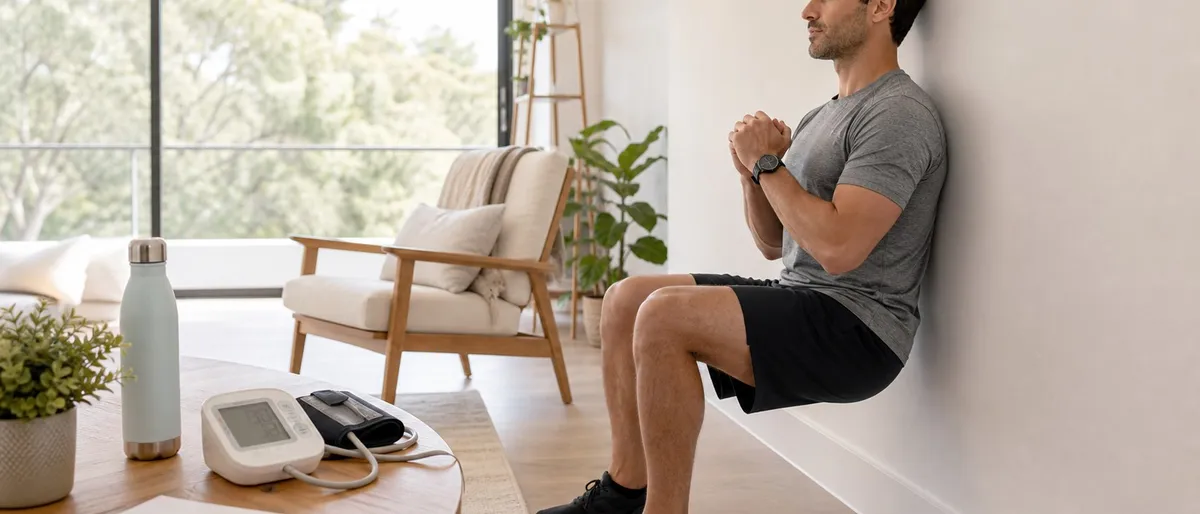
Isometric exercise means the muscle works while the joint angle stays mostly still. At home, the most accessible options are wall sits, planks, side planks, glute bridge holds, and hand squeezes with a soft ball or towel.
Start lower than your ego wants.
Beginner isometric block
Do this 2-3 days per week on nonconsecutive days:
| Exercise | Dose | Cue |
|---|---|---|
| Wall sit | 2 holds of 15-20 seconds | Knees comfortable, back against wall, breathe normally |
| Forearm plank | 2 holds of 10-20 seconds | Ribs down, glutes lightly tight, no breath-holding |
| Glute bridge hold | 2 holds of 15-25 seconds | Push through heels, squeeze glutes, avoid arching the low back |
| Side plank from knees | 1-2 holds of 10-15 seconds per side | Straight line from shoulder to knee |
Rest 45-90 seconds between holds. Longer rest is fine. The goal is controlled tension, not shaking through a survival scene.
Two safety details matter. First, breathe. The AHA warns that holding your breath during exercise can raise blood pressure. Second, avoid maximal efforts unless your clinician has cleared that level of intensity. A wall sit at 6 out of 10 effort is still training.
If you want a deeper guide to static holds, read Isometric Exercises at Home Guide. Beginner strength training is the broader program around those isometric holds: the sit-to-stands, incline push-ups, and hinge work that fill the rest of the week. It is not a medical cure for blood pressure.
Aerobic work still belongs in the plan
(Source 1; Source 2; Source 3; Source 4; Source 5; Source 6)
The isometric research is interesting, but it should not push aerobic exercise out of your week. Aerobic activity remains central in the AHA, CDC, and Physical Activity Guidelines recommendations because it trains the cardiovascular system directly and supports weight, stress, glucose regulation, and general health.
At home, aerobic does not have to mean jumping. Try one of these:
- Brisk indoor walking: 10-20 minutes around the room, hallway, or stairs.
- Step-jack circuit: 30 seconds step jacks, 30 seconds easy march, repeat 8-12 rounds.
- Stair intervals: 30-60 seconds easy stair climbing, then 60-90 seconds flat walking.
- Low-impact cardio flow: side steps, marching high knees, heel digs, shadow boxing.
- Zone 2 walk: an outdoor brisk walk where conversation is possible but not effortless.
For a no-equipment cardio breakdown, use the home cardio without equipment guide. If you want a lower-intensity weekly anchor, Zone 2 cardio at home is a good match.
A realistic blood-pressure-friendly week
(Source 1; Source 2; Source 3; Source 4; Source 5; Source 6)
Here is a home plan that respects the evidence without pretending everyone has a gym schedule.
| Day | Session |
|---|---|
| Monday | 12-minute moderate cardio plus beginner isometric block |
| Tuesday | 20-30 minute brisk walk or easy Zone 2 session |
| Wednesday | Rest, mobility, or two 5-minute movement breaks |
| Thursday | 12-minute moderate cardio plus bodyweight strength |
| Friday | Easy walk, stairs, or low-impact cardio at RPE 4-5 |
| Saturday | Isometric block plus gentle full-body circuit |
| Sunday | Rest, relaxed walk, or mobility |
The bodyweight strength circuit can be simple:
| Exercise | Dose |
|---|---|
| Sit-to-stand or squat | 2 sets of 8-10 |
| Incline push-up | 2 sets of 6-10 |
| Glute bridge | 2 sets of 10 |
| Dead bug | 2 sets of 6 per side |
| Wall sit | 2 holds of 15-30 seconds |
Progress one variable at a time. Add five minutes to the walk before you add intensity. Add one round before you shorten rest. Move from wall push-ups to counter push-ups before you chase floor push-ups.
How to monitor intensity without overcomplicating it
(Source 1; Source 2; Source 3; Source 4; Source 5; Source 6)
Blood pressure management rewards boring consistency, so the monitoring system should be boring too.
Use these guardrails:
- RPE 4-6 for most workouts: challenging but conversational.
- No breath-holding: exhale through effort, keep air moving during holds.
- Longer warm-ups: 3-5 minutes if you are older, deconditioned, stressed, or training early.
- Longer cool-downs: stop gradually rather than collapsing onto the couch.
- No sudden max tests: avoid all-out plank, wall sit, or HIIT challenges unless cleared.
If you measure blood pressure at home, follow your clinician’s instructions about timing. Do not treat an immediately post-workout number as your resting baseline; exercise temporarily changes cardiovascular demand. If readings are unexpectedly high, unusually low, or paired with symptoms, use medical guidance rather than internet guesswork.
When to stop and get medical advice
(Source 1; Source 2; Source 3; Source 4; Source 5; Source 6)
Stop exercising and seek urgent help if you develop chest pain, fainting, severe shortness of breath, sudden weakness, confusion, or symptoms that feel like a medical emergency.
Pause the workout and contact a health care professional if you notice unusual dizziness, palpitations, severe headache, new exercise intolerance, or blood pressure readings outside the range your clinician told you to expect.
The AHA notes that adults with cardiovascular disease or other pre-existing conditions should check with a health care professional before increasing activity. That is not fear-based advice. It is how you make the plan fit the person instead of forcing the person into the plan.
The practical starting point
(Source 1; Source 2; Source 3; Source 4; Source 5; Source 6)
Start with this for two weeks:
Three days per week, do the 12-minute template. Two other days, take a 20-minute brisk walk or split it into two 10-minute walks. Add the beginner isometric block twice per week. Keep every session at a level where breathing rises but stays controlled.
After two weeks, choose one progression:
- Add 5 minutes to two walks.
- Add one extra round to the cardio circuit.
- Add 5-10 seconds to each wall sit or plank hold.
- Add one more strength exercise, such as reverse lunges or calf raises.
That is enough. Blood-pressure-friendly training is not about proving pain tolerance. It is about giving your cardiovascular system a clear, repeatable reason to adapt.
References
-
American Heart Association. (2025). “Getting Active to Control High Blood Pressure.” https://www.heart.org/en/health-topics/high-blood-pressure/changes-you-can-make-to-manage-high-blood-pressure/getting-active-to-control-high-blood-pressure
-
Centers for Disease Control and Prevention. (2024). “Preventing High Blood Pressure.” https://www.cdc.gov/high-blood-pressure/prevention/index.html
-
U.S. Department of Health and Human Services. (2018). “Physical Activity Guidelines for Americans, 2nd edition.” https://odphp.health.gov/our-work/nutrition-physical-activity/physical-activity-guidelines/current-guidelines
-
Edwards, J.J., Deenmamode, A.H.P., Griffiths, M., Arnold, O., Cooper, N.J., Wiles, J.D., & O’Driscoll, J.M. (2023). “Exercise training and resting blood pressure: a large-scale pairwise and network meta-analysis of randomised controlled trials.” British Journal of Sports Medicine. PMID 37491419. https://pubmed.ncbi.nlm.nih.gov/37491419/
-
Hansford, H.J., Parmenter, B.J., McLeod, K.A., Wewege, M.A., Smart, N.A., Schutte, A.E., & Jones, M.D. (2021). “The effectiveness and safety of isometric resistance training for adults with high blood pressure: a systematic review and meta-analysis.” PMID 34385688. https://pubmed.ncbi.nlm.nih.gov/34385688/
-
Goessler, K.F., Buys, R., VanderTrappen, D., Vanhumbeeck, L., & Cornelissen, V.A. (2022). “Isometric handgrip training, but not a single session, reduces blood pressure in individuals with hypertension: a systematic review and meta-analysis.” PMID 36379974. https://pubmed.ncbi.nlm.nih.gov/36379974/