Hot Weather Home Workouts: How to Train Safely in Summer
Train safely in hot weather with practical rules for timing, intensity, hydration, cooling, and red flags during summer home workouts.
The mistake people make in summer is treating heat like a motivation problem. It is not. Heat changes the dose of a workout.
A 10-minute bodyweight circuit that feels crisp in April can feel strangely heavy in July. Your breathing rises sooner. Sweat shows up before the warm-up is finished. Movements that normally feel smooth start asking for longer pauses. That does not mean your fitness disappeared overnight. It means the room, the balcony, the humidity, and the time of day joined the workout.
The goal is not to fear hot-weather training. The goal is to stop pretending temperature is background noise.
Heat Changes the Session Before You Do
(Source 1; Source 2; Source 3; Source 4; Source 5)
The WHO 2020 guidelines still give the big picture: adults should aim for 150-300 minutes of moderate aerobic activity, 75-150 minutes of vigorous activity, or an equivalent mix across the week, plus regular muscle-strengthening work. Summer does not cancel that. It does make the path more flexible.
The CDC’s heat guidance for athletes is practical: limit outdoor activity during the middle of the day when possible, schedule workouts earlier or later when it is cooler, start slowly, pace the activity, drink more water than usual, and wear loose, lightweight, light-colored clothing. Those ideas sound basic because they are. They are also the difference between a workout that adapts and a workout that picks a fight with the weather.
The contrarian point: lowering intensity in heat is not “going easy.” It is accurate programming. Casa and colleagues’ NATA position statement treats exertional heat illness as something best managed through prevention, recognition, and fast response, especially in high-risk environments. For home workouts, that means you adjust before the session gets dramatic.
Think of heat like adding a weighted vest you did not choose. The exercise is the same, but the total load is not.
Choose the Cooler Window First
(Source 1; Source 2; Source 3; Source 4; Source 5)
Before changing exercises, change timing.
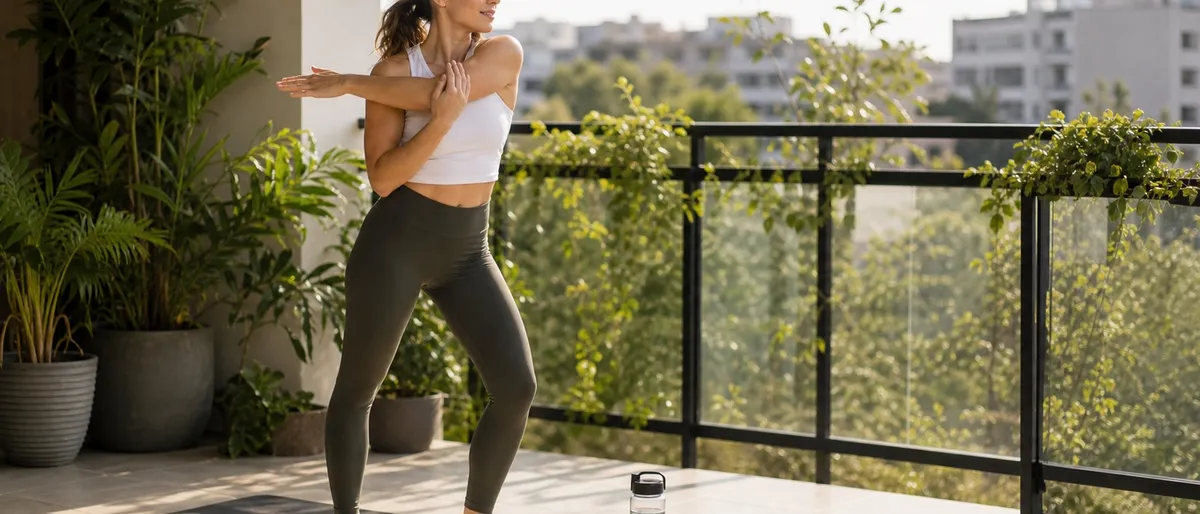
If you train outdoors, the CDC recommends moving activity away from the hottest middle part of the day when possible. For a home workout, that might mean a shaded balcony at 7 a.m., an indoor session with airflow at lunch, or a short evening mobility block once the room has cooled. If timing is your main variable, the tradeoffs in morning vs evening workouts become even more useful in summer.
Indoors, use the environment like equipment. Open windows only if the outside air is cooler than the room. Use a fan for airflow. Move away from direct sun. Put the mat on tile or a cooler floor instead of a trapped-heat corner. None of this makes the workout heroic. Good. Heroic is not the objective.
Humidity matters because sweat has to evaporate to cool you. On a humid day, sweat may appear faster but cool you less effectively. That is a reason to choose lower-impact movements, longer rests, and shorter blocks. If the room feels heavy before you start, make the workout shorter before your body has to negotiate.
Use RPE as Your Heat Governor
(Source 1; Source 2; Source 3; Source 4; Source 5)
Hot-weather intensity should be set by feel, not pride.
Use the same 0-10 effort scale from the RPE guide for home workouts, but cap the session lower than usual. A normal hard interval day might touch RPE 8. In heat, stop most work at RPE 6-7 unless you are well acclimatized, well hydrated, and recovering normally. If you planned vigorous intervals and the warm-up already feels like RPE 6, the plan has changed.
A simple summer rule:
| Heat signal | Adjustment |
|---|---|
| Breathing rises earlier than usual | Add 15-30 seconds rest |
| Sweat appears before the warm-up ends | Reduce impact and slow tempo |
| Legs feel heavy in the first round | Cut one round or switch to mobility |
| Coordination gets sloppy | Stop the hard work immediately |
This overlaps with the workout readiness check. Poor sleep, unusual fatigue, illness, dehydration, and heat stack together. One yellow signal may only ask for caution. Two or three should change the workout.
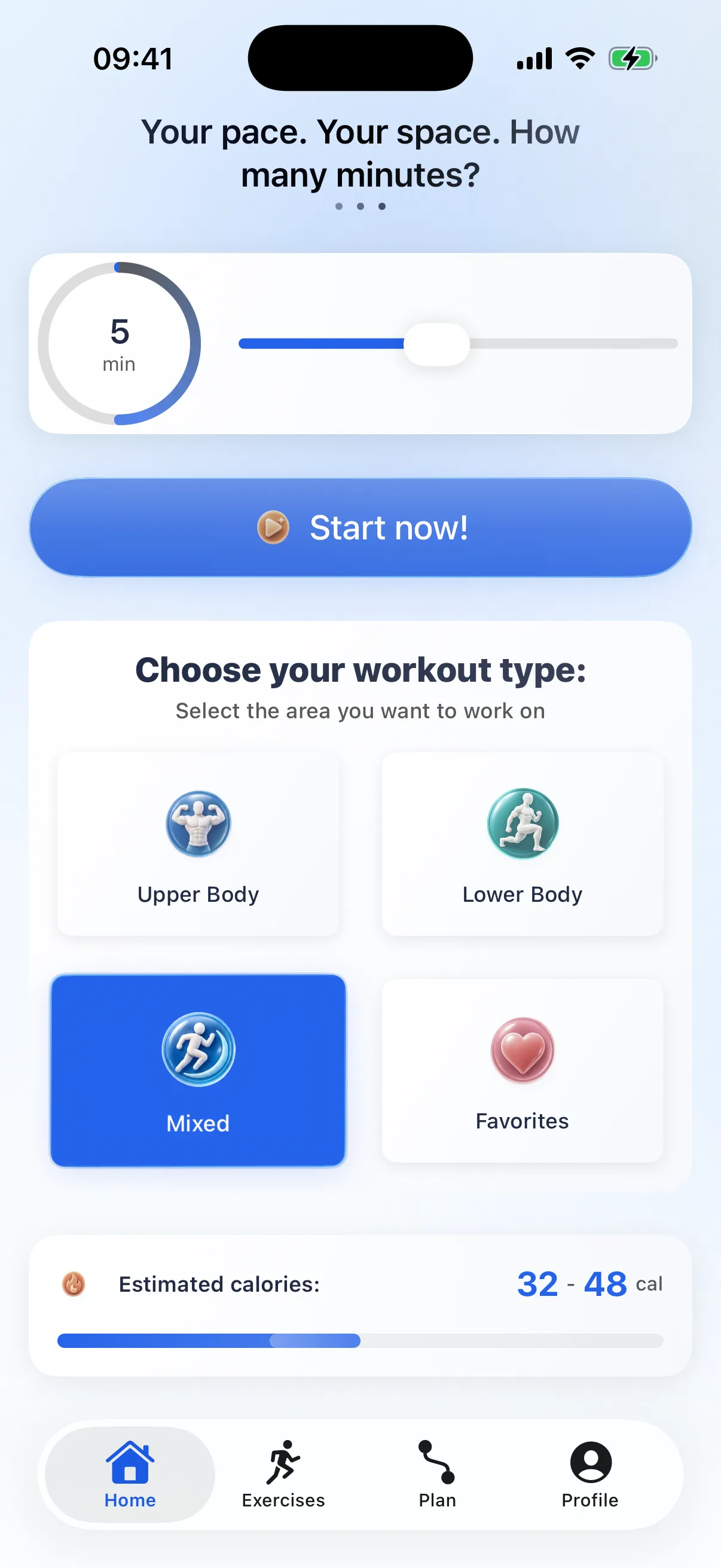
For RazFit-style 1-10 minute sessions, the easiest lever is duration. Choose 5 minutes instead of 10. Choose low-impact cardio instead of jumps. Choose mobility or core instead of the hardest interval day. Consistency survives better when the session fits the weather.
Hydrate Without Turning It Into Theater
(Source 1; Source 2; Source 3; Source 4; Source 5)
Hydration advice gets weird fast: giant bottles, exact ounces, electrolyte panic, and people drinking as if every 8-minute workout were an ultramarathon.
The ACSM position stand is more grounded. Its goal for drinking during exercise is to prevent excessive dehydration, described as more than 2% body weight loss from water deficit, while avoiding excessive electrolyte disturbance. It also emphasizes that sweat rate varies a lot between people, so fluid plans should be individualized.
For short home workouts, that translates into three simple behaviors.
Start hydrated. If you have been in heat all afternoon, drink before the workout rather than trying to catch up mid-circuit. During most 1-10 minute sessions, water nearby is enough. After a sweaty session, keep sipping and eat normal meals; longer, hotter, or very sweaty workouts may justify electrolytes, but most short home sessions do not require supplement theater.
The CDC also warns not to wait until thirst is the only cue during hot-day exercise, and notes that muscle cramping can be an early sign of heat-related illness. Do not overreact to one cramp. Do pay attention if cramps arrive with weakness, dizziness, nausea, or unusual fatigue.
Red Flags That End the Workout
(Source 1; Source 2; Source 3; Source 4; Source 5)
Most summer workouts should end normally: breathing settles, sweat dries, and you move on. A few symptoms deserve a hard stop.
The CDC says that if you feel faint or weak, stop all activity and get to a cool place. NIOSH lists heat exhaustion symptoms such as headache, nausea, dizziness, weakness, irritability, thirst, heavy sweating, elevated body temperature, and decreased urine output. That is not a cue to finish the last round. It is a cue to cool down, drink carefully, and stop training.
Heat stroke is the emergency category. NIOSH describes it as the most serious heat-related illness, with symptoms that can include confusion, altered mental status, loss of consciousness, seizures, very high body temperature, and hot dry skin or heavy sweating. Call emergency services if those signs appear. Move the person to a cooler area and begin cooling while help is on the way.
Medical note
If you have cardiovascular disease, take medication that affects sweating or heart rate, are pregnant, are recovering from illness, or have been advised to limit vigorous exercise, get individualized guidance before hard training in heat.
A 10-Minute Hot-Weather Template
(Source 1; Source 2; Source 3; Source 4; Source 5)
Use this on a warm day when you still want movement but do not want to overcook the session.
Start with 90 seconds easy: marching, shoulder rolls, hip circles, and bodyweight hinges. Then do 6 minutes at RPE 5-6: step jacks, incline push-ups, slow squats, dead bugs, and reverse lunges, moving for 30 seconds and resting for 30 seconds. Finish with 2 minutes of walking, slow breathing, and the proportional reset from cool-downs after short workouts.
If the room is hotter than expected, remove the lunges and repeat mobility. If you feel great, do not automatically add intensity. Save the harder session for a cooler window.
That is the summer skill: not quitting, not forcing, just reading the conditions clearly enough to keep training.
References
-
Centers for Disease Control and Prevention. (2024). “Heat and Athletes.” https://www.cdc.gov/heat-health/risk-factors/heat-and-athletes.html
-
National Institute for Occupational Safety and Health. (2026). “Heat-related Illnesses.” https://www.cdc.gov/niosh/heat-stress/about/illnesses.html
-
Casa, D.J., DeMartini, J.K., Bergeron, M.F., et al. (2015). “National Athletic Trainers’ Association Position Statement: Exertional Heat Illnesses.” Journal of Athletic Training, 50(9), 986-1000. PMID 26381473. https://pubmed.ncbi.nlm.nih.gov/26381473/
-
Sawka, M.N., Burke, L.M., Eichner, E.R., et al. (2007). “American College of Sports Medicine position stand. Exercise and fluid replacement.” Medicine & Science in Sports & Exercise, 39(2), 377-390. PMID 17277604. https://pubmed.ncbi.nlm.nih.gov/17277604/
-
Bull, F.C., Al-Ansari, S.S., Biddle, S., et al. (2020). “World Health Organization 2020 guidelines on physical activity and sedentary behaviour.” British Journal of Sports Medicine, 54(24), 1451-1462. PMID 33239350. https://pubmed.ncbi.nlm.nih.gov/33239350/