Home Workout Form Check: Are You Doing It Right?
Use a simple home workout form check for pain, range of motion, control, symmetry, breathing, fatigue cutoff, and phone video review.
The hardest part of checking your own form at home is not knowing every anatomy term. It is noticing when a rep has changed.
The first squat feels smooth. By rep twelve, the range is shorter, the knees drift, the breath is gone, and the whole thing still technically counts because you moved down and up. That is where most beginner exercise mistakes hide: not in one dramatic error, but in tiny leaks that accumulate while you chase the number.
A good home workout form check gives you a repeatable loop. Pain check. Range of motion. Control. Symmetry. Breathing. Fatigue cutoff. Then, occasionally, a simple phone video review. No trainer required. No mirror required. No need to turn a 10-minute workout into a film project.
Use this alongside progressive overload at home and training to failure with bodyweight. Progress only matters when the reps you are progressing still look like the exercise.
Start with the pain check
(Source 1; Source 2; Source 3; Source 4; Source 5)
Before asking whether your form is perfect, ask a better first question: does this rep feel safe enough to repeat?
Muscle effort is expected. Warmth, fatigue, and the feeling of working hard can belong in a normal set. Sharp joint pain, pinching, numbness, dizziness, chest pain, or a sensation that gets worse as the set continues does not belong in a form checklist. That is not a cue problem. That is a stop sign.
The ACSM position stand by Garber and colleagues (PMID 21694556) frames exercise prescription around health status, goals, fitness level, progression, and individual response. That sounds formal, but it applies perfectly to home workout technique. The right version is the one your body can control today, not the one you saw someone else perform online.
Use this first-pass filter:
- Muscle burn: usually fine if technique stays controlled.
- Joint pressure that fades after changing range or stance: use the easier version.
- Sharp, worsening, or unusual symptoms: stop the exercise.
- Pain that changes your movement immediately: do not push through it.
- Same discomfort every session: get qualified guidance instead of guessing.
The most useful form correction is often a regression. Wall push-ups instead of floor push-ups. Squats to a chair instead of deep squats. Forearm plank instead of high plank. Shorter reverse lunges instead of forward lunges.
That is not going backward. It is choosing the version that gives you clean data.
Medical note
This article is practical coaching, not medical diagnosis. If pain is sharp, persistent, linked with swelling, affects daily movement, or comes with symptoms such as chest pain, faintness, unusual shortness of breath, or neurological signs, stop and speak with a qualified clinician.
Check range of motion before intensity
(Source 1; Source 2; Source 3; Source 4; Source 5)
Range of motion is the easiest thing to fake without noticing.
A push-up can become two inches shorter every rep. A squat can start below chair height and end as a shallow knee bend. A lunge can lose the back-knee descent while still feeling hard because fatigue is rising. The workout gets more intense, but the movement gets less honest.
Schoenfeld and Grgic’s 2020 systematic review on resistance training range of motion (PMID 32030125; PMCID PMC6977096) found limited but useful evidence: lower-body hypertrophy outcomes tended to favor full range of motion compared with partial range, while upper-body findings were less conclusive. The honest takeaway for bodyweight exercise form is not “deeper is always better.” It is this: range of motion is a training variable, so you should know when it changes.
Use a repeatable target for each exercise:
| Exercise | Simple range target | Stop or modify when |
|---|---|---|
| Squat | Same comfortable depth each rep | Depth shortens because you are rushing or avoiding control |
| Push-up | Chest moves toward the same floor distance | Hips sag or elbows flare to steal range |
| Reverse lunge | Back knee lowers toward the same spot | Front knee collapses or stance gets unstable |
| Glute bridge | Hips lift without low-back arching | The top comes from the spine, not the hips |
| Plank | Body line stays steady | Low back sags or hips rise to escape tension |
Notice the word “comfortable.” A good range of motion should be controlled and pain-free. If your squat depth improves after a warm-up, use that range. If deeper reps change your pelvis, feet, or knees in a way you cannot control, stay higher and build gradually.
The form-check question is: could I draw the same rep twice?
If the answer is no, reduce speed, range, or variation difficulty. Your future progress depends on comparing like with like. Ten controlled squats and ten half-rushed squats are not the same set.
Control is the sound of a good rep
(Source 1; Source 2; Source 3; Source 4; Source 5)
Good reps usually feel quieter than bad ones.
You do not crash into the bottom of a squat. You do not drop into a push-up and hope your arms catch you. You do not bounce through lunges like the floor is making the decisions. Control means you can choose the speed on the way down, pause briefly if needed, and reverse direction without a panic move.
This is where many people misunderstand “form.” They think form means the body part checklist: knees here, elbows there, back like this. That matters, but control is the operating system underneath it. If you cannot slow a movement down, you probably do not own it yet.
Try the three-second test:
- Lower for about three seconds.
- Pause for one quiet beat.
- Return without bouncing, twisting, or holding your breath.
- Stop the set when the test fails twice.
You do not need to train every rep this slowly. Use it as a diagnostic. If your standard push-up turns into a collapse when you slow the lowering phase, your regular reps may be relying on momentum. If your split squat feels fine fast but wobbly slow, balance and strength are not sharing the job evenly yet.
The U.S. Physical Activity Guidelines support regular aerobic and muscle-strengthening activity for adults, including muscle-strengthening work on two or more days per week. They do not say every rep has to be maximal, fast, or exhausting. A controlled 8-minute session that you can repeat next week is more useful than a heroic one you cannot reproduce.
For breath rhythm during slower reps, pair this with breathing during home workouts. Control gets much easier when the breath is not locked in your throat.
Symmetry: compare sides without obsessing
(Source 1; Source 2; Source 3; Source 4; Source 5)
Nobody is perfectly symmetrical. You may balance better on one leg, rotate more easily one way, or feel one shoulder working sooner in push-ups. The goal is not to become a geometry diagram. The goal is to catch side-to-side differences that affect the exercise.
A simple home workout form check uses comparison, not panic.
For single-leg and single-arm patterns, ask:
- Does one side lose range sooner?
- Does one knee drift inward more than the other?
- Does one hip rotate or hike?
- Does one side feel like muscle effort while the other feels like joint stress?
- Does one side need a much wider stance to survive?
If the answer is yes, start sets on the weaker or less coordinated side. Match the stronger side to that rep count and range. For example, if your left reverse lunge gives you 8 clean reps and the right side could do 12, perform 8 on both. That keeps training balanced while the lower side catches up.
Symmetry also applies to push-ups and planks. Watch for one shoulder rising, one elbow flaring, one hand creeping forward, or the hips rotating. You can often fix it by widening the feet slightly, slowing down, or choosing an incline version.
Dr. Gabriele Wulf’s attentional-focus research is useful here. In a 2001 balance-task study (PMID 11770783), most participants preferred an external focus and performed better in retention than those who preferred an internal focus. In a later study with children learning a soccer throw-in (PMID 21833250; PMCID PMC3153799), frequent feedback that directed attention externally improved movement-form learning more than internal-focus feedback.
Put differently: do not spend the whole set thinking “left glute, right shoulder, ribs, knees, wrists.” Pick one outside cue. Push the floor away. Spread the floor. Reach the crown of the head forward. Keep the phone tripod in line with your chest. A good cue makes the movement better without filling your head with noise.
For muscle-specific cues, use mind-muscle connection for bodyweight training. For a form check, though, start with the movement you can see.
Breathing tells you when form is getting expensive
(Source 1; Source 2; Source 3; Source 4; Source 5)
Breathing is a form cue because it reveals effort honestly.
If you can breathe through a set, you usually still have some control available. If the breath disappears, the jaw locks, and every rep becomes a held-air event, the exercise may be too hard, too fast, or too close to failure for the goal of the set.
Use the basic rhythm:
- Squat: inhale down, exhale up.
- Push-up: inhale down, exhale as you press.
- Lunge: inhale as you lower, exhale as you return.
- Plank: short, steady breaths without letting the ribs flare.
- Mountain climber: keep breathing matched to pace, not panic.
The breathing article linked above covers this in detail, but the form-check version is simple: if you cannot keep air moving, stop or make the movement easier. That might mean a lower incline push-up, a slower squat tempo, a shorter plank, or more rest between rounds.
This is especially important in short workouts because fatigue arrives quickly. A 7-minute session can move from clean to chaotic in one interval. The goal is not to avoid effort. The goal is to notice when effort starts buying reps with compensation.
Ask this during the final third of a set: are my reps getting harder because the target muscles are tired, or because the whole movement is falling apart?
That question saves a lot of bad volume.
Use a fatigue cutoff before form fails loudly
(Source 1; Source 2; Source 3; Source 4; Source 5)
Technical failure is the point where the rep no longer matches the exercise. You may still be able to move, but the pattern has changed.
For home training, stop before that change becomes dramatic. You do not need a coach watching every rep if you set clear cutoffs ahead of time.
Use these fatigue cutoffs:
- Range cutoff: the rep gets noticeably shorter twice in a row.
- Speed cutoff: the rep slows so much that you twist or bounce to finish.
- Breath cutoff: you cannot exhale during the effort phase.
- Symmetry cutoff: one side shifts, rotates, or collapses repeatedly.
- Pain cutoff: discomfort changes the way you move.
- Focus cutoff: you cannot remember the cue you started with.
This connects directly to training to failure with bodyweight. Going close to fatigue can be useful, especially for muscle-building bodyweight work, but technical failure should end the set. A final clean rep is better data than three ugly guesses.
If the same cutoff appears every session, do not just “try harder.” Adjust the plan. Use the beginner home workout guide if you are still building the basics, or use progressive overload at home if the movement is clean and ready for a harder variation.
A good rep should feel challenging, but organized. You feel the target muscles. You can tell where the movement starts and ends. You could stop on purpose. That last part matters.
The 60-second phone video review
(Source 1; Source 2; Source 3; Source 4; Source 5)
You do not need to record every workout. That gets annoying fast.
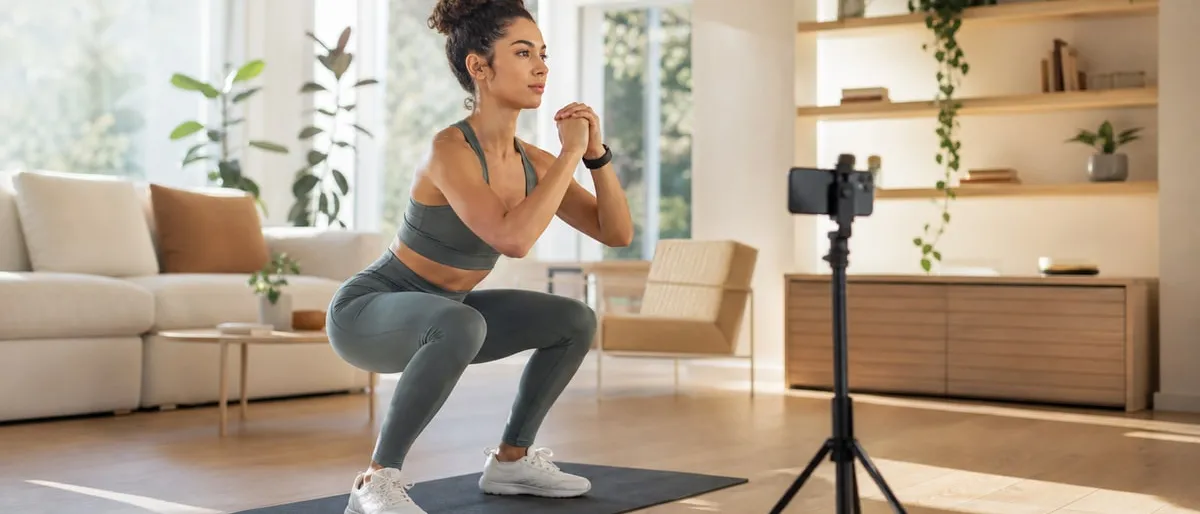
Use video like a quick audit, maybe once per week or when a movement feels different. Set your phone on a tripod, shelf, or stable object. Film one set from the side and one set from the front or front angle. Keep the clip short: 5 to 8 reps is enough for most bodyweight exercise form checks.
Before watching, choose one thing to evaluate. Not ten. One.
For squats, check whether depth stays consistent and knees track roughly with toes. For push-ups, check whether the body moves as one line and the chest approaches the same depth. For lunges, check whether both sides use the same stride and the front knee stays controlled. For planks, check whether ribs, hips, and head stay organized while you breathe.
Use slow motion only if it helps. Most form leaks are visible at normal speed. The bigger mistake is watching the clip like a critic instead of a coach. You are not looking for reasons to feel bad. You are looking for the next useful cue.
The loop looks like this:
- Pick one exercise.
- Film one normal set.
- Watch for pain signs, range, control, symmetry, and breathing.
- Choose one correction.
- Repeat one easier or slower set.
- Keep the cue only if the second set looks better.
That is the whole home workout form check. It is not glamorous, but it works because it is repeatable.
Next session, choose one movement and run the loop. A push-up with cleaner range. A squat with quieter control. A plank with real breathing. Good reps do not have to look perfect. They have to feel clear enough that you can repeat them.
References
-
Garber, C.E., Blissmer, B., Deschenes, M.R., et al. (2011). “American College of Sports Medicine position stand. Quantity and quality of exercise for developing and maintaining cardiorespiratory, musculoskeletal, and neuromotor fitness in apparently healthy adults: guidance for prescribing exercise.” Medicine & Science in Sports & Exercise, 43(7), 1334-1359. PMID 21694556. DOI: 10.1249/MSS.0b013e318213fefb. https://pubmed.ncbi.nlm.nih.gov/21694556/
-
Wulf, G., Shea, C., & Park, J.H. (2001). “Attention and motor performance: preferences for and advantages of an external focus.” Research Quarterly for Exercise and Sport, 72(4), 335-344. PMID 11770783. DOI: 10.1080/02701367.2001.10608970. https://pubmed.ncbi.nlm.nih.gov/11770783/
-
Wulf, G., Chiviacowsky, S., Schiller, E., & Avila, L.T.G. (2010). “Frequent external-focus feedback enhances motor learning.” Frontiers in Psychology, 1, 190. PMID 21833250. PMCID PMC3153799. DOI: 10.3389/fpsyg.2010.00190. https://pmc.ncbi.nlm.nih.gov/articles/PMC3153799/
-
Schoenfeld, B.J., & Grgic, J. (2020). “Effects of range of motion on muscle development during resistance training interventions: A systematic review.” SAGE Open Medicine, 8, 2050312120901559. PMID 32030125. PMCID PMC6977096. DOI: 10.1177/2050312120901559. https://pmc.ncbi.nlm.nih.gov/articles/PMC6977096/
-
U.S. Department of Health and Human Services. (2018). Physical Activity Guidelines for Americans, 2nd edition. https://odphp.health.gov/our-work/nutrition-physical-activity/physical-activity-guidelines/current-guidelines