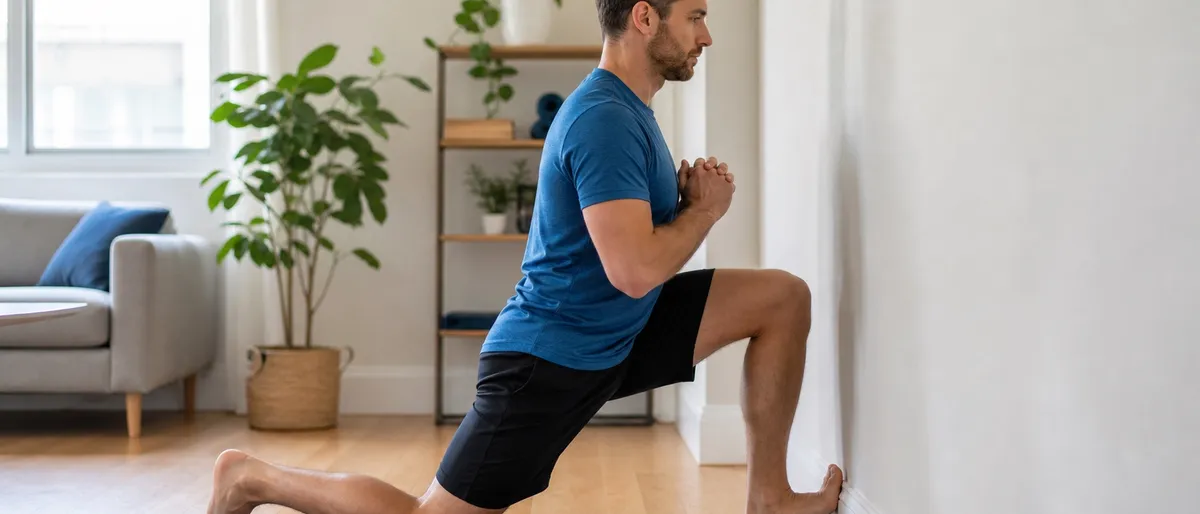
Ankle Mobility for Squats: A Home Dorsiflexion Plan
Improve squat ankle mobility at home with dorsiflexion tests, calf and soleus drills, and a 6-minute pre-squat routine you can repeat.
The squat is usually blamed on the knees first. The ankles often started the problem.
If your heels lift, your torso folds forward, or your knees collapse inward when you try to squat deeper, the limiting factor may be ankle dorsiflexion: the shin moving forward over the foot while the heel stays down. That motion is small, unglamorous, and easy to ignore. It also decides whether a bodyweight squat feels smooth or like a negotiation with the floor.
This guide is narrower than a general mobility routine. For the broader distinction between dynamic mobility and static stretching, use mobility vs stretching at home. Here, the question is specific: how do you improve squat ankle mobility at home without forcing painful depth, buying equipment, or turning a warm-up into a second workout?
Why ankle dorsiflexion changes your squat
(PMID 22100617; PMID 25144599; PMID 33713896; PMC full text)
Dorsiflexion lets the knee travel forward while the whole foot stays grounded. During a squat, that forward shin angle helps you keep balance, reach depth, and keep the movement distributed across ankle, knee, hip, and trunk instead of dumping everything into one joint.
Macrum and colleagues tested 30 healthy, recreationally active people during double-leg squats under a no-wedge condition and a 12-degree forefoot wedge condition that simulated reduced plantar-flexor flexibility (PMID 22100617). With the wedge, participants showed less peak knee flexion, more peak knee valgus, more medial knee displacement, lower vastus lateralis and vastus medialis oblique activity, and higher soleus activity. That does not mean every home exerciser with stiff ankles has patellofemoral pain. It means ankle position can change the whole squat pattern.
A later Journal of Athletic Training study by Dill and colleagues compared people with limited versus normal weight-bearing lunge ankle-dorsiflexion range during squatting (PMID 25144599). The limited group showed altered knee and ankle kinematics during the squat, which supports the practical screen most coaches use: watch what happens when the knee has to move over the toes while the heel stays down.
The contrarian point: ankle mobility is not a moral badge. Some people squat well with a wider stance, slightly turned-out toes, or a torso angle that fits their anatomy. The goal is not to chase an internet-perfect narrow squat. The goal is to have enough dorsiflexion that your squat choice is a choice, not a compensation.
Test it before you stretch it
(PMID 33713896; PMC full text; PMID 29223884; PMID 21694556)
Do the weight-bearing wall test before choosing ankle dorsiflexion exercises. It takes one minute and gives you better information than guessing from squat depth alone.
Stand facing a wall. Place one foot a few inches away, keep the heel down, and drive the knee toward the wall over the second or third toe. Move the foot back until the knee can barely touch without the heel lifting or the arch collapsing. Compare sides. Then repeat with the knee slightly bent and with the knee straighter. The bent-knee version biases the soleus more; the straighter-knee version brings the gastrocnemius into the limitation because it crosses the knee.
You do not need a perfect number for this to be useful. You need a repeatable setup. If the left side reaches the wall easily and the right side twists, lifts, or caves inward, your squat may be borrowing motion from foot pronation, knee valgus, or trunk lean.
The 2021 single-leg squat study by da Costa and colleagues found that greater passive ankle dorsiflexion range was associated with smaller thigh internal rotation, while dynamic dorsiflexion related differently to trunk and pelvis strategies (PMID 33713896). In plain terms: passive range and usable range are related but not identical. A wall test tells you what range you can access; a squat or single-leg squat tells you what range you can control.
Use a phone video if you are unsure. Film one set of slow squats from the front and one from the side, then compare it with the checks in home workout form check. You are looking for heel lift, arch collapse, knee dive, or a sudden torso fold right when depth becomes hard.
The 6-minute home ankle mobility routine
(PMID 29223884; PMID 21694556; Physical Activity Guidelines; PMID 22100617)
Use this before lower-body RazFit sessions, squat practice, or any workout with lunges, step-ups, or jump landings. Keep it easy enough that your legs feel warmer, not tired.
| Time | Drill | What to feel |
|---|---|---|
| 60 seconds | Slow ankle circles | Smooth motion through the whole ankle, not fast foot-flapping |
| 60 seconds | Knee-to-wall rocks | Knee tracks over the middle toes while the heel stays heavy |
| 60 seconds | Bent-knee calf stretch | Low calf and Achilles area, more soleus than high calf |
| 60 seconds | Straight-knee calf stretch | Higher calf, heel down, arch quiet |
| 60 seconds | Split-squat ankle pulses | Front shin glides forward without the foot rolling inward |
| 60 seconds | Slow squat-to-stand practice | Newly gained range becomes part of the squat pattern |
For the knee-to-wall rocks, use 8 to 12 slow reps per side. Pause for one breath at the end of each rep. Do not bounce. If the knee drifts inward, reduce range until the foot, knee, and hip stay organized.
For the bent-knee calf stretch, stand in a short split stance with the target foot behind you. Bend the back knee slightly while keeping the heel down. Hold 20 to 30 seconds, breathe, then switch. For the straight-knee version, lengthen the stance and keep the back knee straight without locking it aggressively. A slow calf raise after those holds loads the same ankle and calf range you just opened.
Young and colleagues reviewed conservative interventions for increasing ankle dorsiflexion and included 23 studies with 734 participants (PMID 24225348). Their meta-analysis found some evidence supporting static stretching alone and stretching combined with warm-up or heel-raise exercise, while noting that the evidence for several other therapies was limited. Medeiros and Martini’s 2018 systematic review also concluded that chronic stretching improves ankle dorsiflexion range of motion in healthy people, especially when the program includes a static component (PMID 29223884).
That is why this routine combines motion and holds. Rocks teach the ankle to use range under bodyweight. Calf stretches give the plantar flexors time under length. Squat-to-stand practice tells the body where the new range belongs.
Build mobility into the squat, not around it
(Physical Activity Guidelines; PMID 22100617; PMID 25144599; PMID 33713896)
The common mistake is doing ankle mobility, then squatting exactly the same way as before. Range that never gets rehearsed under the target movement tends to stay separate from the workout.
After the 6-minute routine, do two practice sets before your real session:
- Five slow squats with a three-second descent.
- Five squats with a one-second pause at your deepest controlled position.
Stop the descent before the heel lifts, the arch collapses, or the knee dives inward. That depth is your working depth today. It may be higher than you want. Good. Honest range improves faster than forced range.
If your ankles feel blocked but pain-free, use a small heel elevation temporarily: a folded towel, thin book, or stable wedge under the heels. This does not “fix” ankle mobility. It changes the squat demand so you can train the pattern while continuing dorsiflexion work separately. If the elevation makes the squat smoother and the wall test is limited, the ankle is probably part of the bottleneck.
The ACSM position stand by Garber and colleagues recommends flexibility exercises for major muscle-tendon groups and emphasizes progressive exercise prescription based on individual response (PMID 21694556). For home squats, that means you progress range the same way you progress reps: gradually, with control, and without pretending discomfort is discipline.
Pair this with progressive overload at home when your squat depth becomes consistent. Better ankle mobility is useful, but it is not the whole leg program. beginner strength training is the strength work that uses the new squat depth.
When stiffness is not just stiffness
(PMID 25144599; PMID 33713896; PMC full text; PMID 29223884)
Most ankle stiffness in home workouts is ordinary: long sitting, little calf loading, no recent deep-squat practice, old habits around shoes or posture. A few minutes a day can change the first rep quickly.
Some signs deserve more caution. Do not force ankle mobility if you have sharp pain, swelling, warmth, a recent sprain, a history of fracture or surgery, numbness, tingling, or a hard bony block that does not change with warm-up. A blog routine cannot separate calf tightness from joint restriction, tendon irritation, or post-injury mechanics.
Use the pain rule from the form-check guide: muscle stretch is acceptable; joint pain that changes your movement is a stop sign. If one ankle is dramatically different after an injury, get a qualified clinician to assess it.
The Physical Activity Guidelines for Americans frame activity as a health behavior that should be sustainable across weeks and years, not a single heroic session. Ankle mobility fits that logic. You do not need to win the squat today. You need the next month of squats to feel a little less blocked.
Here is the simple weekly dose:
| Day type | Ankle work |
|---|---|
| Lower-body workout | Full 6-minute routine, then two slow squat practice sets |
| Upper-body workout | 2 minutes of knee-to-wall rocks and calf stretching as movement prep |
| Recovery day | 4 to 6 relaxed minutes, no hard end-range pushing |
| Stiff morning | 60 seconds per side before the first RazFit session or walking break |
The payoff is not dramatic on day one. It is quieter than that. Heels stay down. Knees track with less argument. The bottom of the squat stops feeling like a cliff.
Start with the wall test today. Choose the tighter side. Give it six minutes. Then do five slow squats and keep only the depth you can own.
References
-
Macrum, E., Bell, D.R., Boling, M., Lewek, M., & Padua, D. (2012). “Effect of limiting ankle-dorsiflexion range of motion on lower extremity kinematics and muscle-activation patterns during a squat.” Journal of Sport Rehabilitation, 21(2), 144-150. PMID 22100617. DOI: 10.1123/jsr.21.2.144. https://pubmed.ncbi.nlm.nih.gov/22100617/
-
Dill, K.E., Begalle, R.L., Frank, B.S., Zinder, S.M., & Padua, D.A. (2014). “Altered knee and ankle kinematics during squatting in those with limited weight-bearing-lunge ankle-dorsiflexion range of motion.” Journal of Athletic Training, 49(6), 723-732. PMID 25144599. DOI: 10.4085/1062-6050-49.3.29. https://pubmed.ncbi.nlm.nih.gov/25144599/
-
da Costa, G.V., de Castro, M.P., Sanchotene, C.G., Ribeiro, D.C., de Brito Fontana, H., & Ruschel, C. (2021). “Relationship between passive ankle dorsiflexion range, dynamic ankle dorsiflexion range and lower limb and trunk kinematics during the single-leg squat.” Gait & Posture, 86, 106-111. PMID 33713896. DOI: 10.1016/j.gaitpost.2021.03.015. https://pubmed.ncbi.nlm.nih.gov/33713896/
-
Young, R., Nix, S., Wholohan, A., Bradhurst, R., & Reed, L. (2013). “Interventions for increasing ankle joint dorsiflexion: a systematic review and meta-analysis.” Journal of Foot and Ankle Research, 6, 46. PMID 24225348. DOI: 10.1186/1757-1146-6-46. https://pmc.ncbi.nlm.nih.gov/articles/PMC4176290/
-
Medeiros, D.M., & Martini, T.F. (2018). “Chronic effect of different types of stretching on ankle dorsiflexion range of motion: Systematic review and meta-analysis.” Foot, 34, 28-35. PMID 29223884. DOI: 10.1016/j.foot.2017.09.006. https://pubmed.ncbi.nlm.nih.gov/29223884/
-
Garber, C.E., Blissmer, B., Deschenes, M.R., et al. (2011). “American College of Sports Medicine position stand. Quantity and quality of exercise for developing and maintaining cardiorespiratory, musculoskeletal, and neuromotor fitness in apparently healthy adults: guidance for prescribing exercise.” Medicine & Science in Sports & Exercise, 43(7), 1334-1359. PMID 21694556. DOI: 10.1249/MSS.0b013e318213fefb. https://pubmed.ncbi.nlm.nih.gov/21694556/
-
U.S. Department of Health and Human Services. (2018). Physical Activity Guidelines for Americans, 2nd edition. https://odphp.health.gov/our-work/nutrition-physical-activity/physical-activity-guidelines/current-guidelines