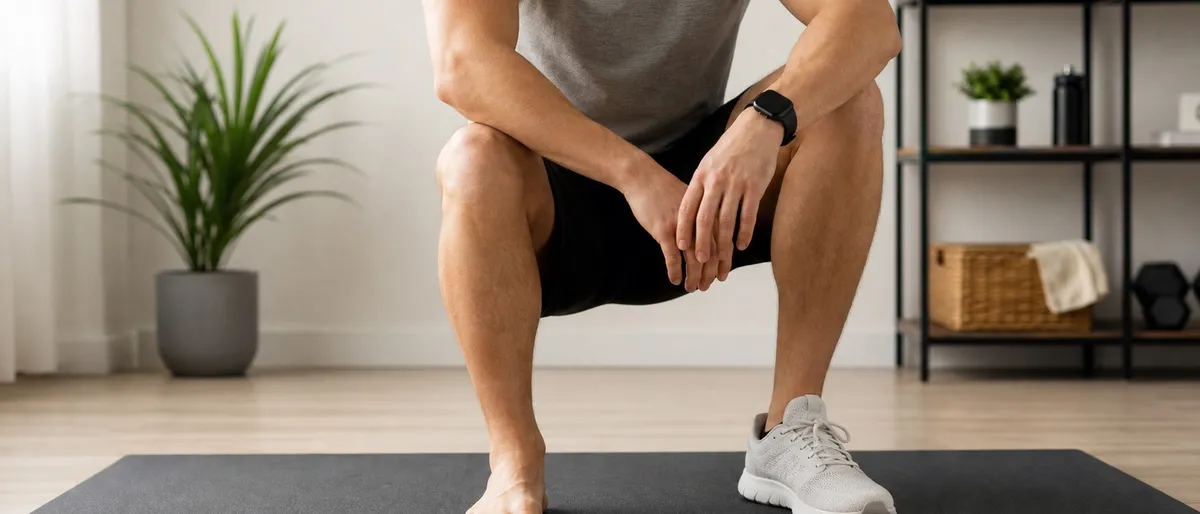
Barefoot or Shoes for Home Workouts: The Practical Rule
Decide when to work out barefoot or in shoes at home using exercise type, floor grip, foot strength, balance, and injury-history checks.
The most honest answer to “Should I work out barefoot or in shoes at home?” is annoyingly simple: it depends on the exercise, the floor, and your feet.
That sounds less satisfying than a hard rule. Barefoot training feels natural, shoes feel protective, and social media turns both into identity choices. But the evidence is more useful than the argument. Barefoot or minimalist conditions can change mechanics and increase the demand on foot muscles, while shoes can improve protection, grip, and comfort when the surface or exercise is less forgiving.
The practical rule is this: train barefoot for controlled, low-impact movements when the floor is clean and grippy; wear shoes for jumping, fast direction changes, slippery surfaces, public spaces, or any workout where your feet need protection more than feedback.
The U.S. Physical Activity Guidelines count bodyweight exercises such as push-ups, squats, and lunges as muscle-strengthening activity, which is the category most home workouts live in. Footwear changes how you contact the floor during those movements; it does not decide whether the workout “counts.”
Use this as a decision layer on top of your home workout form check and beginner home workout guide. Footwear is not a personality trait. It is a training variable.
What barefoot training actually changes
(PMID 25364479; PMID 30113521; PMID 23439417; PMID 34545114)
Barefoot home workouts increase the sensory information coming from the sole of the foot. That matters because plantar cutaneous feedback contributes to postural control. Viseux and colleagues reviewed this mechanism in 2019, describing the foot as a sensory interface between the body and the ground (PMID 30639034). In plain English: your foot is not just a base. It is part of the balance system.
Minimalist-footwear research also suggests the foot can get stronger when it has to work more. Ridge and colleagues randomized 57 runners to minimalist-shoe walking, foot-strengthening exercises, or control while maintaining running mileage. After 8 weeks, the minimalist-shoe walking and foot-strengthening groups improved foot muscle size and strength, while the control group did not (PMID 30113521). Curtis and colleagues later reported a 57.4% average increase in foot strength after six months of daily activity in minimal footwear (PMID 34545114).
That does not mean every home workout should be barefoot. Those studies looked at progressive exposure over weeks or months, not a sudden switch to barefoot burpees on a slick kitchen floor.
Think of barefoot training like turning up the sensitivity on a camera. More detail can help you focus, but it also reveals every shake. For slow squats, lunges, glute bridges, yoga-style mobility, and balance drills, that extra feedback may help you feel tripod foot contact: heel, base of big toe, base of little toe. For fast HIIT, fatigue can turn the same sensitivity into noise.
The useful question is not “Are bare feet better?” It is “Do bare feet make this specific movement cleaner today?”
When barefoot is usually the better choice
(PMID 23439417; PMID 34545114; PMID 34902659; PMID 25331484)
Barefoot or sock-free training works best when the movement is controlled, the floor has grip, and the goal is body awareness rather than impact absorption.
Good candidates include bodyweight squats, split squats, reverse lunges, glute bridge floor work, dead bugs, planks, calf raise drills, balance drills, and slow mobility work. In these exercises, the foot can spread naturally, the toes can grip lightly, and you can notice whether weight drifts to the inside or outside edge of the foot.
Balance evidence points in the same direction, with caveats. Reutimann and colleagues analyzed barefoot and shod static posturography studies and found higher sway velocity in habitual shoes than barefoot in several eyes-open and eyes-closed conditions (PMID 34902659). The authors also emphasized heterogeneity across testing methods. That combination is exactly why a home-workout rule should be practical instead of absolute: barefoot may improve static feedback for some tasks, but the effect depends on context.
Try this two-minute floor test before a barefoot home workout:
- Stand on one foot for 20 seconds per side.
- Do five slow bodyweight squats.
- Do five reverse lunges per side.
- Hold a plank for 20 seconds.
Barefoot is a good option if your feet feel secure, the floor does not slide, and your balance improves or stays the same. Wear shoes if your toes claw aggressively, the floor feels cold or slick, your arches cramp, or your knees and hips look less controlled on video.
This is especially useful for slow strength sessions. A controlled leg workout with no equipment often benefits from feeling the floor clearly. A chaotic conditioning circuit usually needs a different decision.
When shoes are the safer call
(PMID 34902659; PMID 25331484; PMID 30639034; Physical Activity Guidelines)
Shoes win when protection matters.
Wear shoes for jump squats, skaters, fast mountain climbers, burpees, high knees, lateral shuffles, stair work, outdoor sessions, garage workouts, public gyms, rough patios, and any surface where glass, splinters, grit, or sharp edges are plausible. A shoe also makes sense if you have current plantar fasciitis, a recent ankle sprain, stress-injury history, diabetes-related foot concerns, reduced sensation, or clinician-provided orthotics.
The barefoot-running literature is a useful warning even though home workouts are not running. Perkins, Hanney, and Rothschild reviewed 23 studies on barefoot or minimalist running and concluded that evidence was not strong enough to make definitive claims about risks or benefits (PMID 25364479). The review found moderate evidence for biomechanical differences, including shorter stride length and increased stride frequency, but that is not the same as proving fewer injuries.
Ridge and colleagues make the caution more concrete. In a 10-week minimalist-running transition study, more runners in the Vibram FiveFingers group showed increases in foot bone marrow edema than controls in traditional shoes (PMID 23439417). The authors recommended a very slow transition to avoid potential foot stress injury. Again, your living-room squats are not a running study. But tissue adaptation follows the same principle: new load deserves gradual exposure.
Shoes also help when the workout is fast enough that grip becomes the limiting factor. If you are doing a small-space HIIT workout, flat trainers can reduce slipping during step-touches, plank transitions, and reverse lunges. A barefoot foot sliding on laminate is not more “functional.” It is just less controlled.
The home-workout decision table
(PMID 30639034; Physical Activity Guidelines; PMID 25364479; PMID 30113521)
Use the table as a starting point, then let the floor test override it.
| Workout type | Barefoot | Shoes |
|---|---|---|
| Slow bodyweight squats | Good option on clean, grippy floors | Better if heels lift or floor is cold |
| Reverse lunges | Good if balance improves | Better for slippery floors or fast reps |
| Glute bridges and floor core | Usually fine | Optional for comfort |
| Yoga-style mobility | Usually best | Optional if feet need warmth or support |
| Jumping HIIT | Usually no | Usually yes |
| Lateral shuffles or skaters | Only on excellent grip | Usually yes |
| Outdoor patio or garage workouts | Risky unless surface is clean | Usually yes |
| Public gym or shared studio | Hygiene and protection issue | Yes |
| Heavy loaded lifting | Depends on lift and experience | Flat shoes or lifting shoes often better |
The squat study by Sinclair and colleagues is a good reminder that preference and mechanics can diverge. Fourteen experienced male participants squatted at 70% of one-rep max in different footwear conditions. Running shoes were associated with increased squat depth, knee flexion, and rectus femoris activation compared with barefoot, while participants still preferred barefoot (PMID 25331484). The authors did not find biomechanical evidence proving barefoot was superior.
That matters for home training because preference is loud. Data is quieter. If barefoot squats feel better and look controlled, use them. If shoes let you reach a cleaner range without wobbling, that is the better training choice for you.
How to transition without annoying your feet
(PMID 25364479; PMID 30113521; PMID 23439417; PMID 34545114)
Sarah T. Ridge’s minimalist-footwear studies support a balanced rule for home exercisers: feet can adapt when exposure is progressive, but a sudden jump from cushioned shoes to unsupported training can overload tissues before strength catches up (PMIDs 30113521 and 23439417).
Start small if you normally train in cushioned shoes.
Week one: use barefoot training for warm-ups and slow strength only, 5 to 10 minutes at a time. Keep HIIT, jumping, and fast lateral work in shoes.
Week two: add one or two barefoot sets to squats, glute bridges, calf raises, or balance drills. Stop if you feel arch cramping, sharp heel pain, metatarsal soreness, numbness, or Achilles irritation.
Week three: keep barefoot work for controlled movements and decide exercise by exercise. You do not earn a medal for doing every rep barefoot. The goal is better movement.
Use the same progression logic you would use for progressive overload at home. Add exposure gradually, then watch the response over the next 24 to 48 hours. Mild foot-muscle fatigue can be normal. Pain that changes how you walk is not.
Medical note
If you have diabetes-related foot symptoms, peripheral neuropathy, recurrent stress fractures, active plantar fasciitis, a recent ankle sprain, unexplained numbness, or clinician-prescribed footwear, do not use a blog article as your clearance to train barefoot. Ask a qualified clinician who knows your history.
The practical rule for your next workout
(PMID 23439417; PMID 34545114; PMID 34902659; PMID 25331484)
Before your next session, look down before you start.
If the workout is slow, controlled, and done on a clean grippy mat or floor, barefoot is reasonable. If the workout is fast, jumpy, lateral, outdoors, public, or performed on a floor you do not fully trust, wear shoes. If the answer is still unclear, film five reps both ways and keep the version that looks quieter, steadier, and easier to repeat.
The contrarian point is that there is no universal winner. Barefoot training is not magic. Shoes are not cheating. The best choice is the one that improves the rep you are actually doing.
RazFit sessions are short enough to make this easy: choose barefoot for a slow strength or mobility block, shoes for Lyssa-style cardio, and reassess when the exercise changes. Your feet do not need a manifesto. They need the right surface, the right dose, and a little patience.
References
-
Perkins, K.P., Hanney, W.J., & Rothschild, C.E. (2014). “The risks and benefits of running barefoot or in minimalist shoes: a systematic review.” Sports Health, 6(6), 475-480. PMID 25364479. DOI: 10.1177/1941738114546846. https://pubmed.ncbi.nlm.nih.gov/25364479/
-
Ridge, S.T., Olsen, M.T., Bruening, D.A., et al. (2019). “Walking in Minimalist Shoes Is Effective for Strengthening Foot Muscles.” Medicine & Science in Sports & Exercise, 51(1), 104-113. PMID 30113521. DOI: 10.1249/MSS.0000000000001751. https://pubmed.ncbi.nlm.nih.gov/30113521/
-
Ridge, S.T., Johnson, A.W., Mitchell, U.H., et al. (2013). “Foot bone marrow edema after a 10-wk transition to minimalist running shoes.” Medicine & Science in Sports & Exercise, 45(7), 1363-1368. PMID 23439417. DOI: 10.1249/MSS.0b013e3182874769. https://pubmed.ncbi.nlm.nih.gov/23439417/
-
Curtis, R., Willems, C., Paoletti, P., & D’Aout, K. (2021). “Daily activity in minimal footwear increases foot strength.” Scientific Reports, 11, 18648. PMID 34545114. DOI: 10.1038/s41598-021-98070-0. https://pubmed.ncbi.nlm.nih.gov/34545114/
-
Reutimann, S., Hill-Strathy, M., Krewer, C., et al. (2022). “Influence of footwear on postural sway: A systematic review and meta-analysis on barefoot and shod bipedal static posturography in patients and healthy subjects.” Gait & Posture, 92, 302-314. PMID 34902659. DOI: 10.1016/j.gaitpost.2021.11.022. https://pubmed.ncbi.nlm.nih.gov/34902659/
-
Sinclair, J., McCarthy, D., Bentley, I., Hurst, H.T., & Atkins, S. (2015). “The influence of different footwear on 3-D kinematics and muscle activation during the barbell back squat in males.” European Journal of Sport Science, 15(7), 583-590. PMID 25331484. DOI: 10.1080/17461391.2014.965752. https://pubmed.ncbi.nlm.nih.gov/25331484/
-
Viseux, F., Lemaire, A., Barbier, F., Charpentier, P., Leteneur, S., & Villeneuve, P. (2019). “How can the stimulation of plantar cutaneous receptors improve postural control? Review and clinical commentary.” Neurophysiologie Clinique, 49(3), 263-268. PMID 30639034. DOI: 10.1016/j.neucli.2018.12.006. https://pubmed.ncbi.nlm.nih.gov/30639034/
-
U.S. Department of Health and Human Services. (2018). Physical Activity Guidelines for Americans, 2nd edition. https://odphp.health.gov/our-work/nutrition-physical-activity/physical-activity-guidelines/current-guidelines