Unilateral Training at Home Without Equipment
Learn how to use unilateral exercises at home for strength, control, and balanced practice, with safe progressions and a complete no-equipment plan.
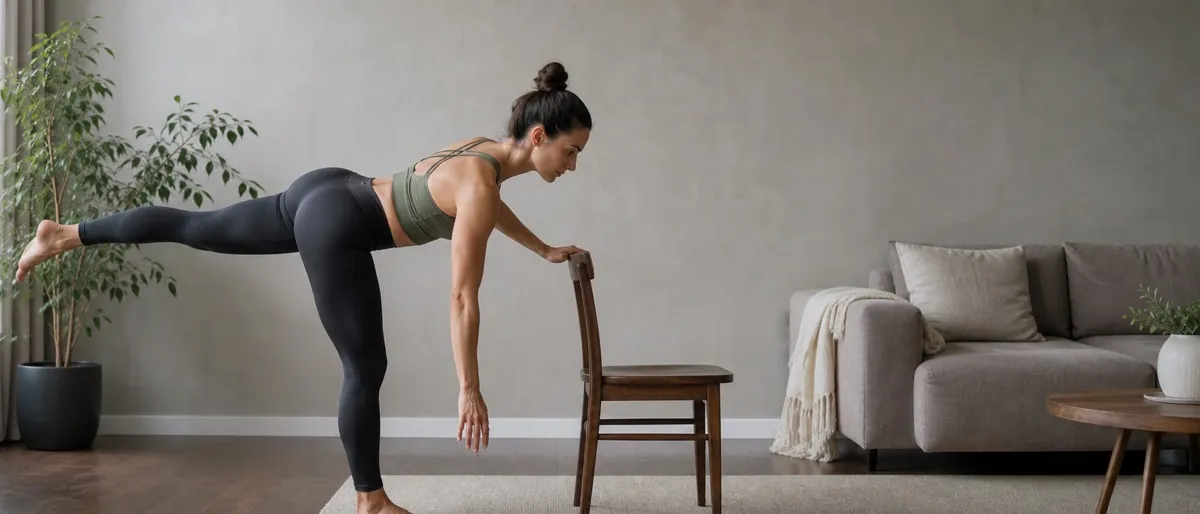
Unilateral training means asking one side of the body to do more of the work at a time. A split squat, single-leg bridge, one-arm wall push-up, and side plank all fit. So does a regular reverse lunge, even though both feet touch the floor, because the front leg carries most of the task.
That definition is more useful than the usual social-media promise that one-sided exercise will “fix imbalances.” Bodies are not perfectly symmetrical, and a shaky first attempt is not a diagnosis. The practical reason to train one side at a time is simpler: it can make bodyweight challenging, expose each side to its own set of repetitions, and develop control in positions that ordinary two-leg squats do not practice.
The research does not crown unilateral work as universally superior. A 2025 systematic review and meta-analysis found no significant difference in muscle growth between unilateral and bilateral resistance training. Strength improved most in the type of task that participants practiced: unilateral training favored unilateral strength, while bilateral training favored bilateral strength (Kassiano et al.). That is a useful starting point. Choose the exercise according to the task you want to improve, not because one camp claims ownership of the “best” method.
This guide stays within that boundary. It is not a rehabilitation protocol, a catalogue of every single-leg exercise, or a replacement for the broader guide to progressive overload with bodyweight training. It shows how a healthy adult can add unilateral work to a home routine, progress it without equipment, and keep the weaker-feeling side from turning the whole session into a guessing game.
What unilateral training changes
Additional evidence: Perceptual and Motor Skills; Biology of Sport; Sports Medicine; U.S. Department of Health and Human Services; Medicine & Science in Sports & Exercise; Sports Medicine.
A bilateral exercise distributes the task across both sides at once. Think of a squat, glute bridge, standard push-up, or forearm plank. A unilateral exercise shifts most or all of the demand toward one limb or one side of the trunk. The difference is a continuum, not a switch. A single-leg squat uses one leg almost exclusively. A split squat still gets help from the rear leg. A staggered push-up biases one arm but does not isolate it.
This matters at home because bodyweight is fixed. Once a regular squat becomes easy, doing endless repetitions is not the only option. Moving to a split squat reduces the base of support and gives the front leg a larger share of the same body mass. A single-leg bridge changes a two-leg hip-extension task into a harder one without buying a barbell.
Unilateral training is therefore a loading tool. It is also a skill choice. The 2025 meta-analysis pooled nine studies and found that muscle hypertrophy did not differ significantly between unilateral and bilateral programs, although the evidence base was limited and the studies had a moderate risk of bias (Kassiano et al.). You do not need to replace every squat with a lunge to build muscle. You need an exercise that is hard enough, repeatable, and capable of progressing.
There is another reason not to pick a side in the bilateral-versus-unilateral argument. A 2022 meta-analysis of 14 studies involving athletes aged 16 to 26 found that unilateral training produced larger improvements in unilateral jumping, while bilateral training had an advantage for bilateral strength. Several other performance outcomes did not differ significantly (Liao et al.). The population and tests were athletic, so the numbers should not be pasted onto every home exerciser. The principle travels better than the effect sizes: training adaptations are specific to what you repeatedly do.
For a general home program, the sensible answer is a mix. Keep bilateral movements that let you produce steady effort. Add unilateral movements where they solve a real programming problem: the bilateral version is too easy, you want to practice single-leg control, or one side keeps borrowing work from the other.
What it can and cannot tell you about asymmetry
Evidence sources: U.S. Department of Health and Human Services; Medicine & Science in Sports & Exercise.
Side-to-side differences are normal. One hand writes; one foot usually leads on stairs; old sport habits leave traces. You may notice that your left split squat feels less coordinated or that your right side plank ends sooner. That observation can guide practice. It cannot, by itself, tell you that a muscle is injured, a joint is misaligned, or your body needs “correction.”
A home comparison is useful when you standardize it. Use the same exercise setup, range of motion, tempo, support, and rest for each side. Record completed repetitions and your effort at the end. Video can help you check whether one side quietly used a shorter range. Repeat the comparison on another day after both sides are familiar with the movement.
Do not treat a one-session gap as a clinical threshold. Balance and coordination change with fatigue, attention, surface, footwear, and familiarity. Even formal research on a rear-foot-elevated split-squat strength test required a familiarization session and controlled loading and measurement; that is far removed from trying a new lunge beside the sofa (Helme et al.). A casual rep count is training information, not a medical screen.
Use three questions instead:
- Does the same side show the same meaningful gap across several sessions?
- Does technique stay comparable, or does one side shorten the movement or rely more on support?
- Is there pain, loss of function, swelling, numbness, or a sudden change rather than ordinary effort?
The first two questions help you program. The third changes the situation. Persistent pain or a sudden loss of capacity deserves assessment by an appropriately qualified clinician, especially after an injury. Adding extra sets to the uncomfortable side is not a substitute for finding out what is wrong.
Strength, balance, and the crossover effect are separate ideas
Unilateral exercises often feel like balance work because the base of support is smaller. Feeling unstable does not automatically mean the exercise is better. If wobbling prevents the target muscles from producing useful force, add light fingertip support. A wall or chair can make a split squat more trainable, not less legitimate.
Single-leg balance practice can improve the tasks people actually train. A 2022 systematic review of 13 studies in healthy adults found gains after single-leg balance programs with several different doses and progressions (Marcori et al.). But balance is highly task-specific. An earlier meta-analysis found that improvement on trained balance tasks may transfer little or not at all to different, untrained tests (Kümmel et al.). Getting steadier in a single-leg stance is useful if that is the capacity you need; it does not prove that every movement or injury risk has improved.
Strength has its own specificity. A controlled split squat develops force through a particular stance and range. It does not make the bilateral squat obsolete. If you want to become better at standing up with both feet planted or at performing a two-leg squat, keep some two-leg practice.
Then there is cross-education: training one limb can produce a smaller strength gain in the opposite, untrained limb. A 2017 meta-analysis confirmed a contralateral strength effect and found that its size depended partly on contraction type (Manca et al.). This is an interesting neural phenomenon, and it has clinical research applications. It is not a reason for healthy people to train only their favorite side. For an ordinary home workout, give both sides direct work unless a clinician has prescribed something different.
Those distinctions keep expectations honest:
- unilateral strength work can make a bodyweight pattern harder and improve that pattern;
- balance practice mainly improves the balance tasks being practiced;
- cross-education exists, but direct training remains the straightforward choice when both limbs can exercise.
The best no-equipment unilateral exercises
Evidence sources: European Journal of Applied Physiology; Journal of Strength and Conditioning Research.
The best exercise is not the one with the fewest points of contact. It is the version you can repeat through a useful range without rushing or turning every repetition into a rescue. Start with supported variations. Remove support only when it no longer improves the quality of the set.
Supported split squat
Stand in a long, comfortable stance with both feet about hip-width apart rather than on a tightrope. Keep the front foot flat. Lower mostly straight down, allowing both knees to bend, then drive through the front foot to rise. Hold a wall or sturdy chair lightly if balance limits the legs before effort does.
This is the main lower-body strength option for most beginners because the feet stay planted. To progress, deepen the range, slow the lowering phase, pause near the bottom, or add repetitions. Elevating the rear foot is optional, not a graduation requirement.
Reverse lunge
From standing, step one foot back and lower under control. Push the floor away with the front leg to return. A reverse lunge adds the challenge of moving into and out of the split stance, so learn the stationary split squat first if the step makes positioning inconsistent.
Alternate legs for conditioning, or complete one side at a time when you want cleaner tracking. Use enough floor space to place the rear foot rather than reaching for an artificially long stride.
Single-leg glute bridge
Lie on your back with one foot planted close enough that the knee is comfortably bent. Keep the other thigh near the same position, then lift and lower the pelvis without twisting. If the pelvis rotates or the hamstring cramps, return to a two-leg bridge or use a kickstand bridge with the second heel touching lightly.
Progress by adding a pause at the top and a slower descent. Do not chase height by arching the lower back.
Supported single-leg squat to a chair
Stand in front of a stable chair and use a doorframe or another secure support. Reach the hips toward the seat while the working foot remains planted, touch down gently, then stand. Adjust chair height or use cushions so the range matches your current control.
This drill is more demanding than its simple setup suggests. Keep it as a strength exercise, not a balance contest. If you drop onto the seat or push hard with the free foot, raise the target and use more hand support.
Single-leg calf raise
Hold a wall, lift one foot, and rise through the ball of the standing foot. Pause briefly at the top and lower until the heel returns to the floor. Support lets the calf do the work instead of forcing the ankle to solve a balance test.
If the single-leg version is too difficult, use both feet to rise and shift more weight to one side during the descent. For a harder version, work from the edge of a step only when the step is secure and the extra range feels comfortable.
Staggered wall or counter push-up
Place both hands on a wall or solid counter, then move one hand slightly lower or farther out. Keep the body straight and lower between the hands. The offset changes the share of work without demanding a full one-arm push-up.
Switch the stagger each set. A small offset is enough at first. If the shoulders rotate sharply or the trunk sags, bring the hands closer to even or use a more upright surface.
Shoulder tap and one-arm support holds
Start at a wall, counter, or floor plank. Shift weight gently into one hand and lift the other hand just enough to tap the opposite shoulder. Keep the pelvis and rib cage as quiet as practical. Widen the feet to make the drill easier; narrow them to demand more anti-rotation control.
This is unilateral loading for the supporting arm and trunk, not a pressing replacement. Pair it with regular push-ups or another pressing variation if upper-body strength is the goal.
Side plank
A side plank loads one side of the trunk while the forearm and side of the lower body support you. Begin with bent knees, then move to straight legs when you can keep the shoulder comfortable and the body aligned. Short, clean holds are more useful than surviving a long hold after the hips have dropped.
If wrists or shoulders need alternative setups, the guide to wrist-friendly home workouts offers more ways to distribute upper-body loading.
How to progress without turning it into a circus trick
The American College of Sports Medicine describes progression as a planned increase in training demand as the body adapts (ACSM position stand). At home, progression does not require adding instability. Standing on a cushion may make the set harder to complete, but it can also reduce how much force you can produce. Use a progression that preserves the purpose of the exercise.
For most unilateral movements, use this order:
- Make the setup repeatable with support.
- Increase the controlled range of motion.
- Add repetitions within the chosen range.
- Slow the lowering phase or add a pause at the hardest position.
- Reduce hand support gradually.
- Move to a harder leverage or exercise variation.
Do not advance all six variables at once. If you deepen a split squat and remove support in the same session, a lower rep count tells you very little. Change one variable, keep the rest stable, and compare the next two or three sessions.
Effort should guide the set more than an arbitrary repetition target. Stop when the next repetition would require a clear loss of range or control. For strength-focused work, a set that ends with roughly two or three good repetitions still available is a practical starting point. That is coaching guidance rather than a universal clinical threshold. Beginners may stop earlier while learning; experienced trainees may work closer to failure when the exercise and setup are safe.
The official U.S. guidelines recommend muscle-strengthening activity involving all major muscle groups on at least two days per week for adults (Physical Activity Guidelines for Americans). They do not require every exercise to be unilateral, nor do they specify that a home exerciser needs a separate day for each side. Two or three full-body sessions can combine both styles.
A complete unilateral home workout
Evidence sources: Perceptual and Motor Skills; Biology of Sport.
This session uses unilateral work where it adds value and retains one bilateral movement for steady pressing practice. It needs a wall and, optionally, a stable chair. Allow about 25 to 35 minutes the first time because setup and side changes take longer while learning.
Warm-up: two rounds at an easy pace
- Five reverse lunges per side, using a shallow range
- Six two-leg glute bridges
- Five wall shoulder taps per side
- Twenty seconds of marching with deliberate single-leg pauses
The warm-up is rehearsal. It should not make the first work set worse.
Main work
| Exercise | Sets | Starting target | Rest |
|---|---|---|---|
| Supported split squat | 2-3 | 6-10 per side | 45-75 seconds after both sides |
| Push-up or incline push-up | 2-3 | 6-12 | 45-75 seconds |
| Single-leg bridge or kickstand bridge | 2-3 | 8-12 per side | 45-60 seconds after both sides |
| Staggered wall/counter push-up | 2 | 6-10 per stagger | 45-60 seconds |
| Side plank | 2 | 15-30 seconds per side | 30-45 seconds after both sides |
| Supported single-leg calf raise | 2 | 8-15 per side | 30-45 seconds after both sides |
Start each exercise with the side that currently feels less coordinated. Match that side’s clean repetitions on the other side rather than adding a large amount of extra work. This is a simple way to distribute practice evenly; it is not a rule that the less coordinated side should always remain first. If performance evens out, alternate the starting side between sessions.
Run the workout twice per week for three weeks before judging it. During week one, make the setup consistent. In week two, add one repetition where all sets stayed controlled. In week three, add a slow three-second descent to the final set of the split squat and bridge, or choose the next harder version if you already reached the top of the range.
For a shorter session, choose the split squat, push-up, bridge, and side plank. For a longer program, do not simply repeat more unilateral variations. Add a horizontal pulling movement if you have safe equipment, or use the broader push-pull balance guide to check what bodyweight-only training may be missing.
When a harder exercise makes the training worse
Evidence sources: Sports Medicine; U.S. Department of Health and Human Services.
Instability is easy to mistake for intensity. If your foot keeps searching for the floor, the leg may never get a good strength set. Use support. Strength and balance can overlap, but the set still needs a main purpose.
The stronger-feeling side can also set a bad target. Suppose the left leg completes eight clean split squats and the right completes twelve. Twelve messy reps on the left do not equalize anything. Record eight, match eight on the right, and let the left accumulate good practice over the next few sessions.
Small differences do not all need extra volume. Day-to-day variation creates noise, especially with a recently learned exercise. Repeat the same setup on several days before adding work. If a stable difference remains and there is no pain, one additional easy set on the less capable side may be reasonable. Keep it modest and check again instead of building permanent compensation into the plan.
Advanced movements create a related trap. One-arm push-ups and unsupported pistol squats look like the purest forms of unilateral training, but they demand substantial strength, mobility, and skill. Treat them as possible goals, not entry requirements. Staggered hand positions, supported split squats, and chair targets provide more adjustable steps.
Transfer is the last place where expectations get ahead of the exercise. Balance gains are often specific to the task that was practiced (Kümmel et al.). Someone training for hiking, running, a sport, or getting up from the floor still needs movements and conditioning that resemble those demands. A longer single-leg stance cannot cover all of them.
When bilateral training is the better choice
Evidence sources: Medicine & Science in Sports & Exercise; Sports Medicine.
Use bilateral work when it lets you train the target safely and progressively with less setup. A standard push-up is usually easier to quantify than a heavily staggered version. A two-leg squat may suit a beginner who is still learning depth and trunk position. A two-leg bridge may keep the hamstrings from cramping while hip extension is new.
Bilateral work also saves time. Unilateral sets effectively double when each side trains separately. If you have ten minutes, two-leg movements may let you cover more patterns. You can keep one unilateral lower-body exercise and use bilateral choices elsewhere.
Choose according to the outcome:
| If you need… | Favor… | Why |
|---|---|---|
| More challenge from fixed bodyweight | A unilateral progression | One side carries more of the task |
| Better performance in a one-sided task | Practice of that task | Strength follows the practiced pattern |
| Efficient general training | Mostly bilateral work | Both sides train in the same set |
| A way to monitor each side | A stable unilateral exercise | Each side produces its own record |
| Maximum stability while learning | A bilateral or supported variation | Less coordination limits the set |
There is no prize for making every movement unilateral. The strongest plan is the one that uses each format for a clear reason and leaves enough stable exercises to track progress.
A sensible next step
Evidence sources: European Journal of Applied Physiology; Journal of Strength and Conditioning Research.
Pick one lower-body movement and one trunk or upper-body movement from this guide. Add them to two weekly sessions for three weeks. Keep the setup identical, log clean repetitions for each side, and change only one progression variable at a time.
If both sides improve, the plan is working even if they never become mirror images. If one side repeatedly loses function, or exercise produces sharp pain, numbness, swelling, dizziness, or symptoms that worry you, stop treating the gap as a programming puzzle and seek qualified medical advice.
For ordinary training, you do not need to hunt for a defect. You need a repeatable movement, an honest record, and a reason to choose one side at a time.
References
- Kassiano W, Nunes JP, Costa B, Ribeiro AS, Loenneke JP, Cyrino ES. (2025). “Comparison of Muscle Growth and Dynamic Strength Adaptations Induced by Unilateral and Bilateral Resistance Training: A Systematic Review and Meta-analysis.” PMID: 39794667. DOI: 10.1007/s40279-024-02169-z.
- Liao K-F, Nassis GP, Bishop C, et al. (2022). “Effects of unilateral vs. bilateral resistance training interventions on measures of strength, jump, linear and change of direction speed: a systematic review and meta-analysis.” PMID: 35959319. DOI: 10.5114/biolsport.2022.107024.
- Manca A, Dragone D, Dvir Z, Deriu F. (2017). “Cross-education of muscular strength following unilateral resistance training: a meta-analysis.” PMID: 28936703. DOI: 10.1007/s00421-017-3720-z.
- Marcori AJ, Monteiro PHM, Oliveira JA, Doumas M, Teixeira LA. (2022). “Single Leg Balance Training: A Systematic Review.” PMID: 35084234. DOI: 10.1177/00315125211070104.
- Kümmel J, Kramer A, Giboin L-S, Gruber M. (2016). “Specificity of Balance Training in Healthy Individuals: A Systematic Review and Meta-Analysis.” PMID: 26993132. DOI: 10.1007/s40279-016-0515-z.
- Helme M, Bishop C, Emmonds S, Low C. (2019). “Validity and Reliability of the Rear Foot Elevated Split Squat 5 Repetition Maximum to Determine Unilateral Leg Strength Symmetry.” PMID: 31524778. DOI: 10.1519/JSC.0000000000003378.
- Ratamess NA, Alvar BA, Evetoch TK, et al. (2009). “American College of Sports Medicine position stand. Progression models in resistance training for healthy adults.” PMID: 19204579. DOI: 10.1249/MSS.0b013e3181915670.
- U.S. Department of Health and Human Services. (2018). “Physical Activity Guidelines for Americans, 2nd edition.”
Medical note
This article provides general exercise education for healthy adults. It does not diagnose asymmetry, prescribe injury rehabilitation, or replace advice from a clinician who can assess your history and movement in person.