VO2 Max at Home: Improve Cardio Fitness Without Equipment
Improve VO2 max at home with no-equipment intervals, Zone 2 work, and weekly progression built around evidence-based cardio training.
Most people hear “VO2 max” and picture a lab mask, a treadmill, and someone in a white coat asking them to keep running until the room feels personally hostile. That is the test. It is not the only way to train the quality being tested.
VO2 max is your body’s upper limit for using oxygen during hard exercise. More practically, it is a marker of how well your heart, lungs, blood vessels, and muscles cooperate when demand rises. The American Heart Association has repeatedly emphasized cardiorespiratory fitness as an important clinical signal, and Ross and colleagues described it as a powerful marker of cardiovascular disease and mortality risk (PMID 27881567).
That does not mean everyone needs formal testing. It means the system matters. And you can train that system at home with stairs, floor space, steady pacing, and intervals that are hard enough to create adaptation without turning every workout into a punishment.
If you already know the basics of Zone 2 cardio at home and heart-rate zones for home workouts, think of this as the next layer: how to aim those tools toward better cardiorespiratory fitness.
What VO2 Max Training Really Asks For
Evidence sources: American Heart Association; American Heart Association; Sports Medicine; British Journal of Sports Medicine.
VO2 max improves when training repeatedly challenges oxygen delivery and oxygen use. That can happen through longer moderate sessions, shorter vigorous intervals, or a mix of both. The method matters less than the signal.
The World Health Organization’s 2020 guidelines recommend that adults accumulate 150-300 minutes of moderate-intensity aerobic activity weekly, or 75-150 minutes of vigorous activity, plus strength work on at least two days. The U.S. Physical Activity Guidelines use the same broad structure. Those targets are not VO2 max hacks; they are the floor for health-focused aerobic training.
The sharper VO2 max question is intensity. Milanović and colleagues reviewed controlled trials comparing high-intensity interval training with continuous endurance training and found that both can improve VO2 max (PMID 26243014). HIIT often produced larger improvements across the included studies, but continuous training still worked. That is the useful takeaway: you do not need one perfect protocol. You need enough repeated aerobic demand to make the system adapt.
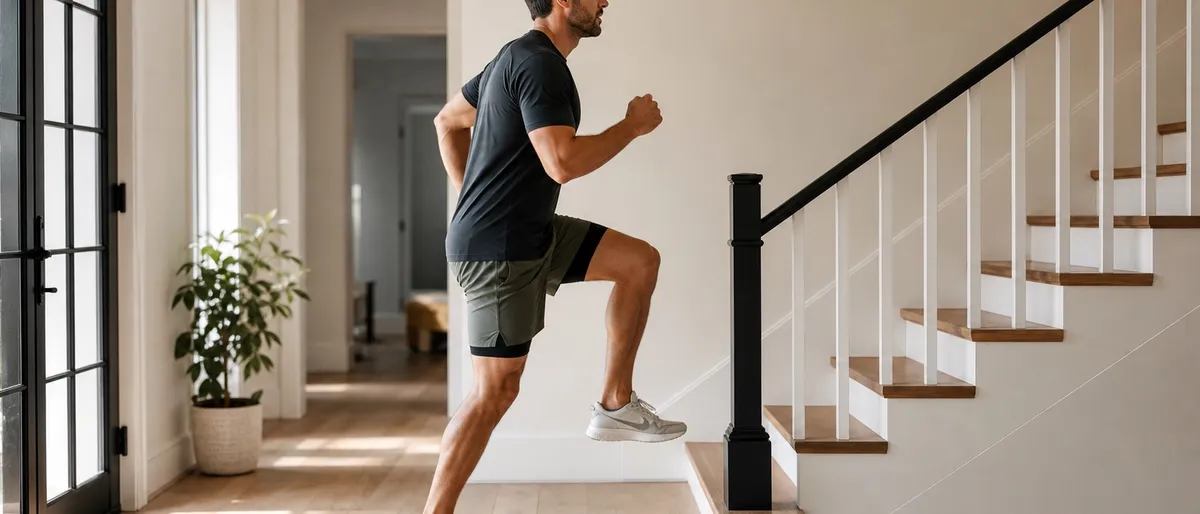
At home, that demand can come from step-ups, fast marching, low-impact skaters, squat-to-reach patterns, shadow boxing, and standing mountain climbers. No treadmill required. The catch is that the movements must be paced with intent. Random sweating is not the same as training.
The No-Equipment VO2 Max Week
Evidence sources: American Heart Association; Sports Medicine; British Journal of Sports Medicine; U.S. Department of Health and Human Services.
A smart home plan uses two gears.
The first gear is moderate aerobic work. This is where you can talk in full sentences but would not want to sing. It builds the repeatable base and helps you collect weekly minutes without needing major recovery. The second gear is vigorous interval work. Speech breaks into short phrases, breathing rises quickly, and the hard parts are deliberately limited.
Use this weekly structure if you are already cleared for vigorous exercise:
| Day | Session | Goal |
|---|---|---|
| Monday | 16-20 min Zone 2-style home cardio | Build aerobic volume |
| Tuesday | Rest or mobility | Recover |
| Wednesday | 12-16 min intervals | Push cardiorespiratory demand |
| Thursday | Easy walk or light movement | Add low stress volume |
| Friday | 16-20 min Zone 2-style home cardio | Repeat the base |
| Saturday | 8-12 min short intervals | Practice controlled intensity |
| Sunday | Rest | Let adaptation happen |
The moderate sessions can use a simple loop: marching with arm drive, step jacks, low-impact skaters, shadow boxing, then repeat. The interval days should be cleaner and shorter: 30 seconds of step-ups or fast low-impact skaters, 60-90 seconds easy marching, repeated six to ten times.
That ratio matters. If every interval becomes an all-out sprint, technique collapses and recovery cost rises. If every interval feels comfortable, it is probably not vigorous enough to improve the ceiling. Aim for hard but repeatable.
How Hard Should the Hard Parts Feel?
Evidence sources: Sports Medicine; British Journal of Sports Medicine; U.S. Department of Health and Human Services; American Heart Association.
For home workouts, use three signals: breathing, RPE, and heart rate if you have it.
During moderate work, stay around RPE 4-6 on a 0-10 scale. During intervals, climb to 7-8. You should not be casually chatting during the hard blocks. You also should not feel panicked, dizzy, or unable to control movement.
Heart rate can help, but it is imperfect indoors. Wrist sensors often lag during arm-heavy exercise. Stairs and step-ups can also create local leg fatigue before your cardiovascular system reaches its target. Use the watch as a dashboard, not a judge.
A practical test: after the third interval, ask whether you could complete the same quality for three more rounds. If yes, continue. If no, reduce range of motion or lengthen the recovery. VO2 max training is not proven by suffering early. It is built by repeating enough quality work.
This is where short workouts can be surprisingly useful. A 10-minute session removes the excuse of time while still giving your heart and lungs a real job. The HIIT vs steady-state cardio comparison explains the tradeoff in more detail: intervals are efficient, but steady work is easier to repeat.
Progress Without Daily HIIT
Evidence sources: British Journal of Sports Medicine; U.S. Department of Health and Human Services; American Heart Association; American Heart Association.
The common mistake is treating VO2 max training as permission to go maximal all the time. That usually backfires. Vigorous work is a stronger signal, but it also costs more recovery.
Progress one variable at a time:
- Add one interval before making intervals harder.
- Make step-ups slightly faster before adding jumps.
- Shorten rest only if your final round still looks controlled.
- Add a second moderate cardio day before adding a third hard day.
- Keep at least one easy or rest day after the hardest session.
A beginner might start with 6 rounds of 20 seconds hard and 100 seconds easy. An intermediate trainee might use 8 rounds of 30 seconds hard and 60 seconds easy. A stronger trainee might alternate 45 seconds hard with 75 seconds easy. All three can be valid. The right version is the one that raises breathing, preserves movement quality, and can be repeated next week.
For no-equipment movement ideas, the home cardio without equipment guide gives higher-intensity options. Use those exercises carefully here. Burpees and jump squats can drive intensity quickly, but they are not mandatory for improving cardio fitness.
When to Be Cautious
Evidence sources: U.S. Department of Health and Human Services; American Heart Association; American Heart Association; Sports Medicine.
VO2 max training is not medical testing, and a blog post cannot clear you for vigorous exercise. If you have cardiovascular disease, unexplained chest pain, fainting episodes, uncontrolled blood pressure, or medication that affects heart rate, ask a qualified clinician what intensity is appropriate.
Stop a session if you feel chest pressure, unusual shortness of breath, dizziness, or symptoms that do not match the work. Downshifting is not failure. It is pacing.
The goal is not to win one workout. The goal is to raise your aerobic ceiling over months. At home, that looks almost boring from the outside: a few hard intervals, a few steady sessions, consistent recovery, then another week. Your heart does not need a machine to adapt. It needs a clear signal, repeated often enough to matter.
References
-
Lavie, C.J., Arena, R., Kaminsky, L.A., et al. (2024). “Update to the 2016 American Heart Association Cardiorespiratory Fitness Statement.” PMID 38387825. https://pubmed.ncbi.nlm.nih.gov/38387825/
-
Ross, R., Blair, S.N., Arena, R., et al. (2016). “Importance of Assessing Cardiorespiratory Fitness in Clinical Practice: A Case for Fitness as a Clinical Vital Sign: A Scientific Statement From the American Heart Association.” PMID 27881567. https://pubmed.ncbi.nlm.nih.gov/27881567/
-
Milanović, Z., Sporiš, G., & Weston, M. (2015). “Effectiveness of High-Intensity Interval Training (HIT) and Continuous Endurance Training for VO2max Improvements.” Sports Medicine, 45(10), 1469-1481. PMID 26243014. https://pubmed.ncbi.nlm.nih.gov/26243014/
-
Bull, F.C., Al-Ansari, S.S., Biddle, S., et al. (2020). “World Health Organization 2020 guidelines on physical activity and sedentary behaviour.” British Journal of Sports Medicine, 54(24), 1451-1462. PMID 33239350. https://pubmed.ncbi.nlm.nih.gov/33239350/
-
U.S. Department of Health and Human Services. (2018). Physical Activity Guidelines for Americans, 2nd edition. https://odphp.health.gov/our-work/nutrition-physical-activity/physical-activity-guidelines/current-guidelines