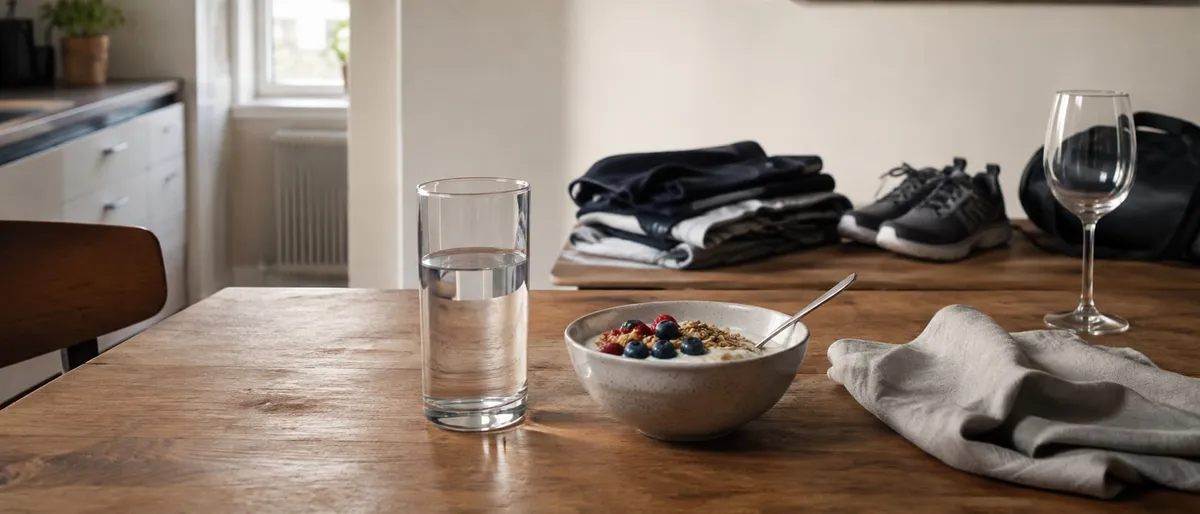
Should you work out the day after drinking alcohol?
After a night of drinking, decide whether to train hard, train light, walk, or rest using sleep, symptoms, dose, and session risk, not detox myths.
The question is usually simpler than the internet makes it. You drank last night. Your calendar says train today. Do you keep the hard session, swap to something easy, walk, or skip?
No workout detoxes alcohol. CDC notes that the liver processes only small amounts at a time, so a hard session is not a clearance shortcut. One drink also does not permanently cancel training. What you need is a next-day decision that respects dose, sleep, how you feel, and what the session asks of your coordination and effort tolerance.
This article stays on that morning choice. It is not a full sleep-science explainer, and it is not a weekly rest-day programming guide. Those topics already have their own homes on RazFit. The job here is narrower: help you decide what kind of training, if any, belongs on the day after drinking.
What “next day after drinking” actually changes
Alcohol is not a single switch. A glass of wine with dinner and a late binge are different exposures, and the research mostly studies the larger end of that range.
In the United States, one standard drink contains 0.6 fluid ounces (14 grams) of pure alcohol. That is roughly 12 ounces of 5% beer, 5 ounces of 12% wine, or 1.5 ounces of 80-proof spirits. CDC standard drink sizes matter because people often undercount pours, cocktails, and higher-ABV cans.
CDC defines binge drinking as 4 or more drinks for women, or 5 or more for men, during an occasion. Moderate drinking, for adults who drink, is described as 2 drinks or less in a day for men and 1 drink or less in a day for women on days alcohol is consumed. Drinking less is better for health than drinking more, and some people should not drink at all. CDC alcohol and health guidance is about overall risk, not a sports-performance guarantee.
For training decisions, three clusters show up repeatedly in the exercise literature: overnight sleep quality and next-morning alertness; hydration plus how unsettled your stomach, head, or balance feel; and muscle recovery signals after hard training, especially when alcohol intake was high.
Those clusters do not all move together. You can feel roughly okay and still have a weaker severe-intensity effort. You can also feel rough enough that even an easy session is a poor idea. The useful habit is to check each cluster instead of asking only “Do I feel motivated?”
What the muscle recovery studies actually measured
The most cited muscle-protein study is blunt about dose. Parr and colleagues had eight physically active men complete concurrent resistance and high-intensity cycling work, then drink about 1.5 grams of alcohol per kilogram of body mass (about 12 ± 2 standard drinks) either with protein or with carbohydrate, compared with protein alone. Read the PLOS ONE trial. Rates of myofibrillar protein synthesis still rose above rest in every condition, but alcohol cut that response: about 24% lower with alcohol plus protein, and about 37% lower with alcohol plus carbohydrate, versus protein alone. Signaling through mTOR was also weaker with the alcohol conditions early in recovery.
That is a heavy-night protocol, not a polite one-drink dinner. It is useful because co-ingesting protein did not fully protect the synthesis response when alcohol intake was that high. It is also limited: young men, one bout, and a binge-scale dose. If your night looked nothing like a dozen drinks, do not pretend the percentage reductions transfer one-for-one.
A systematic review of alcohol after resistance exercise found a split personality in the literature. Many acute markers of force, soreness, creatine kinase, and several blood measures did not clearly change with alcohol in the included studies. Cortisol tended to rise. Testosterone, circulating amino acids, and muscle protein synthesis rates were reduced in the relevant trials. Sample sizes were small, often between 8 and 19 people, and alcohol doses commonly sat between about 0.6 and 1.5 g/kg. The 2020 review is honest that long-term adaptation risk is inferred more from hormone and synthesis changes than from next-morning strength tests alone.
Duplanty and colleagues added a mechanistic note after resistance exercise: alcohol ingestion appeared to attenuate exercise-related mTORC1 signaling in men at three hours, while women in that study did not show the same alcohol interaction. The JSCR paper is another reminder not to treat every finding as universal across sex, dose, and timing.
Barnes’s 2014 review of male athletes puts dose in practical language. Impact depends on timing, how soon you need to train again, injury status, and how much you drank. In that synthesis, roughly 0.5 g/kg body weight is described as unlikely to affect most aspects of recovery if alcohol is consumed in that period, while larger intakes raise more concern for processes tied to protein synthesis and recovery from muscle injury. Barnes Sports Medicine review
High post-exercise or heavy evening intakes can blunt anabolic signaling and synthesis in controlled settings. Ordinary strength numbers the next morning are often less dramatic than social media implies. Neither statement means “train through anything.”
Previous-day drinking and next-morning performance
A different question is how you perform the morning after, not only how muscle tissue signals overnight.
Shaw, Levitt, and colleagues gave recreationally active adults either water or 1.09 grams of ethanol per kilogram of fat-free mass in the evening, then tested them the next morning. Time to exhaustion on a severe-intensity cycle test fell by about 11% after alcohol. Vertical jump, isometric mid-thigh pull, and biceps-curl performance did not differ between conditions. PubMed abstract of the sports physiology study
That split is awkward for programming, which is exactly why it helps. A max-effort interval finish, a hard bike threshold piece, or any session that leans on sustained severe intensity may feel “off” even when a short strength test looks normal. If your planned day is skill work, heavy loaded lifts that need crisp bracing, or anything where a balance error is costly, subjective hangover symptoms still count even when a lab jump test would not have moved.
The resistance-exercise recovery review makes a related point from the other direction: next-morning force and power often look less disturbed than hormone or protein-synthesis measures after alcohol. See that review’s conclusions. When intake is large and sleep is poor, expecting yesterday’s best effort is wishful thinking. When intake is low and you slept well, an ordinary session may still be fine. Match the session to the capacity most likely to dip, not to the one that flatters your ego.
Sleep disruption is part of the next-day problem
Alcohol can make the start of the night feel easy and the second half worse. In a detailed review of alcohol and sleep, acute large amounts taken before bed are linked to shorter sleep-onset latency and altered early-night architecture, followed by more disrupted, poorer-quality sleep later as alcohol is metabolized. REM sleep is often reduced early; wakefulness or lighter sleep can rise later. Alcohol and the Sleeping Brain
Barnes’s athlete-focused review also flags sleep disruption among the reasons heavy drinking can undermine recovery and next-day readiness, alongside the direct tissue and performance issues. See the Sports Medicine discussion. That pairing is one reason next-day training feels harder than “hours since last drink” alone would predict. You may have been in bed for eight hours and still feel unrefreshed. Some people call that “I slept, so I should be fine.” The architecture of the night disagrees.
RazFit already covers the broader sleep and exercise performance relationship. Use that piece when you want sleep hygiene and training quality in general. For this topic, treat a fragmented night after drinking as a reason to lower intensity or postpone the hard session, not as a puzzle to solve with more caffeine and a PR attempt.
If you wake early, lie there, and then doze in light scraps of sleep, log that as fragmented even if the clock says you were “in bed long enough.” The decision framework below cares more about that quality than about a perfect bedtime story.
Hydration, food, and what they do not claim
CDC notes that the liver can only process small amounts of alcohol and that the remainder can harm organs as it moves through the body. CDC alcohol facts That is a health statement, not a stopwatch for your workout clearance.
Barnes notes that rehydration and glycogen restoration may be affected to a lesser extent than protein synthesis and some injury-recovery processes when alcohol is involved. Recovery hierarchy in the Barnes review. That is another reason not to treat breakfast and water as a full reset. Morning water, a normal breakfast, and fluids if you are thirsty are ordinary self-care. They are not a flush protocol. Yogurt, oats, fruit, and a water glass on the table do not cure a hangover, and no serious guideline claims that they do. They may help you feel steadier enough to decide whether movement is appropriate.
Coffee is a separate trap. It can sharpen attention a little and still leave coordination, stomach comfort, and severe-intensity tolerance where they were. Use it as a beverage preference, not as proof you are ready for heavy work.
If you are still vomiting, profoundly dizzy, confused, short of breath, or in chest pain, do not train. Contact local emergency services or urgent medical care. This article cannot triage that for you.
A practical decision framework for the morning after
Run four checks before you load a hard session.
-
Are you still intoxicated or unsafe to move with control? If balance is unreliable, vision is swimming, or you would not drive, skip training. Short-term excessive drinking raises injury risk in daily life; adding jump landings or heavy barbells does not improve that math. CDC short-term harms
-
How rough is the hangover, really? Mild headache with stable walking is different from nausea that makes standing unpleasant. Score the morning in plain language: clear, foggy, queasy, wrecked. Foggy or queasy usually means easy movement only, or rest.
-
What did dose and timing look like? One standard drink early in the evening is not the Parr protocol. A late night that crossed binge thresholds is closer to the doses that reduced synthesis or next-morning severe-intensity endurance in the studies above. Count drinks honestly using standard-drink equivalents.
-
What does today’s session demand?
- Easy walk, mobility, or a light circuit with conservative ranges: often acceptable if you feel stable.
- Technique practice with low load and a careful warm-up: possible on mild mornings if coordination feels intact; keep ego out of it and use a form-check mindset.
- Heavy strength, complex Olympic lifts, high-impact plyometrics, or severe intervals: poor fit after heavy drinking or poor sleep.
- Anything outdoors in heat: worse fit when hydration and thermoregulation already feel off.
If the plan was a short home session, a longer warm-up for short workouts can help you test readiness without jumping straight into intensity. If joints feel awkward or control slips during the warm-up, stop there. That is useful information, not a character test.
Choosing among train hard, train light, walk, or rest
Keep the hard session when all of these are true: drinks were modest, sleep was mostly intact, you feel coordinated, and the session is not unusually technical or severe. Even then, leave a rep or two in reserve. The Physical Activity Guidelines still want adults accumulating aerobic and muscle-strengthening work across the week; missing or modifying one day does not erase that weekly pattern. ODPHP current guidelines
Train light when you feel a bit off but stable. Reduce load, shorten the session, swap intervals for steady easy work, or replace jumps with controlled strength. Light means a deliberate downgrade, not a half-focused grind that still chases yesterday’s numbers. If last night was closer to binge drinking than to a single standard drink, bias toward the lighter options even when pride argues otherwise. Binge and standard-drink definitions
Walk when you want movement for mood and routine without pretending it is a training stimulus. A walk also makes it easier to notice whether symptoms are settling or worsening. If a ten-minute loop feels worse at minute eight than at minute two, turn around and call it information.
Rest when symptoms are strong, sleep was badly fragmented, drinking was heavy, or the planned work needs precision you do not have. Rest after a hard social night is not the same topic as building a long-term recovery schedule; for that broader framing see recovery and rest days. Today’s rest is a safety and quality choice.
People often fear that resting wastes the week. Weekly physical activity is cumulative. Under the Physical Activity Guidelines for Americans, adults need at least 150 to 300 minutes of moderate-intensity aerobic activity a week, or the vigorous equivalent, plus muscle-strengthening activity on at least two days. Those adult targets leave room to move a hard session by a day.
Two worked examples help more than slogans. Example A: two early drinks, solid sleep, mild dry mouth, planned session is easy full-body strength. Keeping the session with slightly lower loads is reasonable. Example B: late binge past five drinks, fragmented sleep, queasy, planned session is jump progressions plus heavy hinges. Walk or rest. Rebook the hard work when bracing and landing feel trustworthy again.
Common objections, answered without the folklore
“I’ll just sweat it out.” Exercise does not establish a reliable shortcut for clearing alcohol or curing hangover symptoms. Framing a brutal session as detox is marketing language, not a finding from Parr’s synthesis trial or the broader recovery reviews.
“I feel fine, so intensity is fine.” Feeling fine enough to chat is not the same as preserving severe-intensity time to exhaustion. The previous-day alcohol study cut cycle time to exhaustion without changing several strength and power tests. Match the session to the capacity that is most likely affected.
“Protein and a big breakfast will cover it.” Food helps you function. In Parr’s high-dose study, protein with alcohol still left myofibrillar protein synthesis lower than protein without alcohol. Those biopsy results are the reason breakfast is sensible without being a shield against a heavy intake.
“Athletes drink after games all the time.” True as culture; weak as evidence that the practice is cost-free. Barnes notes that athletes often drink more through binge patterns than the general population, while also being told to abstain for performance reasons. The useful middle is dose awareness, not folklore.
“If I skip today I’ll lose the habit.” Habits survive honest modifications. A short walk or a light session keeps the streak of showing up without demanding a performance you cannot deliver safely.
“Rest means I am soft.” Rest means you read the room. Pushing a technical session on a foggy morning is not toughness; it is a way to collect a preventable miss or a sloppy rep you then have to unlearn.
Limitations you should keep in view
Most tightly controlled alcohol-and-training studies use small groups, often young men, and alcohol doses that map to heavy drinking rather than one conservative drink. The resistance-exercise alcohol review makes that sample-and-dose pattern hard to miss. Women are underrepresented in several key signaling and synthesis papers, including the mTORC1 signaling comparison after resistance exercise. Hangover symptom scales and next-day performance do not always move together. Acute force tests can look unchanged while synthesis or severe-intensity endurance looks worse, a tension already visible across the systematic review and the morning-after performance trial.
Findings also differ by when alcohol is taken relative to training. Some protocols drink after the workout in the lab. Your real life may involve drinking in the evening after an earlier session, or drinking on a rest day before tomorrow’s training. The physiology overlaps, but the schedule is not identical, so treat percentages as directional evidence rather than a personal calculator.
This page is general fitness education for adults. It is not medical advice, not treatment for alcohol use disorder, and not a clearance for training with chest pain, fainting, confusion, or injury. If drinking is hard to control, or if you want help cutting down, use official resources such as CDC’s alcohol pages and clinical care where you live rather than a workout blog.
A note on health context
Training decisions sit inside larger health choices. Excessive alcohol use has short-term and long-term harms that go well beyond tomorrow’s session quality. Choosing not to drink, or drinking less, lowers those risks compared with drinking more.
How to use RazFit the morning after
If you keep a session, open a shorter or easier option than the one you planned while tired and optimistic at midnight. Warm up longer than usual. Stop if form degrades. Log what you drank and how you slept in ordinary words so the next social weekend is less of a surprise. The app can hold the plan; it cannot metabolize last night for you.
A concrete next-step checklist
- Count last night in standard drinks, not “a couple.”
- Score sleep and hangover symptoms in one sentence each, including whether the second half of the night felt broken the way alcohol-and-sleep research describes.
- Pick the session type that matches those scores: hard, light, walk, or rest.
- If you train, extend the warm-up and cut intensity before you cut safety margins.
- Move the hard work to another day in the same week if needed so weekly activity still adds up under the Physical Activity Guidelines.
- Treat food and fluids as support for comfort and decision making, not as detox.
That is the whole skill. Next-day training after alcohol is a judgment call with better and worse inputs. Use the inputs the studies actually speak to (dose, sleep disruption, symptoms, and session demands) and ignore the promise that a workout can erase the night before.
Frequently Asked Questions
5 questions answered
01
Should I work out with a hangover?
Not automatically. Use how you slept, how unsteady or nauseated you feel, how much you drank, and what the session demands. A short walk or an easy session can fit some mornings; hard intervals or heavy loaded work are a weaker choice when coordination, balance, or severe-intensity capacity feel compromised.
02
Does sweating help you recover faster after drinking?
No credible evidence supports using a workout to flush alcohol or cure a hangover. Your liver processes alcohol over time. Training may still have a place for mood or habit, but it does not erase last night's intake or guarantee better recovery.
03
Will one night of drinking ruin my muscle gains?
A single night is not the same as a training cycle. The clearest muscle-protein-synthesis reductions come from high laboratory doses around a dozen standard drinks, not from one drink. Repeated heavy drinking during recovery windows is a different problem than an occasional social evening.
04
Is light exercise safer than rest the morning after?
Safer depends on symptoms and session choice. Easy movement can be reasonable if you feel stable and hydrated enough to move carefully. Rest is the better option when dizziness or poor coordination show up, or when the planned workout needs precision you do not have today. Chest pain, persistent vomiting, confusion, or breathing difficulty after drinking are not a training choice: contact local emergency services.
05
How long should I wait after drinking before a hard workout?
Studies do not give one universal wait time for every person and every dose. Practical planning uses time since your last drink, sleep quality, hangover symptoms, and session risk. If you still feel intoxicated, do not train. For hard work after a heavy night, many people are better served by delaying intensity until they feel coordinated and clear-headed again.
References
Sources
Expert perspective
Parr and colleagues concluded that alcohol ingestion suppresses the anabolic response in skeletal muscle after concurrent exercise and may therefore impair recovery and adaptation, even when protein is co-ingested.
Evelyn B. Parr · Lead author of the 2014 myofibrillar protein synthesis trial · RMIT University Exercise and Nutrition Research Group · Source: https://journals.plos.org/plosone/article?id=10.1371/journal.pone.0088384