Build golf-ready strength at home without chasing distance
A practical home strength plan for golfers: build hip, trunk and balance control, progress safely and keep research limits clear.
Golf strength training at home works best with a modest aim. You are building a body that can practise, walk, rotate and control positions with less fuss. You are not trying to turn a living room into a driving range, and a few exercises will not replace a golf lesson. A useful plan gives you a repeatable way to train hip and trunk control, leg strength and balance, then leaves the swing itself to practice and coaching.
That distinction matters because golf research often measures more than one thing at once. A supervised programme may report a change in a physical test, clubhead speed or driving distance. It does not follow that the same exercise sequence at home will change your swing, carry, accuracy, handicap or injury risk. The 2024 review supports keeping that limitation explicit. The research on golfers includes collegiate players, older men and young players, and those groups are not interchangeable. The guidance below uses research for context and sticks to conservative exercise choices for practice.
What golf strength at home can actually target
Golf asks you to create and control force while your feet stay connected to the ground. I am using that as a practical framing for a home plan, not as a quote from the rulebook. It also asks you to manage balance, trunk position and rotation under a task that has timing and technical decisions. A home session can train pieces of that picture: standing up with control, loading one leg, moving the hips behind you, resisting unwanted trunk movement and turning gently through a comfortable range. Those are physical qualities, not swing instructions.
The R&A’s guidance separates body strengthening and movement performance from teaching the mechanics of swinging and hitting. Its guidance on Rule 4 makes that boundary explicit. The NHS strength guidance also uses accessible options such as sit-to-stand, a mini-squat and a wall press-up for general adults. Read the NHS starting points here. Neither source establishes a golf-specific routine, so the plan in this article is an editorial example built around control and progression.
A good session lets you answer simple questions. Did your whole foot stay steady? Did your knee track in a direction you could control? Could you keep the ribs and pelvis quiet while the hips moved? Did you stop before fatigue changed the movement? Those answers are more useful for a home session than pretending that a set of lunges has measured your clubhead speed.
What golfer research measured — and what it did not
The research is useful when you keep each study in its lane. Doan and colleagues studied 16 intercollegiate golfers through 11 weeks of supervised strength, power and flexibility training three times per week. Their report included a 1.6% clubhead-speed increase and a change in driving distance, with details tied to that programme and its participants. The PubMed record describes the intervention and outcomes. It does not show that a beginner should copy three weekly sessions at home or that every golfer will gain distance.
Oranchuk and colleagues followed 12 NCAA Division II golfers through an eight-week periodized strength-and-power programme and a bodyweight or rotational movement-focused comparison. The study measured physical tests and clubhead speed; the abstract does not turn a home exercise into a guaranteed swing result. The controlled study record is available here. A small supervised collegiate sample is a reason to measure carefully. It is not a reason to promise a consumer outcome.
Thompson and colleagues studied 18 older male golfers in an eight-week programme that combined flexibility, core stability, balance and resistance work. Their sample and delivery are specific. The trial record reports that population and combined programme. A youth report by Coughlan and colleagues likewise used a 12-week coached programme for male golfers aged 11 to 17. The full golf-science article shows the age range and study limits. Neither study supplies an adult home prescription.
The broader reviews push the same caution. Brennan and colleagues synthesized associations between physical characteristics and performance in injury-free golfers; association does not prove that an exercise causes a faster clubhead. The 2024 review explains its observational scope. Johansen and colleagues’ 2026 review was published on 2026-08-27, after this topic’s assigned 2026-08-20 editorial date. Its abstract reports 33 studies and 798 participants, with low certainty for controlled outcomes and very low certainty for single-group pre/post outcomes. The current publisher abstract is the source for those limits. Treat it as an update signal. It is not evidence that this exact plan works.
Build a base with squat, hinge and split stance
Start with movements that make control visible. A squat gives you a way to practise lowering and standing while keeping the feet connected. Stand with your feet at a comfortable width, sit the hips back and down only as far as your balance and foot pressure remain steady, then stand without bouncing. A chair behind you can provide a clear depth target. The NHS includes sit-to-stand and mini-squat options for general strength practice. Use its stable setup guidance when you need a simpler start.
For the hinge used here, shift the movement toward the hips while the knees stay softly bent. Stand a short step in front of a wall with your back toward it. Send the hips back until they lightly touch, then return tall. The wall is a feedback target, not a demand to reach a particular depth. Keep the ribs relaxed and stop if you have to arch, twist or lose your foot contact. The R&A’s distinction between movement performance and swing mechanics is useful here: body strengthening stays outside teaching the mechanics of swinging and hitting.
A split squat lets you load one side while the other foot stays down as a balance aid. Use a narrow enough stance that you can lower vertically, but wide enough to feel stable. Hold a wall or chair if balance is the limiting factor. Begin with a shallow range and make the lowering quiet. Progress by adding one repetition, a small range change or a light backpack, not all three at once. The ACSM resistance-training update supports adaptable bodyweight and home-based options, while the golfer trials show why the exact dose still needs individual judgment.
Treat these movements as a base, not a golf-skill test. A smoother split squat may make a walking or practice position feel more manageable. It does not demonstrate a change in clubhead speed or ball striking. Write down the version you used, the number of clean repetitions and the point at which control began to fade.
Add trunk control and comfortable rotation
Trunk work for golfers does not need to become a contest to twist farther. Begin with a dead bug or a slow heel tap if lying on the floor is comfortable. Keep the lower ribs from flaring and move one limb at a time. If getting down or up is awkward, use a standing march with a light hand on a wall. Keep the torso organised while the hips and limbs move. Do not turn it into a backswing rehearsal.
A side plank from the knees is another adjustable option. Press the floor away, keep the neck relaxed and hold only while the pelvis stays lifted without shaking. A standing band press-out can train resistance to rotation: hold a light band at the chest, step far enough to create manageable tension and press forward without letting the torso turn. Turn the resistance down if you have to lean or hold your breath.
The older-golfer trial combined core stability, balance, flexibility and resistance rather than isolating one magic exercise. Its programme is a useful reminder to keep the physical qualities separate from the golf outcome. The 2024 review also dealt with physical characteristics and performance associations rather than a causal home routine. Read the review’s scope before treating an association as a prescription.
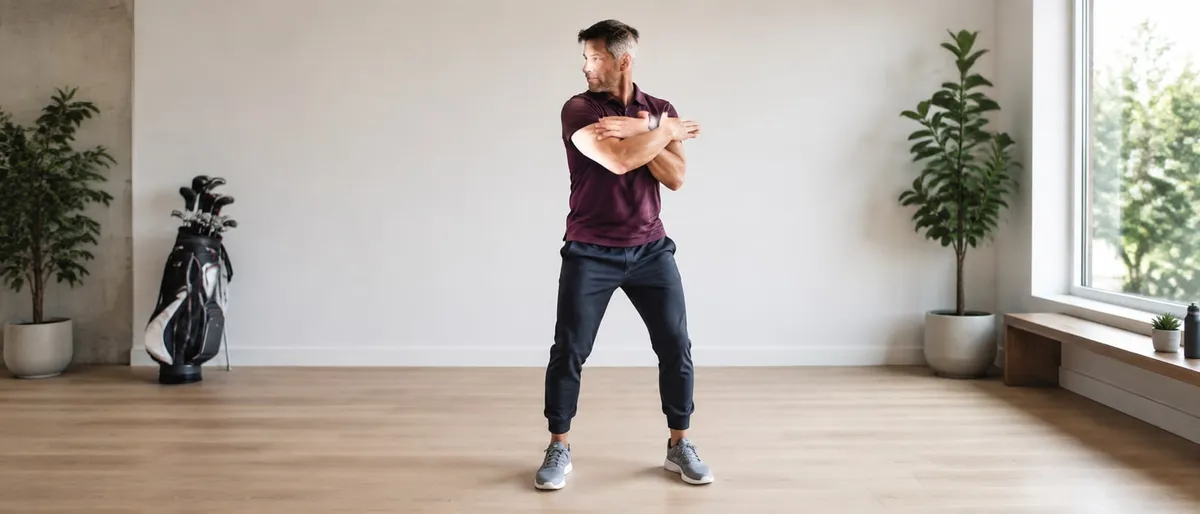
For rotation, use a small range with the feet planted and the hands across the chest. Turn the rib cage gently while the pelvis stays quiet, then return to centre. This is a control drill. It is not a rehearsal of the order, speed or shape of a golf swing. If your low back, shoulder or hip feels pinched, choose a smaller range or leave the movement out and ask a qualified professional for individual guidance.
Train balance without turning it into a stunt
Balance work can be as plain as a supported single-leg stand. Keep one fingertip on a wall, shift weight onto one foot and hold the other heel just off the floor. The target is a steady foot and calm breathing. If that is easy, reduce the hand support or add a slow reach. Do not close your eyes or stand on an unstable surface to make a home drill look advanced.
A step-down from a low step can connect balance to leg control. Lower one heel toward the floor, keep the standing knee aligned with the foot and push back up. Use a smaller step or a handrail when necessary. The older-golfer research included balance as part of a broader supervised programme, not as evidence that a particular step-down improves a golfer’s score. The trial’s population and combined intervention are described in PubMed.
Coughlan’s youth programme included strength and conditioning alongside golf performance tests, but its male adolescent sample and coached weekly delivery do not define an adult plan. The study’s methods and limitations are available in the full report. If you are older, returning to activity or uncertain about balance, use support and choose a slower version. A controlled exercise is still training when it looks ordinary.
A practical two-day home week
The following schedule is an example for a generally healthy adult with a clear floor, stable footwear and no active injury. It is not the protocol from any golf trial. The ACSM resistance-training guidance and NHS strength guidance support adaptable general exercise choices, so this example stays adjustable rather than golf-specific. Keep at least one easier day between the two sessions at first, and place them so they do not make your next round feel heavy.
Day A: force and positions
Warm up with five minutes of easy walking or marching. Then perform two rounds of six to ten chair squats, six to eight wall hip hinges, six to eight split squats per side and five slow dead bugs per side. Rest long enough to keep the next repetition similar to the first. If the wall hinge is new, use fewer repetitions and pause at the point of comfortable contact.
Finish with one or two sets of a supported single-leg stand on each side. Record the version, repetitions, support and whether your last clean repetition matched your first. A light session should leave you able to walk normally and practise without needing to compensate.
Day B: unilateral control and trunk resistance
Repeat the same warm-up, then choose a lower step-down or supported single-leg sit-to-stand for two sets of five to eight per side. Add a side plank from the knees for two short holds per side, or use a standing band press-out for six to ten controlled repetitions per side. Finish with a gentle standing rotation in a small range, five per side, if it feels comfortable and does not change your breathing.
If you also run, hike or do a general lower-body workout, count those sessions in the week’s total. A golf label does not make every squat a separate requirement. The existing core workout guide can help you compare general trunk options, and the unilateral training guide is another progression reference. Those pages cover broader exercise choices. They do not add golf-specific evidence to this plan.
Progress around golf, recovery and other training
Progress should answer one question at a time. First make the movement repeatable. Then add a repetition, a little resistance, a slightly longer hold or a small range change. For a balance drill, reduce hand support before adding speed. For a hinge, make the wall target farther away only when you can keep the feet and ribs steady. For a squat, a backpack can provide a clearer stimulus than endless repetitions once bodyweight work is easy.
Use your golf calendar as a constraint. A demanding strength session the day before a long walking round may be a poor fit even if the exercise itself is sensible. After a round, an easy mobility or walking day may be more useful than forcing a full session. A short practice session can be placed near golf when the goal is movement quality; harder loading deserves room for recovery. The NHS strength guidance also supports gradual, repeatable progress for general exercise. No study in the brief establishes a universal home frequency for every golfer. The 2026 review is the source for that limitation.
The 2006 collegiate programme used three supervised sessions each week, while the youth report used one coached session weekly and the older-golfer trial used its own structured schedule. The collegiate study documents the three-session schedule. The ACSM guidance also emphasises that resistance plans depend on goals and circumstances. Those different designs are evidence against copying a single number into every home plan. Start with the smallest dose that lets you observe the effect and recover for the activities you care about.
Measure what you trained
Track process measures before chasing golf outcomes. Note the exercise variation, load, repetitions, hold time, balance support, perceived effort and any pain or loss of control. If you use a clubhead-speed monitor, keep it as a separate measurement with the same club, warm-up and test conditions. A faster reading on one day may reflect timing, fatigue, equipment or normal variation. It is not automatically the effect of the last home session.
The 2026 review reports golf-shot outcomes across heterogeneous interventions and rates certainty low or very low depending on the design. Its abstract is the appropriate source for that uncertainty. Oranchuk’s study also measured strength and power outcomes alongside golf variables in a small collegiate sample. The study record shows why those measures should stay distinct. At home, a clean set of split squats or a steadier single-leg stand is a valid training result even when your handicap does not move.
A simple check every few weeks is enough: repeat the same squat depth, hinge-to-wall distance, supported balance hold or band press-out under similar conditions. Stop the comparison if the movement changes. Do not use the check to diagnose a hip, back or shoulder problem. A qualified clinician or exercise professional can help if symptoms persist, and a qualified golf coach can address technique, equipment and ball flight.
When to get individual advice
This is general fitness information, not rehabilitation or swing coaching. Stop an exercise when pain increases, balance repeatedly gives way, you feel unwell or you cannot tell what changed. Seek individual assessment for persistent pain, swelling, a recent operation or injury, neurological symptoms, chest symptoms or unexplained breathlessness. Ask a qualified coach about swing mechanics and a clinician about diagnosed conditions or return-to-training decisions.
Use RazFit to keep the work repeatable: save the exercise version, resistance and target repetitions, then return to the same movement before changing several variables. A small plan that fits your week beats a dramatic routine you cannot recover from. Support golf practice with physical preparation, and keep claims about distance, accuracy, handicap and injury risk in proportion to the evidence.
Frequently Asked Questions
5 questions answered
01
Can strength training at home improve my golf?
It can help you practise general strength, balance and trunk or hip control, but these exercise changes are different from a proven change in swing mechanics, distance, accuracy or handicap.
02
What exercises should a golfer do at home?
Begin with controlled squats, a hip hinge, split-stance work, a supported balance drill and gentle trunk-control exercises. Choose versions you can repeat without pain or loss of control.
03
How often should I do golf strength training at home?
Two short sessions on non-consecutive days are a reasonable example for a generally healthy adult. Adjust around golf, recovery and other training; this is not a tested universal dose.
04
Will home strength training add distance?
Some supervised golfer studies measured clubhead speed or distance after structured programmes, but they do not prove that this home plan will add yards for you.
05
Should I train strength before or after playing golf?
Keep demanding strength work away from the round when possible. A light technique-focused session can fit nearer to play, while a hard session deserves recovery and a clear reason.
References
Sources
Expert perspective
The R&A separates body strengthening and movement performance from teaching the mechanics of swinging and hitting; that distinction keeps a home strength plan useful without presenting it as swing coaching.
The R&A · Guidance Notes for Rule 4: Biometrics, Movement Performance and Body Strengthening · The R&A · Source: https://www.randa.org/sw/amateur-status/appendices/guidance-notes-for-rule-4