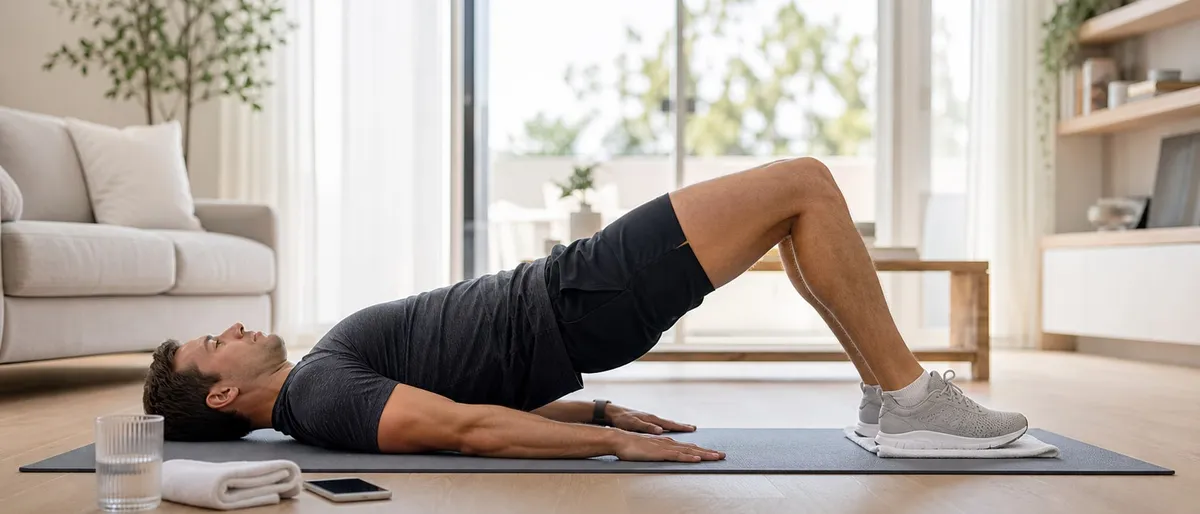
Hamstring Exercises at Home for Posterior-Chain Strength
Build stronger hamstrings at home with bridges, towel sliders, hinges, walkouts, and cautious Nordic progressions without machines.
Most home leg workouts accidentally train the front of the body.
Squats, lunges, wall sits, step-ups, and jump squats all have value. They also let the quads take the spotlight. The hamstrings sit behind the thigh, doing quieter work: bending the knee, extending the hip, controlling deceleration, and helping the glutes when you hinge, climb stairs, sprint, or pick something up.
A real no-equipment hamstring plan needs more than doing squats slower. It needs posterior-chain work: bridges, sliders, hinges, walkouts, and eventually cautious Nordic hamstring progressions.
For a full lower-body base, pair this with leg workouts without equipment. For the broader strength framework, use progressive overload at home.
Why hamstrings need their own plan
(Source 1; Source 2; Source 3; Source 4; Source 5; Source 6)
The hamstrings cross two joints: the hip and the knee. They help extend the hip in a hinge or bridge, and they help flex the knee in a curl or slider. A complete home plan should train both.
That is the first mistake at home: only doing hip-dominant work. Glute bridges, hip hinges, and good mornings help, but they do not fully replace knee-flexion work. A towel slider or walkout fills that gap because the heels move away from the hips while the hamstrings fight to control the motion.
CDC and ODPHP guidance both support muscle-strengthening activity at least two days per week. For home training, the posterior chain belongs in that major-muscle-group bucket.
Van Dyk, Behan, and Whiteley analyzed Nordic hamstring programs across 8,459 athletes and found lower hamstring injury rates when the Nordic was included (PMID 30808663). Al Attar and colleagues reached a similar conclusion in soccer players (PMID 27752982). That does not mean every home exerciser should start with full Nordics. It means eccentric hamstring strength is useful enough to deserve a careful progression.
Five no-equipment hamstring exercises
(Source 1; Source 2; Source 3; Source 4; Source 5; Source 6)
Use these as a ladder. Start with the version you can control without cramping, back arching, or knee discomfort.
| Exercise | Main job | Start with |
|---|---|---|
| Glute bridge | Hip extension base | 2-3 sets of 10-15 |
| Hamstring bridge hold | Isometric control | 3 holds of 20-30 seconds |
| Towel slider curl | Knee-flexion strength | 2-3 sets of 5-8 |
| Hip hinge | Posterior-chain pattern | 2-3 sets of 8-12 |
| Hamstring walkout | Eccentric bridge control | 2-3 sets of 4-6 |
Bridge with ribs quiet and heels heavy. For sliders, use socks, a towel, or sliders on a smooth floor. For walkouts, take tiny heel steps away from the hips, then walk back in. The slow outward walk is where the hamstrings lengthen under tension.
If these feel easy, do not add speed first. Add range, pauses, single-leg assistance, or slower lowering.
The 12-minute posterior-chain session
(Source 1; Source 2; Source 3; Source 4; Source 5; Source 6)
Do this workout once or twice per week. Put it after a short warm-up or after your main lower-body work.
| Block | Exercise | Work |
|---|---|---|
| 1 | Hip hinge | 2 sets of 10 slow reps |
| 2 | Glute bridge | 2 sets of 12 with a 2-second top hold |
| 3 | Towel slider curl | 3 sets of 5-8 |
| 4 | Hamstring walkout | 2 sets of 4-6 |
| 5 | Long-lever bridge hold | 2 holds of 20-30 seconds |
Rest 45 to 90 seconds between sets. If sliders make you cramp, switch to bridge holds for a week. Cramps often mean the demand jumped too quickly.
The ACSM progression model emphasizes gradual changes in volume, intensity, and exercise complexity. That matters because home hamstring moves can jump from easy to brutal fast. A full Nordic is not just the next bridge.
Progress without machines
(Source 1; Source 2; Source 3; Source 4; Source 5; Source 6)
Progress one variable at a time. Start with reps. When you can do three sets of eight clean towel sliders, make the lowering phase slower or extend the heels farther. When walkouts feel controlled, take smaller steps and pause at the farthest point.
Use this four-week plan:
| Week | Focus | Prescription |
|---|---|---|
| 1 | Learn positions | Bridges, hinges, short walkouts |
| 2 | Add knee flexion | Sliders for 2-3 controlled sets |
| 3 | Add eccentrics | Longer slider lowering, slower walkouts |
| 4 | Add asymmetry | Single-leg-assisted bridge or offset sliders |
This is where home training gets interesting. You are not limited by a missing leg-curl machine. You are limited by how precisely you manipulate friction and leverage. For the same principle across bodyweight training, read the calisthenics progression system.
Where Nordics fit
(Source 1; Source 2; Source 3; Source 4; Source 5; Source 6)
The Nordic hamstring exercise has strong evidence in sport, but online videos often show the dramatic full-range fall. That is not the beginner version.
Try this ladder:
- Tall kneeling hip hinge, hands ready to catch
- Short-range Nordic lean, only a few inches forward
- Nordic lean to a sofa cushion or stacked pillows
- Assisted Nordic with hands pushing lightly off the floor
- Slower assisted Nordic with a longer range
Stop before control disappears. A good Nordic progression feels like a controlled forward lean, not a panic drop. Anchor the ankles only if the setup is stable and comfortable. A couch that slides is not a training partner.
The best hamstring exercise is not always the hardest one. For many home exercisers, sliders and walkouts give a better risk-to-reward ratio than full Nordics.
If you have a recent hamstring strain, back pain that worsens with hinging, sciatic symptoms, or sharp pain behind the knee, get medical or physical-therapy guidance before aggressive eccentric work.
Related Articles
- Leg Day at Home: The Bodyweight Science
- Progressive Overload at Home: No-Gym Guide
- Tempo Training for Bodyweight Workouts
- Your Calisthenics Progression System
- Back Pain Exercises at Home
References
-
van Dyk, N., Behan, F.P., & Whiteley, R. (2019). “Including the Nordic hamstring exercise in injury prevention programmes halves the rate of hamstring injuries: a systematic review and meta-analysis of 8459 athletes.” British Journal of Sports Medicine, 53(21), 1362-1370. PMID 30808663. DOI 10.1136/bjsports-2018-100045. https://pubmed.ncbi.nlm.nih.gov/30808663/
-
Al Attar, W.S.A., Soomro, N., Sinclair, P.J., Pappas, E., & Sanders, R.H. (2017). “Effect of injury prevention programs that include the Nordic hamstring exercise on hamstring injury rates in soccer players: a systematic review and meta-analysis.” Sports Medicine, 47(5), 907-916. PMID 27752982. DOI 10.1007/s40279-016-0638-2. https://pubmed.ncbi.nlm.nih.gov/27752982/
-
American College of Sports Medicine. (2009). “Progression models in resistance training for healthy adults.” Medicine & Science in Sports & Exercise, 41(3), 687-708. PMID 19204579. DOI 10.1249/MSS.0b013e3181915670. https://pubmed.ncbi.nlm.nih.gov/19204579/
-
Garber, C.E., Blissmer, B., Deschenes, M.R., Franklin, B.A., Lamonte, M.J., Lee, I.M., Nieman, D.C., & Swain, D.P. (2011). “Quantity and quality of exercise for developing and maintaining cardiorespiratory, musculoskeletal, and neuromotor fitness in apparently healthy adults.” Medicine & Science in Sports & Exercise, 43(7), 1334-1359. PMID 21694556. DOI 10.1249/MSS.0b013e318213fefb. https://pubmed.ncbi.nlm.nih.gov/21694556/
-
U.S. Department of Health and Human Services. (2018). Physical Activity Guidelines for Americans, 2nd edition. https://odphp.health.gov/our-work/nutrition-physical-activity/physical-activity-guidelines/current-guidelines
-
Centers for Disease Control and Prevention. (2023). “Adult Activity: An Overview.” https://www.cdc.gov/physical-activity-basics/guidelines/adults.html