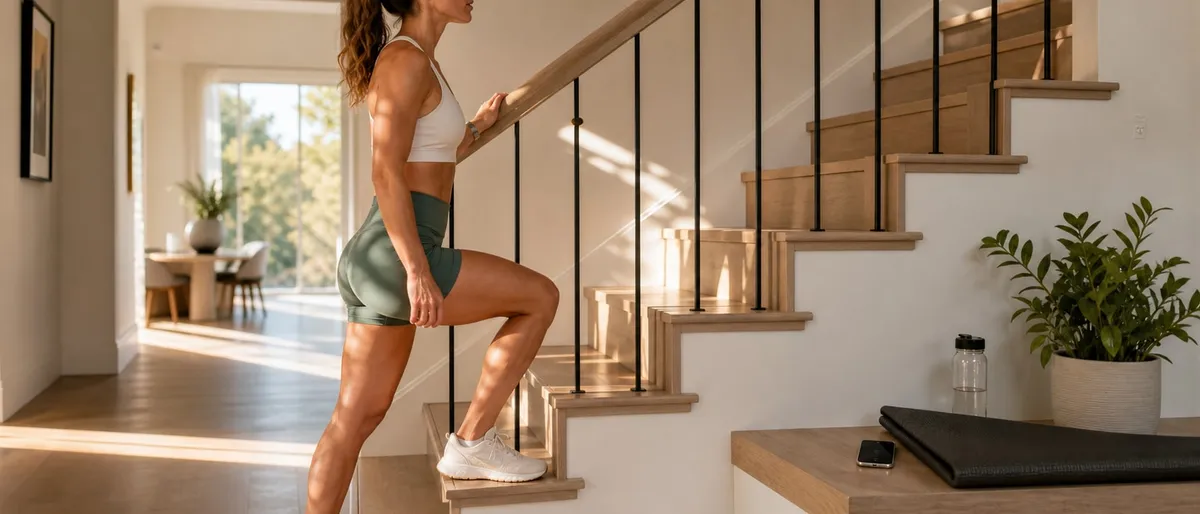
Stair Workouts at Home: Cardio and Strength
A safe home stair workout plan for cardio and leg strength, with short sessions, progression options, and evidence-backed safety cues.
The most useful exercise machine in your home may already be bolted to the wall.
A staircase is not glamorous. It does not track watts or promise a perfect training zone. But it gives you something most no-equipment workouts struggle to create quickly: vertical work. Every step asks your calves, quads, glutes, lungs, and balance system to coordinate against gravity.
Jenkins and colleagues tested vigorous stair-climbing snacks in sedentary young adults: three bouts per day, each ascending a three-flight stairwell of about 60 steps, separated by one to four hours, three days per week for six weeks. Peak oxygen uptake improved compared with controls (PMID 30649897). That does not mean every stair session has to be a sprint. It means short stair bouts can be a real training signal when the dose is specific.
Use this guide when you have a safe staircase, want cardio and lower-body strength without equipment, and need sessions short enough to repeat. For the broader short-session science, read micro-workouts. For flat-floor options, use home cardio without equipment.
Why stairs feel hard so fast
Evidence sources: Peer-reviewed journal; Peer-reviewed journal; Centers for Disease Control and Prevention.
Walking on flat ground moves you forward. Stairs move you upward. That difference changes the cost of the movement.
Each ascent is a small step-up. Your front leg extends the knee and hip, the back leg helps push, your calves finish the motion, and your trunk has to stay tall. Repeat that for 30 to 60 steps and breathing climbs quickly, even if the pace looks modest.
A 2024 scoping review by Ghosal and Chandrasekaran found that stair-climbing interventions across 24 studies were associated with improvements in aerobic capacity and several cardiometabolic indicators, though protocols and populations varied. The contrarian point is simple: stairs are not magic because they are stairs. They work because they combine large-muscle effort, vertical displacement, and easy progression.
Think of stairs like a gas stove. The flame responds instantly. Useful, but it can burn the pan fast. You need a dial, not just enthusiasm.
Check the staircase first
Evidence sources: Centers for Disease Control and Prevention; U.S. Department of Health and Human Services; Peer-reviewed journal.
A stair workout starts before the timer. Use stairs only if the surface is dry, stable, well lit, and clear of toys, shoes, bags, cords, and loose rugs. Keep one hand close to the handrail during warm-up, descent, fatigue, and any single-leg work. Wear shoes with grip if the surface is smooth. Socks on stairs are not training. They are a plot twist.
CDC guidance recommends at least 150 minutes of moderate activity or 75 minutes of vigorous activity per week, plus two days of muscle-strengthening work. Stairs can contribute to both the aerobic side and the leg-strength side, but activity can be spread across the week. You do not have to force one long staircase session.
Use these rules:
- Walk down slowly.
- Face forward and skip sideways runs.
- Step on the full foot when possible.
- Stop for chest pain, dizziness, unusual shortness of breath, or pain that changes your gait.
- Avoid carrying weights on stairs unless the setup has been cleared by a professional.
If you have knee pain, balance problems, recent injury, pregnancy-related symptoms, cardiovascular disease, or a condition that changes exercise tolerance, ask a qualified clinician first.
The 8-minute home stair workout
Evidence sources: Peer-reviewed journal; Peer-reviewed journal; Peer-reviewed journal.
Use one flight of stairs. If the staircase is short, turn around carefully at the top and reset. Do not rush turns.
| Block | Time | Movement | Effort cue |
|---|---|---|---|
| Warm-up | 2 min | Easy stair walk up, slow walk down | RPE 3-4 |
| Build | 2 min | Controlled step-ups on the first or second step | RPE 5-6 |
| Main | 3 min | Walk up one flight briskly, walk down slowly | RPE 6-8 |
| Finish | 1 min | Easy stair walk or marching at the bottom | Breathing settles |
The main block should feel challenging, not chaotic. If your feet get loud, slow down. If you cannot control the descent, the ascent was too aggressive.
According to Martin J. Gibala, PhD, senior author on the Jenkins stair-climbing study, the useful takeaway is brief vigorous bouts placed across the day. For RazFit users, that maps neatly onto short sessions: use Lyssa for cardio on flat-floor days, then use a stair block when you want a vertical stimulus.
Progress without sprinting
Evidence sources: Peer-reviewed journal; Centers for Disease Control and Prevention; U.S. Department of Health and Human Services.
The common mistake is making stairs harder by making them frantic. That works briefly. Then form breaks and descent gets careless.
Progress one variable at a time:
- Add duration from 6 to 8, then 10 minutes.
- Add frequency from 2 to 3 days per week.
- Add one extra ascent in the main block.
- Slow the lowering phase on step-ups to two seconds.
- Shorten standing rest at the bottom by 10 seconds.
Michael, White, and Eves tested sedentary adult females over eight weeks and progressed from two ascents per day to five ascents per day. Compared with controls, stair climbing improved estimated aerobic fitness, body composition, and some lipid measures. The population was specific, so keep the claim narrow; the progression lesson is useful.
Cardio, strength, or both?
Evidence sources: U.S. Department of Health and Human Services; Peer-reviewed journal; Peer-reviewed journal.
A stair workout can sit in three lanes. Continuous steady climbing behaves like cardio. Slow step-ups with pauses behave like strength endurance for quads, glutes, and calves. Brisk ascents with easy descents become intervals.
Decide the purpose before you start:
- Cardio day: continuous easy-to-moderate stair walking, 8-15 minutes.
- Strength day: slow step-ups, 3-5 sets of 6-10 reps per leg.
- Interval day: brisk ascents, slow descents, 6-10 rounds.
Stairs are useful, but they are not a complete strength program. You still need pushing, pulling, hinging, core work, and mobility. For lower-intensity aerobic work, use Zone 2 cardio at home. For a no-floor strength option, use the standing home workout.
Related Articles
- Micro-Workouts: Why Short Exercise Works
- Home Cardio Without Equipment: The Science
- Zone 2 Cardio at Home: No Equipment
- Standing Home Workout, No Floor Needed
References
-
Jenkins, E.M., Nairn, L.N., Skelly, L.E., Little, J.P., & Gibala, M.J. (2019). “Do stair climbing exercise snacks improve cardiorespiratory fitness?” Applied Physiology, Nutrition, and Metabolism, 44(6), 681-684. PMID 30649897. DOI 10.1139/apnm-2018-0675. https://pubmed.ncbi.nlm.nih.gov/30649897/
-
Ghosal, A.M., & Chandrasekaran, B. (2024). “Stair-climbing interventions on cardio-metabolic outcomes in adults: A scoping review.” Journal of Taibah University Medical Sciences, 19(1), 136-150. PMID 38021217. DOI 10.1016/j.jtumed.2023.10.003. https://pmc.ncbi.nlm.nih.gov/articles/PMC10656261/
-
Centers for Disease Control and Prevention. (2023). “Adult Activity: An Overview.” https://www.cdc.gov/physical-activity-basics/guidelines/adults.html
-
U.S. Department of Health and Human Services. (2018). Physical Activity Guidelines for Americans, 2nd edition. https://odphp.health.gov/our-work/nutrition-physical-activity/physical-activity-guidelines/current-guidelines
-
Michael, E., White, M.J., & Eves, F.F. (2021). “Home-Based Stair Climbing as an Intervention for Disease Risk in Adult Females; A Controlled Study.” International Journal of Environmental Research and Public Health, 18(2), 603. PMID 33445686. DOI 10.3390/ijerph18020603. https://www.mdpi.com/1660-4601/18/2/603