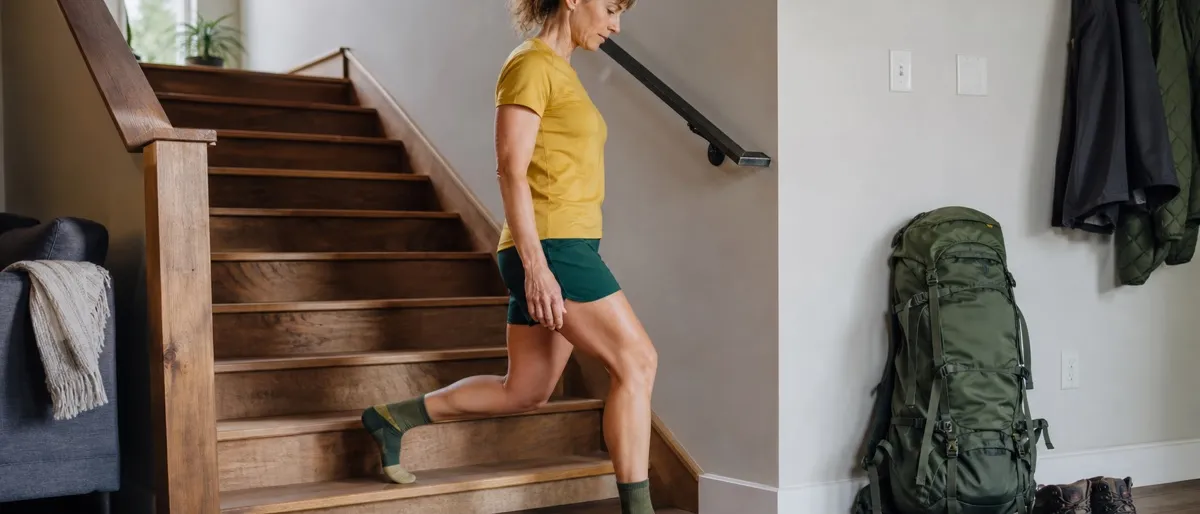
Home Workout for Hiking: Build Uphill and Downhill Capacity
Prepare for hiking at home with a six-week plan for uphill fitness, downhill control, single-leg strength, balance, and gradual pack practice.
A home workout for hiking should prepare four things: sustained uphill effort, controlled downhill steps, single-leg strength, and the ability to keep moving with the pack you plan to carry (downhill study; backpack load study; Physical Activity Guidelines). Two strength sessions and two conditioning sessions per week give you a workable six-week starting plan. If your hike is longer, steeper, or more technical than your current walks, add real outdoor walking before the trip. The living room can build capacity, but it cannot reproduce loose rock, heat, altitude, or hours on your feet.
That last boundary matters. A stair workout usually asks how to make climbing harder for cardiovascular fitness. Hiking preparation asks a wider question: can you climb, control the descent, manage uneven contacts, tolerate time under load, and still make good foot-placement decisions when tired? Stairs can help with one part of the answer. They are not the whole plan.
The descent needs its own preparation
Evidence sources: International Journal of Environmental Research and Public Health; PLOS One.
Uphill walking feels like the obvious problem because breathing and heart rate rise quickly. Downhill walking can feel easier aerobically while asking the quadriceps to brake the body on every step. Those repeated lengthening contractions are eccentric muscle actions. They are one reason an unprepared hiker may feel fine at the top and discover very different legs on the way down.
A 2023 laboratory study tested young, healthy adults before and after 30 minutes of treadmill walking at a 20-degree decline. After the descent, leg dexterity and front-to-back balance declined even though maximal leg-extension strength did not. The result suggests that downhill difficulty is not explained by simple strength loss alone; the control of foot-ground interactions can change after prolonged eccentric work (PMID 37048038).
A smaller crossover trial found that 30 minutes of downhill treadmill walking at a 5% decline produced more next-day soreness than uphill walking at a 5% incline in ten healthy young adults. The protocol was controlled and modest, so it does not predict how sore you will be after a mountain. It does show that ascent and descent are different training problems (PMID 29679309).
This changes the home plan. Step-ups and marching build the climbing side. Slow step-downs, controlled split squats, calf work, and balance practice build qualities that matter when you have to lower your body repeatedly. None of those exercises guarantees safe hiking or prevents injury. They simply give you a more complete preparation target than “do more stairs.”
What home training can and cannot reproduce
Evidence sources: Journal of Physiological Sciences; Sports Medicine International Open.
Home training is useful because it controls the variables. You can choose a stable step, use support, slow the lowering phase, and stop a set when technique changes. That makes it a good place to develop basic strength and movement control.
It cannot reproduce trail-specific exposure:
- irregular step height and changing surface grip;
- long continuous climbs and descents;
- navigation while physically tired;
- weather, heat, cold, or altitude;
- the exact fit and movement of a loaded pack;
- the psychological cost of knowing the car is still three hours away.
For a short, local hike on a maintained path, a home block plus ordinary walking may be enough. For a long day, substantial elevation, technical terrain, or a heavier pack, use home training as the foundation and outdoor practice as the test.
The U.S. Physical Activity Guidelines recommend aerobic activity each week and muscle-strengthening work on at least two days each week. That is a health framework rather than a hiking program, but it supports the two-part structure used here: conditioning for prolonged movement and strength for the major muscle groups (Physical Activity Guidelines).
The five jobs in a hiking workout
Evidence sources: Applied Ergonomics; Journal of Orthopaedic & Sports Physical Therapy.
Each exercise should earn its place by covering a job you will meet on the trail.
| Training job | Home options | Trail demand it approximates |
|---|---|---|
| Climb | Step-up, split squat, supported high-knee march | Raising the body and advancing one leg at a time |
| Brake | Low step-down, slow reverse lunge, tempo squat | Lowering the body under control during descent |
| Push through the ankle | Straight- and bent-knee calf raise | Repeated plantarflexor work on inclines and uneven steps |
| Stabilize | Single-leg balance, hip hinge, side plank | Controlling the trunk and stance leg while the other foot moves |
| Carry | Suitcase hold, march with the actual daypack | Maintaining posture and movement while loaded |
The table describes movement similarities, not proven one-to-one transfer. A step-down on a wooden box is predictable. A trail step may be sloped, wet, loose, or partially hidden. The exercise creates capacity. Trail practice teaches you how to use it in context.
Step height deserves restraint. A laboratory study of 20 healthy adults compared forward and lateral step-ups with forward step-downs, standardized at 45 degrees of knee flexion. Patellofemoral joint force and stress were higher during the forward step-down than during either step-up (PMID 21289449). That finding does not make step-downs dangerous. It means a low step, hand support, and gradual range are sensible when you introduce the movement, especially if the knee is already irritable.
Strength session A: climb and carry
Evidence sources: International Journal of Exercise Science; U.S. Department of Health and Human Services.
Perform this session once per week. During the first two weeks, use two working sets. Add a third set only if soreness is mild and the next conditioning session still feels normal.
| Exercise | Dose | What to watch |
|---|---|---|
| Step-up | 2-3 x 6-10 per side | Whole foot supported; stand without pushing off the floor leg |
| Split squat | 2-3 x 6-10 per side | Comfortable depth; stable front foot; controlled knee path |
| Single-leg calf raise | 3 x 8-15 per side | Full comfortable lowering and a clear pause at the top |
| Single-leg bridge | 2-3 x 8-15 per side | Hips stay level; stop before the lower back takes over |
| Daypack march | 3 x 45-90 seconds | Tall posture, quiet feet, normal breathing rhythm |
| Side plank | 2 x 20-40 seconds per side | Straight line without rotating toward the floor |
Choose a step that lets you control every repetition. A kitchen chair is usually too high and too easy to tip. Use the lowest stair, a purpose-built aerobic step, or a stable platform that cannot slide. If you have to launch from the back foot, the step is too high for the current goal.
The daypack march begins unloaded. Once the straps fit and the pack stays stable, add only gear you genuinely expect to carry. Water containers, a jacket, and normal hiking items distribute more realistically than one loose dumbbell bouncing at the bottom.
Pack studies support specificity but do not provide a universal recreational loading formula. In a 2018 field study, 20 young male pole walkers completed four walking conditions with and without poles and additional load. Oxygen use, heart rate, and energy expenditure changed across conditions, and poles did not reliably reduce perceived effort under load (PMID 30539128). The sample was narrow, and the result is not a reason to copy its load.
A 2026 crossover study reached a similar practical limit from a much heavier military context. Twelve soldiers completed 5 km marches carrying 30 kg in three pack systems. Objective outcomes did not differ significantly between packs, leading the authors to conclude that load weight affected physical and physiological cost more than the tested pack design (PMID 41548350). Recreational hikers should not train with 30 kg because soldiers did. Practice the actual load gradually instead of assuming a different backpack will erase it.
Strength session B: descent and control
Evidence sources: Journal of Strength and Conditioning Research; International Journal of Environmental Research and Public Health.
This session trains lowering strength without trying to imitate a mountain in one evening.
| Exercise | Dose | What to watch |
|---|---|---|
| Supported low step-down | 2-3 x 5-8 per side | Three-second lower; light heel touch; use a rail or wall |
| Reverse lunge | 2-3 x 6-10 per side | Lower smoothly; keep the stance foot planted |
| Single-leg hip hinge | 2-3 x 6-10 per side | Use fingertip support so balance does not end the set |
| Bent-knee calf raise | 3 x 10-20 per side | Keep the heel path controlled, not bouncing |
| Single-leg balance reach | 2 x 4-6 reaches per direction | Small reach with a stable stance foot |
| Dead bug | 2-3 x 5-8 per side | Move only as far as the trunk stays controlled |
The step-down is deliberately slow. Lowering for three seconds increases the time you spend controlling the descent without requiring a high platform. Progress by adding one repetition, then slightly increasing range. Add load only when the movement is quiet and repeatable.
Downhill exposure also shows a repeated-bout effect, but the evidence should be applied carefully. In a controlled study, 36 untrained young men were assigned to a five-minute downhill preconditioning bout, five minutes of level walking, or no preconditioning. One week later, all groups completed 40 minutes of steep downhill treadmill walking with a load equal to 10% of body mass. The earlier downhill bout attenuated later changes in strength, creatine kinase, and soreness by 47% to 64% compared with the other groups (PMID 28288187).
That study used a treadmill decline of 28%, a fixed speed, and young men. It does not prove that slow step-downs prevent injury or that five minutes prepares everyone for a trek. It does support a modest principle: a small, recoverable dose of eccentric work before a larger exposure can be more useful than arriving at the trail with no descent preparation at all.
Conditioning without turning this into a stair plan
Evidence sources: PLOS One; Journal of Physiological Sciences.
The conditioning goal is sustained movement at an effort you can repeat, plus short exposures to climbing effort. You do not need a stairwell. Marching, low step-ups, brisk walking around the home, and low-impact circuits can raise demand. If you have safe stairs, use them as one option.
A counterbalanced study of 21 healthy college-age adults compared 15-minute treadmill walks at their preferred speed on 0%, 4%, and 8% inclines. Cardiovascular, metabolic, and perceived responses changed across the gradients, with the steeper incline producing a different demand from level walking (PMID 36895797). The study does not establish an ideal hiking workout. It shows that grade changes the cost of walking.
Use two conditioning formats each week.
Steady session
Work for 20 to 40 minutes at a pace where you can speak in short sentences without gasping. Choose one:
- brisk outdoor walking if available;
- continuous low step-ups, changing the lead leg often;
- marching mixed with easy step-ups;
- a treadmill incline walk;
- stairs at a controlled pace, walking down slowly.
Start at the low end. Add five minutes when the session no longer affects the next day’s strength work. Do not make the pack heavier and extend the duration in the same week.
Hill-interval substitute
After five minutes of easy movement, alternate one minute of purposeful climbing work with two minutes easy. Repeat four to eight times. The work minute can be step-ups, stair ascent, or a low-impact march with strong arm drive. You should finish knowing you could complete another interval with the same technique.
For a dedicated stair progression, use the stair workout at home guide. In hiking preparation, climbing intervals are only one piece alongside eccentric control, balance, and load practice.
A six-week hiking preparation schedule
Evidence sources: Sports Medicine International Open; Applied Ergonomics.
The schedule assumes you already tolerate ordinary walking and have no current symptoms that change your gait. Move sessions to fit your week, but avoid placing the descent session immediately before your longest walk.
| Week | Strength | Conditioning | Pack practice |
|---|---|---|---|
| 1 | Sessions A and B, 2 sets | 20-minute steady; 4 intervals | Fit and march with empty pack |
| 2 | Same exercises, add reps | 25-minute steady; 5 intervals | Add light expected gear |
| 3 | Add a third set to first two exercises | 30-minute steady; 6 intervals | Use pack during part of steady session |
| 4 | Progress step height or range slightly | 30-35 minutes; 6-7 intervals | Practice planned daypack load briefly |
| 5 | Maintain strength; do not chase soreness | 35-40 minutes; 7-8 intervals | Longer walk with planned load if possible |
| 6 | Reduce strength sets by about one-third | One moderate session early in week | Short equipment check; no last-minute overload |
The final week is not the time to prove that the program worked. Fitness changes slowly; soreness can arrive overnight. Reduce volume, keep familiar movements, and save your longest effort for the hike.
If you have access to a trail, replace one steady session in weeks four or five with a shorter real hike that includes manageable elevation. Wear the footwear and pack you plan to use. That session gives you information a living-room workout cannot: hotspots, strap movement, pacing on actual grade, and how well you make decisions outside.
Progress the plan without guessing
Evidence sources: Journal of Orthopaedic & Sports Physical Therapy; International Journal of Exercise Science.
For strength exercises, use a rep range. Start with a variation that leaves two or three controlled repetitions available at the end of each set. Add repetitions until all sets reach the top of the range. Then increase range, choose a harder unilateral version, or add a small amount of external load.
For conditioning, progress one variable per week:
- duration;
- number of intervals;
- step height or incline;
- pack load;
- total elevation during outdoor practice.
Those variables are not interchangeable. Adding five minutes to a steady walk is different from adding pack weight or a steeper step. Record the change and watch how the next 24 to 48 hours feel.
The progressive overload at home guide explains how to advance bodyweight movements. Hiking adds a second ledger: the outdoor load. Strength progress does not give you permission to double elevation, distance, and pack weight in the same weekend.
Use checkpoints, not tests of toughness
Evidence sources: U.S. Department of Health and Human Services; Journal of Strength and Conditioning Research.
Recheck these markers at the end of weeks two and four:
- Can you complete ten controlled step-ups per side without pushing off the floor foot?
- Can you perform six low step-downs per side at a three-second tempo?
- Can you balance on each leg for 30 seconds near a support?
- Can you complete 30 minutes of steady conditioning without unusual next-day fatigue?
- Can you carry the planned daypack for a short walk without strap, foot, or back discomfort?
These are practice checks, not validated pass-fail standards for mountain safety. A person can pass all five and still be unprepared for altitude, exposure, navigation, weather, or technical terrain. Use them to find weak points in the plan, not to certify yourself.
Balance work belongs near a wall or sturdy support. Closing your eyes or standing on unstable cushions may make a drill harder, but harder is not always more useful. The 2023 downhill study found changes in dynamic control after descent; it did not show that unstable-surface tricks improve hiking outcomes (PMID 37048038).
Adjust for knees, calves, and current fitness
Evidence sources: International Journal of Environmental Research and Public Health; PLOS One.
Muscular effort is expected. Sharp pain, swelling, giving way, numbness, chest symptoms, dizziness, or pain that changes your walking pattern is not a cue to progress.
If step-downs irritate the front of the knee, lower the step, reduce the range, use support, or substitute a slow reverse lunge within a comfortable range. The step-task study found higher patellofemoral force and stress in forward step-downs than step-ups at the same standardized knee angle, which is why smaller exposure is the first adjustment (PMID 21289449).
If calves or Achilles tendons feel increasingly stiff after step-ups, remove one calf set and reduce interval volume. Do not add hopping as a shortcut. Hiking preparation does not require plyometrics for most recreational day hikes.
If you are starting from a low activity level, spend the first two weeks on ordinary walking, sit-to-stands, low step-ups, calf raises, and supported balance. The knee-friendly bodyweight workout guide offers lower-impact substitutions. A clinician or qualified professional should individualize the plan if you have recent surgery, recurrent falls, significant heart or lung disease, active joint symptoms, or a previous condition that limits walking.
The week before the hike
Evidence sources: Journal of Physiological Sciences; Sports Medicine International Open.
Keep the familiar movements and cut the work that creates soreness. One short strength session early in the week is enough. Walk easily, sleep, check the forecast, and inspect the equipment you will actually use.
Do not add a heavy pack test, a long stair session, or your first deep step-down workout three days before departure. Last-minute fatigue is not stored fitness.
For the hike itself, choose a route that matches your demonstrated capacity, not the best week you imagine having. Distance alone is a poor summary. Elevation, surface, pack load, temperature, altitude, daylight, and escape options all change the day.
The home plan has done its job when uphill effort feels familiar, lowering steps no longer surprises your quadriceps, the pack stays quiet, and you know what training dose you can recover from. It has not made the mountain predictable. That part still requires route judgment, appropriate equipment, and experience outside.
References
- Werner, I., Valero-Cuevas, F.J., & Federolf, P. (2023). “Mountain Hiking: Prolonged Eccentric Muscle Contraction during Simulated Downhill Walking Perturbs Sensorimotor Control Loops Needed for Safe Dynamic Foot-Ground Interactions.” International Journal of Environmental Research and Public Health, 20(7), 5424. PMID 37048038.
- Maeo, S., Yamamoto, M., Kanehisa, H., & Nosaka, K. (2017). “Prevention of downhill walking-induced muscle damage by non-damaging downhill walking.” PLOS One, 12(3), e0173909. PMID 28288187.
- Nakayama, A., Aoi, W., Takami, M., et al. (2019). “Effect of downhill walking on next-day muscle damage and glucose metabolism in healthy young subjects.” Journal of Physiological Sciences, 69(1), 31-38. PMID 29679309.
- Brito, J.P., Garrido, N., Romero, F., et al. (2018). “Effects of Backpack Load and Trekking Poles on Energy Expenditure During Field Track Walking.” Sports Medicine International Open, 2(4), E117-E122. PMID 30539128.
- Orr, R., Rousseau, J., Canetti, E.F.D., & Schram, B. (2026). “Soldier load carriage: Does the type of pack matter?” Applied Ergonomics, 134, 104733. PMID 41548350.
- Chinkulprasert, C., Vachalathiti, R., & Powers, C.M. (2011). “Patellofemoral joint forces and stress during forward step-up, lateral step-up, and forward step-down exercises.” Journal of Orthopaedic & Sports Physical Therapy, 41(4), 241-248. PMID 21289449.
- Magal, M., Fann, S.L., & Thomas, K.S. (2022). “Cardiovascular, Metabolic and Perceptual Responses to Preferred Walking Speed at Different Inclines and Post Exercise Postural Control in Healthy College Age Adults.” International Journal of Exercise Science, 15(2), 113-124. PMID 36895797.
- U.S. Department of Health and Human Services. (2018). Physical Activity Guidelines for Americans, 2nd edition. Current guidelines.