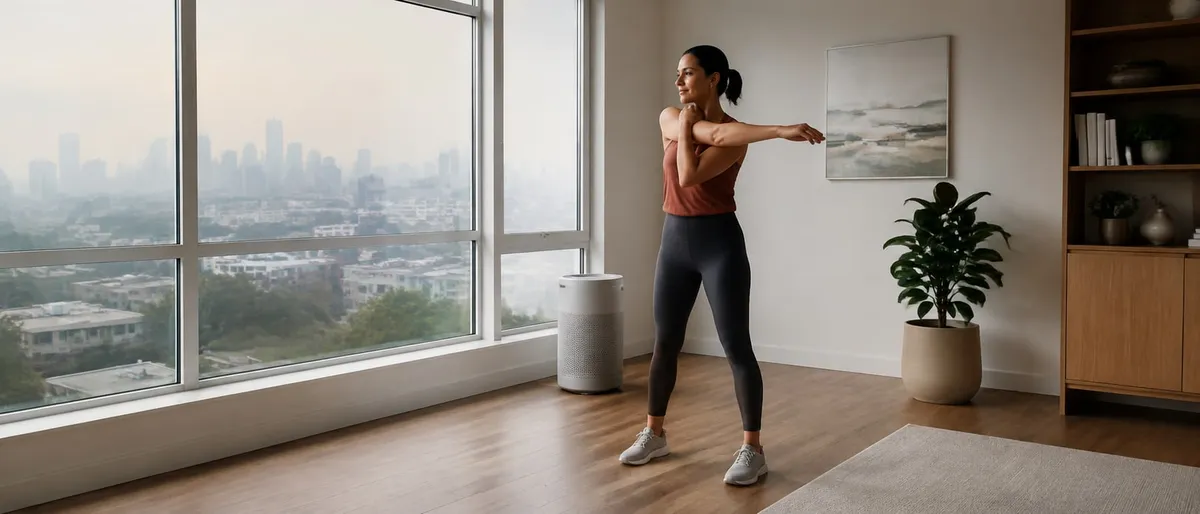
Home workouts when air quality is poor: check the room first
Decide whether to move, ease or postpone a home workout during smoke or pollution, with advice on indoor air, filtration and local alerts.
Home workouts during poor air quality start with a question about the room: is the air you will breathe actually better there? Moving your exercise mat inside changes the location. It does not, by itself, establish that the new space is suitable for a workout.
Wildfire smoke can enter a home and affect indoor air. EPA recommends steps to reduce that exposure, including appropriate filtration and attention to how outside air enters the building. EPA indoor-air guidance
The practical options are to choose a cleaner place, change the timing, reduce the planned exertion when appropriate, or postpone. Which option makes sense depends on current local advice, conditions inside and your own health circumstances. You do not need to rescue every scheduled workout. You do need a reason to believe the place you choose is appropriate.
Read the local advice before choosing the workout
Check an official air-quality service for your location and read its accompanying health message. Note when it was updated, which area it covers and whether an emergency instruction applies. An old screenshot from a friend is not a substitute for today’s local report.
The US Air Quality Index has categories linked to levels of health concern. AirNow labels 101–150 as Unhealthy for Sensitive Groups and 151–200 as Unhealthy. These are US index categories, not indoor exercise thresholds or numbers to transfer unchanged into another country’s system. AirNow AQI basics
The UK’s Daily Air Quality Index instead presents low, moderate, high and very high bands with associated advice. Its current guidance distinguishes the general public from people who may be more sensitive, including those with heart or lung conditions. UK DAQI health advice
If you are traveling, start with the local service’s explanation. Do not interpret a color by memory from an app you used elsewhere. Ask what the category means on that service, then follow the relevant message. Check the index name and location before interpreting the number.
For US particle pollution, AirNow’s activity guide scales advice by the pollution category and the population. It includes options such as shorter or less intense outdoor activity, rescheduling and moving indoors, depending on conditions. The particle-pollution activity guide
Treat an instruction to move indoors as the start of the room check. It is not permission to do the hardest available circuit in any enclosed space. Likewise, advice to reduce outdoor exertion does not tell you what a particular apartment’s air is like. Keep the outdoor advisory and the indoor decision connected without pretending they are the same measurement.
Indoors is a location, not an air-quality result
Imagine two possible workout spaces: a bedroom where the windows have stayed closed during smoke, and a room where an open window faces the haze. The word “indoors” describes both. Before comparing workouts, check the conditions and the pollution controls in the actual space you would use.
WHO says staying indoors can reduce pollution exposure provided indoor pollutant levels remain low. Its evidence summary also notes limited evidence for some indoor exercise settings and susceptible populations. A general statement about the benefits of activity is therefore not a guarantee for a smoky living room. WHO’s evidence summary
Look for avoidable sources around the workout area. Are people smoking? Is someone frying food beside an open-plan exercise space? Could a planned cleaning job wait? You are choosing a place to spend time and breathe more heavily, not merely finding enough floor space for a mat.
AirNow recommends avoiding activities that add indoor pollution during smoke events, including frying and vacuuming. Its smoke guidance combines reducing indoor sources with keeping the space cool and using filtration where available. AirNow smoke advice
Make a simple household agreement before starting. For example, use the selected room after cooking rather than beside the stove, and avoid opening its window just because you usually like a breeze during exercise. These are examples of applying the guidance, not a claim that waiting a set number of minutes will clear the air. This article cannot supply a universal clearance time.
If you cannot establish a suitable space, leave the exercise decision open. You can postpone while you check alternatives. Wanting to keep a streak is not evidence that the room is suitable. It is more useful to identify what remains unknown: incoming smoke, indoor sources, heat, or the availability of a cleaner location.
Prepare a cleaner room without creating a heat problem
During wildfire smoke, EPA describes a cleaner room as a space intended to keep smoke particles low, with doors and windows closed, indoor particle sources avoided and suitable air cleaning where available. Exits must remain usable. EPA cleaner-room guidance
EPA also advises avoiding exercise while in a wildfire clean room, to reduce exposure to particles that may still enter. Filtration does not turn this shelter space into an exercise room. EPA’s clean-room activity restriction
Choose the room for people first. It should be somewhere the household can occupy comfortably, with access to what you need and a clear way out. Postpone the workout while sheltering there. The possibility of activity in another appropriate environment later in this guide does not override this restriction. A smoke plan is not primarily a gym layout.
EPA advises learning how your own air-conditioning or ventilation system brings in outdoor air. Options and limitations differ among central systems, window units and portable air conditioners. Do not assume that every device labeled air conditioner provides the same smoke protection. EPA’s equipment guidance
Check the instructions for the system you have. If you rent, ask the landlord or building manager how it operates; do not alter shared equipment on guesswork. Write down the relevant setting when you learn it, so the next smoke alert does not require another search through an unfamiliar control panel. Use professional help where the equipment requires it.
Keeping smoke out must not leave you in an excessively hot room. EPA advises seeking shelter elsewhere if you cannot stay cool, power is lost or too much smoke is entering the home. EPA’s guidance on alternative shelter
Our hot-weather home workout guide addresses heat-related changes to a session. When heat and smoke occur together, avoid taking a cooling suggestion out of that context: opening a window is not automatically helpful if the incoming air is polluted. If the room cannot meet both needs, finding a better environment takes priority over modifying repetitions.
Understand what a filter can and cannot do
An air cleaner can help improve conditions. It cannot certify that a workout is safe. Start with the pollutant problem and the space. A small device beside a large open-plan room does not answer the same question as a suitable unit operating in the room it was selected to serve.
EPA explains that portable air cleaners and HVAC filters can reduce indoor pollution, but cannot remove every pollutant. Particle removal and gas removal are different tasks, and ozone-producing cleaners should be avoided because ozone irritates the lungs. EPA’s home air-cleaner guide
For wildfire smoke, EPA recommends a portable cleaner sized for the room and one that does not generate ozone. Its cleaner-room advice recommends continuous operation at the highest fan setting you can use. EPA cleaner-room filtration advice
Follow the device’s placement and maintenance instructions. Keep the air inlet and outlet clear, route the power cord outside your exercise area, and avoid moving furniture against the unit to make room for a lunge. The safest layout for movement is not useful if you have blocked the equipment you meant to rely on.
Consider whether the setup is practical for the time you will occupy the room. Can you tolerate the fan setting? Is a replacement filter available? Can the room stay comfortably cool? If the answer is no, that is information for your plan, not a reason to assume the unit’s quietest or least maintained setting offers the same result.
WHO’s European report evaluates personal exposure-reduction measures alongside costs and social factors. It notes that much of the underlying evidence comes from western Europe and North America, so feasibility needs consideration in the local setting. WHO’s personal-actions report
You do not need to buy equipment to prove you care about exercise. If an appropriate cleaner is unavailable, look for local cleaner-air spaces or a suitable place with family or friends when advised. Postponing a workout is also an option. This guide does not recommend a brand, a homemade electrical assembly or a product that claims to neutralize all pollution.
Match the action to the pollutant
The US AQI covers several pollutants, including ground-level ozone and particle pollution. Those names describe different air-quality problems; do not assume a smoke-specific action addresses every alert. AirNow’s pollutant explanation
The cleaner-room instructions here concern wildfire smoke. If today’s warning concerns another pollutant or an industrial incident, read the relevant local instructions rather than copying a wildfire checklist without checking. For example, seeing a particle filter on a device tells you about its intended particle-removal function, not whether the room is protected against an unspecified gas. EPA’s distinction between particle and gas removal is the reason to ask that question. EPA air-cleaner guidance
If you are considering a shared indoor facility, ask concrete questions before traveling: is it operating as a cleaner-air space during this event, what guidance is it following, and are there changes to planned activities? Do not assume that a venue’s normal exercise schedule means someone has assessed today’s event. The staff may be able to explain their arrangements, or they may direct you to the public authority responsible for the advisory. Either answer is more useful than judging the building from a photograph.
Treat indoor sensors as partial information
A monitor can help you ask a more precise question, but first read what it measures. A display labeled air quality may combine several readings, show a manufacturer’s category or report only one pollutant. Read the explanation in the documentation before relying on the screen label.
EPA cautions that low-cost monitors only detect the pollutants or environmental factors they are designed to measure. They do not give a complete picture of indoor air quality, and their readings alone cannot establish an individual’s health risk. EPA’s indoor-monitor guidance
Suppose a particle reading falls after you change a setting on an air cleaner. Record exactly that observation. Avoid expanding it to “all the air is safe” or “hard exercise is now cleared.” If the device measures particles, the information is about that measurement. It cannot answer every question about gases, the room’s temperature or your symptoms.
Outdoor AQI information serves a different purpose. AirNow’s index reports outdoor pollution categories and associated health concern; it does not measure your particular indoor exercise position. AirNow’s index explanation
When readings seem inconsistent, check the basics before deciding one must be wrong. Confirm the location, update time, pollutant and index used. Follow the manufacturer’s placement directions. Do not set a monitor directly in an air cleaner’s outlet simply to obtain the most reassuring display. You want information relevant to the occupied space.
EPA also distinguishes consumer air-quality monitors from certified carbon-monoxide alarms and smoke detectors. A consumer monitor is not a replacement for those emergency warning devices. EPA’s explanation of monitor limitations
Keep that distinction in your plan. Respond to an emergency alarm according to the device and local emergency instructions; do not wait for an app to confirm it. If there is disagreement or uncertainty that you cannot resolve, the workout can wait while you deal with the room. An exercise timer has no role in deciding how seriously to take an alarm.
Choose between moving, easing and postponing
WHO supports regular physical activity while advising people to adapt its timing and location to reduce pollution exposure. That long-term message should not be read as an instruction to finish every planned session during an acute pollution event. WHO’s activity guidance
Use the following worksheet to organize the decision. It is an editorial checklist, not a validated medical score or an AQI-based exercise prescription. Start at the top rather than choosing the option that preserves the most exercise.
-
Situation: Evacuation instruction, emergency alarm or immediate danger
Decision to consider: Stop planning exercise and follow emergency instructions
What must be checked: The local instruction and a way to leave safely
-
Situation: Home is smoky, too hot or cannot be kept suitable
Decision to consider: Postpone; identify a more appropriate place when needed
What must be checked: Current local advice and availability of cleaner, cooler shelter
-
Situation: Sheltering in a wildfire clean room
Decision to consider: Avoid exercise there, including an easier replacement session
What must be checked: EPA’s clean-room restriction still applies with filtration
-
Situation: Another suitable indoor space is available and activity fits current guidance
Decision to consider: Consider familiar activity, with effort appropriate to your circumstances
What must be checked: Room conditions, symptoms and any personal care plan; this excludes exercising in a wildfire clean room
-
Situation: A cleaner time or location is expected later
Decision to consider: Reschedule and reassess before starting
What must be checked: A fresh update rather than the earlier forecast alone
AirNow advises taking it easier when smoke is present and reducing or rescheduling outdoor exercise to limit smoke inhalation. When using an indoor alternative, it also calls for keeping the air cool and clean. AirNow’s smoke recommendations
For a general adult who has another suitable environment and no reason to avoid activity under local advice, an easier familiar session may be a practical option. This does not apply while sheltering in a wildfire clean room. That could mean choosing comfortable movement practice instead of a demanding interval block. It is an example of reducing the task, not evidence that gentle exercise makes a polluted room acceptable. The room decision comes first.
If you use perceived effort, our RPE guide for home workouts explains the training scale. RPE describes how demanding exercise feels; do not use it as a pollution detector. Being able to complete a movement does not measure the air you are inhaling.
Make postponement specific enough to be useful: “I will check the official update before deciding about tomorrow’s session.” You need not promise a double workout to compensate. Your next decision should use the conditions then, not the frustration of today’s interruption. Keep the planned routine saved and move on to what your household needs now.
Symptoms and personal guidance outrank a reassuring display
AirNow identifies people with heart or lung disease, older adults and children among those needing particular attention during smoke exposure. Its health guidance advises discussing protective decisions with a clinician when those circumstances apply. This general adult article does not replace such advice. AirNow fires and health
If symptoms appear, stop the session and address them instead of adjusting the exercise until the warning feels tolerable. You do not need to decide whether pollution, exertion or something else caused the problem before stopping. Stop first; leave the diagnosis to a healthcare professional.
The UK’s current pollution guidance advises contacting a doctor or nurse for new or worsening symptoms and following an agreed management plan for an existing condition. It notes that symptoms may appear after exposure rather than immediately. UK pollution health advice
If you already have an asthma or other care plan, follow it and your clinician’s advice. Do not change medication to make a workout fit the day, and do not use this article to design breathing treatment. Ask about the practical issue you face: which symptoms should stop activity, where to get help and what the plan means during a smoke episode.
An active nearby fire is a separate emergency from choosing exercise intensity. EPA warns that conditions can change quickly and emphasizes following local evacuation information. Staying in a designated cleaner room does not override an instruction to leave. EPA wildfire guidance
A useful next step
Before the next alert, save your official local air-quality source and identify who can answer questions about your building’s ventilation. Decide which room or alternative place you would consider, and keep the relevant instructions accessible. If you choose a RazFit session later, choose it after the environment check; the app selection does not settle the air-quality question.
Limits of this guide
This is general guidance for adult home-exercise decisions, with US smoke resources and a clearly identified UK index example. Local advice, evacuation instructions and personal clinical guidance take priority. The goal is to reduce avoidable exposure while making room for activity when circumstances allow, without inventing a universal indoor cutoff or promising that filtration eliminates risk.
Frequently Asked Questions
5 questions answered
01
Is exercising indoors always safer during wildfire smoke?
Moving indoors may reduce exposure if the indoor air is cleaner, but smoke can enter buildings. Check local advice, conditions inside and the steps available to reduce smoke. If the room remains smoky or too hot, postpone exercise and seek a more suitable place when needed.
02
Can I use the outdoor AQI as my indoor workout limit?
An outdoor AQI report does not measure the air in your room. Use its local health advice, then assess the indoor space separately. Index categories also differ by jurisdiction, so read the explanation attached to the service you are using.
03
Will an air purifier make a hard workout safe?
A suitable air cleaner can reduce some pollutants, but it cannot remove every pollutant or certify that a workout is safe. Room size, operation and incoming pollution matter. Do not treat owning a purifier as a reason to ignore symptoms or official advice.
04
Should I open the windows to cool down while smoke is outside?
During wildfire smoke, official guidance recommends keeping smoke out, but a closed room must also remain cool enough to occupy. If you cannot keep it cool and cleaner, seek a suitable alternative rather than training in either smoke or excessive heat.
05
Can gentle exercise replace my planned intervals on a polluted day?
It may be an option in an appropriate environment when local guidance and your health circumstances allow activity. EPA advises avoiding exercise in a wildfire clean room, even with filtration. Reducing effort does not make polluted air safe. If the space is unsuitable or you develop symptoms, stop or postpone the session.
References
Sources
Expert perspective
The WHO report prepared by Rojas-Rueda considers when and where activity takes place alongside the practical costs and feasibility of reducing pollution exposure.
David Rojas-Rueda · Author of the WHO European Region report · Colorado State University, affiliation in the report · Source: https://www.who.int/europe/publications/i/item/WHO-EURO-2024-9115-48887-72806