Dryland Strength for Swimmers at Home: Support Your Swimming
Build a manageable dryland strength session for swimmers at home, with simple exercises, pool scheduling and clear limits on performance claims.
Dryland strength for swimmers at home can be a small part of your swimming week: a few controlled exercises for the legs, upper body and trunk, chosen around what you can do comfortably. Keep pool practice in the plan. A floor exercise may resemble a swimming position without teaching you to breathe, balance or move through water. Swim England describes dryland training as activity on land that complements aquatic participation and says many exercises can be done at home with bodyweight or simple equipment. Its practical guidance is a useful starting point, not a promise of a faster length.
Start by choosing a modest job for the session. Perhaps you want to learn a controlled squat, make a comfortable push-up variation more demanding over time, or keep your trunk steady while moving an arm. Those are observable land tasks. Whether they improve a particular swim outcome needs a separate answer.
This guide is for generally healthy adult swimmers who want a manageable home complement. It is not a shoulder rehabilitation plan, a youth competition program or a substitute for swimming lessons. The sample session is an editorial example informed by Swim England’s practical guidance. Its exercises and counts have not been tested together as a way to reduce race times.
Decide what belongs on land and what belongs in the pool
The word dryland covers a wide range of work, from a gentle preparation routine to heavy lifting and supervised jumps. Putting the same label on two sessions does not make their demands equivalent. Before choosing an exercise, decide whether today is a short rehearsal of movement, a strength session you can progress, or preparation for a coached swimming practice.
Fone and van den Tillaar’s review found no clear consensus that one broad form of strength training was best for swimming performance. Their 2022 systematic review supports a cautious reading of the word specific. A movement does not become a better choice merely because it looks like a stroke.
The home session can use familiar movements. You can bend and straighten your legs, push against a stable surface and practice controlling your trunk. You do not need to lie across furniture and imitate a freestyle pull with a weight. Nor do you need to invent a breath-holding challenge so that a floor exercise feels aquatic. Breathe normally during the land work.
The same review studied competitive swimmers and excluded Masters swimmers and non-swimmers. Its inclusion criteria matter to an adult learning front crawl after work. The research does not directly establish the result of that adult’s first home session.
There is also a difference between getting stronger in an exercise and swimming faster. In a 2024 meta-analysis, the dry-land resistance subgroup improved maximal upper-body strength without a significant improvement in swimming performance. Jin and colleagues analyzed competitive swimmers; the finding is not proof that land training is useless. It shows why an exercise result and a pool result should be recorded separately.
Write one sentence before starting: “Today I will practice these movements and leave enough energy for my next swim.” If a swimming coach has already given you land work, use that plan as the starting point. Bring this article’s questions to the coach rather than adding another full session on top.
Separate starts, turns and the swimming between them
A faster race can involve several different changes. Leaving a starting block, pushing away from a wall and maintaining speed between walls are distinct tasks. A study of one part should not quietly become a claim about all three.
Fone and van den Tillaar excluded studies focused on starts and turns from their review. That boundary is explicit in the methods. You cannot use its overall conclusion as direct evidence that a living-room squat will improve a diving start.
For turns, there is a separate body of work. A review of six studies found promising results for some strength, ballistic and plyometric programs, while the evidence for core training and turn performance was inconclusive. Hermosilla and colleagues examined swimming turns, not this home session. Their findings do not establish that holding a longer plank produces a faster push-off.
When someone recommends an exercise for swimmers, ask what outcome supports the recommendation:
-
Proposed benefit: A better start
What you would need to know: Was the start itself measured, and under which conditions?
-
Proposed benefit: A faster turn
What you would need to know: Was the outcome a turn measure or simply a dryland jump?
-
Proposed benefit: Faster swimming between walls
What you would need to know: Which stroke, distance, population and training method were studied?
-
Proposed benefit: Better control during a land exercise
What you would need to know: Can you repeat the same movement with a suitable range and resistance?
You can answer the last question at home. The first three usually require a clearly defined pool task and appropriate observation. A change in a whole-length time can include the wall push-off, breathing choices and pacing; it does not tell you which part changed by itself.
The 2024 analysis covered front-crawl performance, and its authors cautioned against transferring the findings to other strokes. That limitation is relevant if you mostly swim breaststroke or are learning backstroke. Keep the land session general unless you have a specific, assessed reason to do something different.
For the home version below, leave out diving practice, explosive wall simulations and fast jumps from furniture. These activities are unnecessary for learning the listed movements. Work on your actual start or turn with suitable pool instruction and facilities.
Choose upper-body work you can control comfortably
Begin with a simple check: can you place your hands on a wall and make a small, comfortable pressing movement? If so, a wall push-up gives you an easy way to rehearse the action. Stand facing the wall, place your palms around chest height, and step back enough to allow a modest bend at the elbows. Bring your body toward the wall, then press away without rushing.
Keep the body moving as a unit rather than letting the head reach the wall first. Use a shorter distance if the attempt feels awkward. The first version does not need to tire you out. You are choosing a movement you can recognize and repeat.
Swim England’s exercise gallery includes both kneeling and standard push-up options. The gallery illustrates different levels; the wall version here is a gentler editorial starting option, not an exact copy of its program. A stable fixed countertop can be another step between wall and floor if you can verify that it will support the load and will not move.
Stop the set if pressing causes shoulder pain. Do not assume that discomfort means the rotator cuff needs to be strengthened harder. NHS shoulder-pain advice says to avoid activities that make the problem worse and not to invent strenuous exercises for a painful shoulder. That guidance is different from a general exercise progression.
Pulling needs its own arrangement. If you already have a resistance band and a purpose-built anchor installed for the intended pull, use a familiar row taught for that equipment. Check the band and anchor before each use. Without an appropriate setup, do not hang from a table or secure a towel to a door handle. A few unresisted arm movements do not replace a progressively loaded pull.
Our push-pull balance guide discusses that equipment gap. For this starter session, it is acceptable to leave the row out until you have a suitable option. The checklist should tell you what is missing rather than disguise a shoulder squeeze as the same exercise.
Swim England recommends learning exercise technique before increasing difficulty. Apply that advice to both pushing and pulling. Increase the challenge only when the setup and movement remain comfortable. You do not need to add explosive push-ups because a competition swimmer uses them in a different program.
Give the legs and trunk a clear task
For the legs, start with a comfortable squat toward a stable chair. Stand in front of the chair with enough space to sit normally. Bend at the hips and knees, sit under control if needed, and stand again. Keep the feet planted. Choose the seat and range for your current ability rather than trying to reach a depth from a photograph.
The chair is a height reference or a place to sit, not a step for jumping. Put it where it cannot slide away. If you already squat comfortably without sitting, keep the chair behind you as a reference and stop at a manageable depth.
The Swim England gallery includes bodyweight squats alongside upper-body and trunk exercises. Its exercise selection supports considering more than the arms, but it does not prove that the chair version changes your wall push-off. Keep the home result modest: you are learning to lower and rise deliberately.
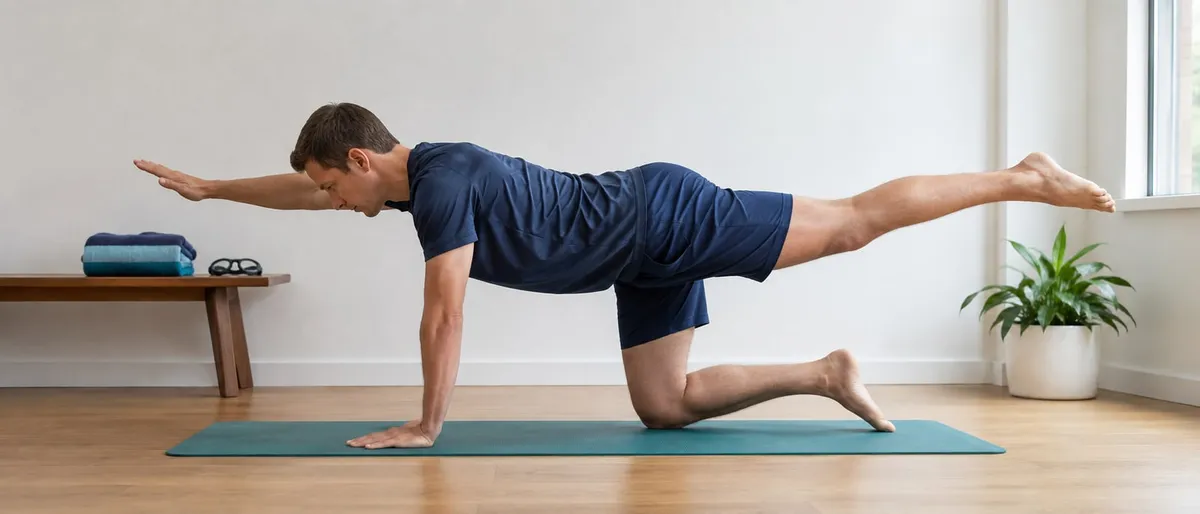
For the trunk, use a four-point position on a comfortable mat, with hands under the shoulders and knees under the hips. Begin by keeping both knees and one hand down while you slide or reach the other hand a small distance forward. Return it before changing sides. You should be able to breathe without twisting to complete the reach.
If that is comfortable, you can try a small opposite arm-and-leg reach, often called a bird-dog. Move slowly, keep the reach short, and return both limbs before switching. You are not trying to lift the leg as high as possible or create a large arch through the back. If the supporting wrist or shoulder hurts, stop the floor version rather than pushing through it.
The hero image shows a long reach. You do not need to match it. A hand slide with both knees down can be the entire task for an introductory session. An alternative is to lie on your back with knees bent and slowly slide one heel away, then bring it back, while keeping the trunk comfortable. Choose one version rather than doing every alternative.
Swim England includes a four-point arm-reach exercise that asks the swimmer to keep the pelvis and back steady. Its example is a practical reference for the simpler reach. The opposite-limb and heel-slide options here are editorial alternatives; none is presented as a tested substitute for swimming.
The turn review did not establish a clear benefit of core training for swimming turns. Keep that uncertainty beside the exercise description. A more controlled bird-dog is an observable improvement in a bird-dog. It does not show that you will hold a better body line in the water without practicing and assessing that task too.
Assemble a first session without turning it into a race
Choose a time when you can work on a dry, clear floor and are not rushing to leave for the pool. Walk around comfortably and rehearse each movement through a small range. Put the instructions where you can read them between attempts. You do not need to keep moving while deciding what comes next.
The list is a starter example for learning the exercises. Its counts are not a validated dose for swimming performance. A 2026 review of developmental competitive swimmers explicitly warned that its exploratory dose-response findings should not be treated as fixed prescriptions or thresholds. Mou and colleagues studied training programs in competitive development pathways, not an adult’s first home workout.
-
Movement: Chair squat or comfortable squat
Conservative first attempt: One set of 6–8 repetitions
What to keep consistent: Same seat or depth, feet planted
-
Movement: Wall push-up
Conservative first attempt: One set of 6–8 repetitions
What to keep consistent: Same hand height and distance from the wall
-
Movement: Four-point arm reach or heel slide
Conservative first attempt: One set of 4–6 each side
What to keep consistent: Short reach, comfortable trunk, normal breathing
-
Movement: Familiar row, only with a verified setup
Conservative first attempt: One easy set using the equipment’s taught technique
What to keep consistent: Secure anchor and controlled return
Take enough time between exercises to stand or change position comfortably and regain your ordinary breathing. Finish a set before the final repetitions become a different movement. You should not need to force the listed minimum when fewer repetitions give you a useful rehearsal.
Once you know how the first set feels, you may repeat a comfortable movement for a second set. You can also finish after one. The point of the first session is to choose versions you can perform and identify anything that needs instruction, equipment or a different starting position.
Swim England’s dryland guidance permits simple home equipment and emphasizes technique before difficulty. That advice does not require a continuous circuit. A rest between the squat and the press is part of organizing the session, not something to erase to make it feel more athletic.
If you use RazFit to organize separate home exercise, keep this introductory work easy to pause. Do not let a timer make you hurry through an unfamiliar floor transition. Count the work as part of your actual week instead of treating it as an invisible extra because it was short.
Fit the land session around the swim you want to learn from
Start with the swimming calendar. Mark the session that matters most: a coached lesson, a technique practice, a longer swim or a competition. Then decide where a new land session leaves room to observe your response. You do not need an exact number of recovery hours supplied by an article to avoid introducing unfamiliar work immediately before a priority session.
A practical first arrangement is one modest land session on a day when you can pay attention, followed by a check at the next ordinary swim. If you already strength-train, replace part of the existing session with the selected work rather than automatically adding another day. This is planning advice, not a swimming-specific frequency prescription.
The 2024 analysis distinguishes dry-land-only training from concurrent programs that also changed resistance work in the water. That distinction prevents a common misunderstanding: the outcome of a combined program cannot be attributed to a short floor routine alone.
Use different responses for different weeks:
- During a week of new swimming skills, keep the land movements familiar and modest.
- Before an important timed swim, avoid using the home session to test a new variation or your maximum repetitions.
- During a week with less swimming, use the extra time to learn equipment or technique rather than assuming all missed lengths must be replaced by land exercise.
- When your coach changes the pool load, review the extra home work before progressing both together.
If the next swim feels unusually awkward, write down what changed. It may be the new land work, the pool session itself or something else in your week. One experience cannot establish the cause. Reduce or postpone the newest addition if needed, then discuss a repeated problem with your coach or an appropriate professional.
Fone and van den Tillaar caution that dryland strength should not be construed as replacing specific swimming practice. Their conclusion gives the scheduling decision its boundary. Preserving time for instruction and actual swimming matters more than completing a land checklist.
Keep two records when you judge progress
Use one record for land work and another for swimming. In the first, write the exercise, setup, repetitions and one note about control. In the second, record the swim task you actually performed: stroke, distance, whether you started from the wall and what you were trying to practice. Write the details you will need to compare the same task later.
A useful land note might read: “Eight wall push-ups at the same distance, comfortable throughout.” A useful pool note might read: “Practiced side breathing with the coach; no timed test.” Neither needs to become a percentage improvement.
When the land exercise becomes comfortably repeatable, choose one change. You might add a repetition, make a small increase in range or use a more demanding variation that you have learned properly. Keep the other details stable. If a band is involved, record which band and setup you used; color alone is not a universal resistance measure.
The 2026 review found that support for training effects varied by modality and outcome, and its dose analyses were exploratory. That finding favors modest conclusions. Your log can show that the chosen exercise progressed; it cannot identify an ideal dose for every swimmer.
For a visual check, record a few normal repetitions from a fixed position and review them afterward. Use our home-workout form-check guide to organize the observation. Do not estimate swimming propulsion from a land video or diagnose a shoulder condition from how the movement looks.
Jin and colleagues note that small numbers of studies and differences in age and training experience limit how broadly their findings can be applied. Their limitations section is a reason to avoid promising a specific time gain from this session. It is also a reason to ask better questions: what did you practice, what changed, and was that change useful for your current goal?
Start with one manageable complement
Choose a squat, a comfortable press and one trunk exercise. Add a suitable pull when the equipment and instruction are available. Keep the first session short enough to learn from, and leave swimming as the place where you develop swimming skills. Progress the land work when it fits your week and the movements remain comfortable.
When shoulder symptoms need a different plan
This guide does not treat swimmer’s shoulder or identify the cause of pain. The NHS recommends assessment when shoulder pain worsens, fails to improve after two weeks or makes moving the arm very difficult. Its shoulder-pain page also advises urgent help for symptoms such as sudden severe pain or inability to move the arm. Use the appropriate local service; NHS pathways describe care in the UK. Stop the aggravating exercise and get advice suited to your circumstances rather than adding more repetitions to solve the symptom.
Frequently Asked Questions
5 questions answered
01
What is dryland strength training for swimmers?
It is strength work done out of the water as a complement to swimming. A home starting session can include a comfortable squat, press and trunk exercise, with a suitable pulling option when equipment is available. It does not replace swimming instruction or establish a faster race time.
02
Should home exercises imitate my swimming stroke?
They do not have to. Looking like a stroke does not prove that an exercise is the best choice. Select a movement for a clear land-training task and learn it properly. Breathing, body position and movement through water still need practice in the pool.
03
Can bird-dogs or planks improve my turns?
A more controlled land exercise is an improvement in that task. The cited review of turn training found inconclusive evidence for core programs and turn performance. This article does not establish that bird-dogs or longer planks improve your wall push-off.
04
How often should I do the starter session?
Begin with one modest session where it fits your current week, then review your response and existing training with your coach if you have one. That is an editorial starting option, not a research-based optimum. The cited research does not validate this exact exercise menu or dose.
05
Should I train through shoulder pain?
Do not use this general plan to work through a painful shoulder. Avoid the aggravating exercise and seek suitable advice if symptoms worsen, persist or make movement difficult. Sudden severe pain or inability to move the arm needs urgent assessment through the appropriate local service.
References
Sources
Expert perspective
Jin and colleagues emphasize that resistance-training methodology affects results and that their front-crawl findings should not be transferred to other strokes.
Guoli Jin · Lead review author and sport science researcher · Quanzhou Normal University at the time of publication · Source: https://www.frontiersin.org/journals/physiology/articles/10.3389/fphys.2024.1406518/full