Grip strength training at home: choose the task and resistance
Learn crushing, pinch and support grip at home. Choose suitable resistance, understand towel practice and track progress without confusing different tests.
Grip strength training at home starts with a more useful question than how hard you can squeeze: which task do you want your hand to perform? Closing a gripper, holding a shopping bag and keeping a thin object between finger and thumb are different tasks. A plan becomes easier to follow when you choose one of them and record what provides the resistance.
Specific hand training can improve measured grip strength, but evidence from a program using rubber balls and hand grippers does not establish the same result for an unloaded towel drill. A randomized trial in older women makes that distinction particularly relevant. You can start with simple practice at home while being honest about what it measures and when you will need a more adjustable resistance source.
This guide is for generally healthy adults choosing grip exercises, rather than treating hand or wrist symptoms. It gives you a way to identify the task, set up a modest first session and compare like with like. You do not need an elaborate forearm circuit. You do need to know whether you are practicing pressure, resisting an external load or measuring a change in force.
Name the grip task before choosing exercises
A practical coaching classification separates crushing grip, with the fingers closing toward the palm; pinching grip, with fingers opposing the thumb; and supporting grip, which maintains a hold on a load. Jace Derwin’s NSCA coaching article uses these three categories. They are useful labels for exercise selection, not three independent scores that one household test can reveal.
Think about the action you want to improve. If a familiar exercise ends because you cannot keep hold of its handle, write down the implement and how your hand is positioned. If your interest is squeezing a gripper, record its model and setting. If you want to practice pinch, specify what sits between your fingers and thumb. “Stronger hands” can remain your overall aim, but the training note needs something more concrete.
-
Grip task: Crushing
What your hand does: Closes around an object
What to record: Object, resistance setting and closure reached
-
Grip task: Pinching
What your hand does: Holds an object between fingers and thumb
What to record: Width, contact points and resistance
-
Grip task: Supporting
What your hand does: Keeps hold of an external load
What to record: Load, handle, hold time and stopping point
-
Grip task: Unloaded practice
What your hand does: Rehearses a shape or controlled squeeze
What to record: The movement practiced; no invented force value
Grip force and pinch force are assessed separately in hand research, using measurements matched to the task. The hand-focused training review distinguishes those outcomes. A better score in a whole-hand squeeze should therefore not be reported as a measured improvement in pinch unless pinch was actually tested.
The distinction also keeps your expectations sensible. A pinch exercise does not need to feel like a heavy carry to have a clearly defined purpose. Conversely, finding a small object awkward to hold does not tell you how much force you can exert on a dynamometer. Awkwardness, coordination and force are different observations; write down the one you actually made.
For someone following an existing strength program, start with its actual demands. You may already hold resistance during rows, carries or other loaded movements. Count that work when deciding whether additional gripping belongs in the session. If your program uses only open-floor bodyweight exercises, do not assume it includes a progressively loaded support-grip task simply because your hands touch the floor.
What the training evidence can and cannot promise
In a randomized study of 36 healthy women older than 65, the training group completed eight weeks of hand-specific work with rubber balls and hand grippers, twice each week. Gerodimos and colleagues compared that group with a control group. The training sessions lasted 10–15 minutes and included prescribed sets and repetitions. That is a defined intervention, rather than evidence for any object squeezed whenever you remember.
The training group improved maximal handgrip strength and measures of repeated-grip endurance in both hands. The trial’s reported outcomes support the possibility of improvement with targeted training. They do not provide a personal percentage forecast for a younger adult, a person with hand pain or someone using a different exercise. Keep the participants and equipment attached to the result.
Broader research does not erase those details. A review of exercise trials in community-dwelling adults aged 60 and over found small transfer effects on handgrip strength across different training approaches. Labott and colleagues included 24 trials. The authors also questioned using grip strength to represent general functional performance after every kind of exercise program. A stronger grip and a better whole-body training result are not interchangeable measurements.
This is a reason to choose a useful training goal instead of chasing the largest claim. You might decide that keeping a consistent hold during an existing exercise matters more to you than beating a squeeze score. Someone else might prefer a repeatable gripper task because it fits a small training space. Both decisions are easier to evaluate when the outcome is named before the program begins.
The research also leaves some outcomes uncertain. The 2025 review of hand-focused interventions reported uncertainty around pinch-strength effects and substantial methodological limitations across the evidence. Its discussion of bias and outcome differences argues against promising that every grip exercise improves every aspect of hand function. This guide does not use its pooled result as an expected gain for your own hands.
Treat research as a guide to the kind of task worth training and measuring. It does not remove the need to select suitable resistance, learn how to use it and make decisions from your own repeatable sessions. Choose exercises you can describe, repeat and adjust.
Use a towel for practice without inventing resistance
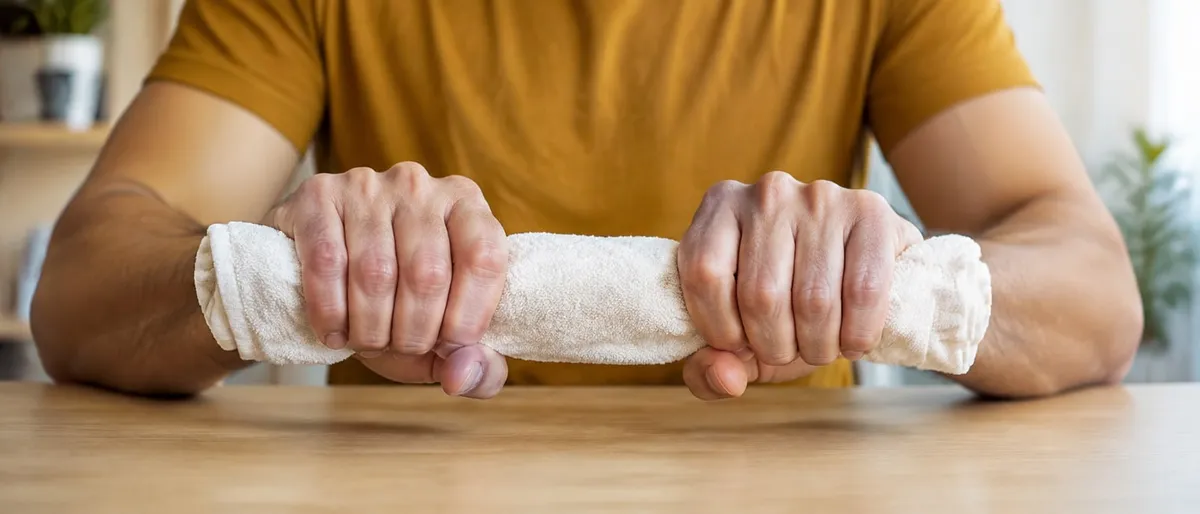
A rolled towel gives you an accessible object to hold. Sit or stand comfortably, place it across your palms and close your fingers around it without forcing the wrist into an extreme position. Apply pressure gradually, then release it smoothly. Start with a few easy rehearsals so you can notice what you are doing. This is an introductory practice option, not a validated towel-strength protocol.
You can make the practice clearer by asking one question at a time. Can you release the pressure without snapping your fingers open? Can you keep the same hand placement between attempts? Are you quietly squeezing, or twisting your whole upper body to make the exercise feel harder? These observations help you describe the movement. They do not convert the towel into a calibrated device.
NSCA towel examples modify loaded exercises by changing the surface being gripped; they are not examples of an unweighted towel replacing the external load. The accompanying coaching PDF shows towels used with training implements. That distinction matters when an online demonstration is shortened to “use a towel.” The object, its attachment and the resistance still need to be identified.
Do not imitate hanging exercises by trapping a towel in a household door or looping it over furniture. This article does not assess those structures or their attachments. Nor do you need to suspend your body to begin learning a grip task. Keep the first practice grounded and simple, with no overhead object or unsecured load that could fall if your fingers open.
The ball-and-gripper trial used resistance tools and a scheduled training program, so it cannot quantify the benefit of your towel squeeze. Its actual methods are a useful boundary for the claim. If the towel becomes easy, write “easy practice” rather than assuming an ever-longer squeeze is the same as a heavier grip task.
For pinch practice, a folded section of soft cloth can help you identify finger-to-thumb contact while it remains supported on a table. Keep the task gentle and do not attach a weight to the cloth. For support grip, identify a suitable loaded implement before prescribing a hold. Without that implement, leave the loaded exercise out rather than improvising something slippery, fragile or difficult to put down.
Progressive resistance training is recommended for healthy adults in ACSM’s 2026 position stand. That updated guidance supports planning how a task can become more demanding over time. It does not supply a hidden resistance value for household fabric. Starting without equipment is a practical choice; expecting unlimited strength progression from an unchanged object is a different expectation.
Choose resistance you can describe and control
Once you want more than movement practice, choose a tool whose use you understand. A purpose-built hand gripper or exercise ball can provide a squeezing task. An appropriate training weight can provide a support hold. These are categories of equipment, not a recommendation to buy a particular product or a guarantee that every product suits every hand.
Read the manufacturer’s instructions before using a new implement. Check how to position it, how to change its resistance and where to place it when the set ends. Begin with a setting or load you can control. The heaviest object you can briefly stop from falling is a poor starting point for learning a repeatable movement.
The NSCA coaching framework includes loaded pinches and carries as distinct ways to challenge the hand. The exercise descriptions help explain why one squeeze exercise is not a complete substitute for every grip task. For a home beginner, that does not mean copying plate flips or other dynamic drills. Choose the simplest suitable version of the task you actually need.
Here is an editorial setup check for a stationary support hold: use an implement designed to be lifted, keep a clear place to put it down, and make sure your feet and other people are outside its drop path. Do not balance loose plates, stack unsecured household objects or use glass containers. If you cannot put the object down calmly before your grip fails, choose a different setup or leave the exercise out.
For a gripper, define what counts as one repetition before starting. Record a consistent closing point and a controlled release according to the device’s instructions. Avoid counting a barely moving squeeze alongside a full closure as if they were identical. If the device has an adjustment scale, note the setting without assuming its printed number is a laboratory measurement of the force your hand produced.
A systematic review found that grip-strength assessment can be reliable and valid, but the reviewed measurements used actual assessment procedures. Bobos and colleagues did not validate a generic gripper label or towel feeling as a force test. A training tool and a measuring instrument can serve different purposes even when both are squeezed with one hand.
ACSM’s current synthesis also found that equipment type did not consistently determine training outcomes across the included resistance-training evidence. The position stand supports flexibility in tool choice. It does not say that resistance itself is optional or that a tool with no suitable progression will meet every strength goal. Buy or borrow a tool because it solves a specific training problem, not because it looks advanced.
Build a small session around one clear goal
Start by choosing one main grip task. If squeezing is your goal, use your selected ball or gripper. If maintaining a handle hold is your goal, use a suitable support-grip setup. You do not have to train crushing, pinch and support in every first session. Give yourself enough time to learn one task and make a useful note afterwards.
The older-women trial used two weekly sessions, but its schedule and workload were studied as a complete intervention in that population. The primary paper’s abstract does not establish an optimal universal dose. If you are following a professionally designed program, use its prescribed workload. For an introductory session, a few controlled practice attempts can help you learn the tool before deciding on a training prescription.
Use a simple sequence: rehearse at easy effort, complete the planned work with the same technique, rest enough to repeat it calmly, then record what happened. Keep breathing normally. End the set while you can still open your hand and put the tool down deliberately. The point of the first session is to establish a controlled task, not to find the absolute limit of your grip.
ACSM’s 2026 review did not find that training to momentary muscle fatigue consistently improved outcomes. The broader evidence does not justify making every grip attempt a failure test. This is general resistance-training guidance, rather than a study comparing two versions of your particular home grip session.
Think about placement in your wider workout. If a planned row or other important loaded exercise depends on holding its handle, do not casually exhaust your hands beforehand. The NSCA article recommends placing supplementary grip work after higher-priority strength work when early grip fatigue could interfere with those lifts. Its programming discussion treats grip as part of the whole session. If grip itself is your main performance goal, discuss the session order within that program rather than applying one order mechanically.
Your first training note can be short: “Right hand, gripper setting A, planned closure reached on every repetition, controlled release.” For a support hold, record the actual load and handle instead. Include what ended the set: your planned stopping point, slipping, discomfort or a change in posture. Those details make the next decision possible.
Grip work also does not replace a whole-body plan. Our guide to push and pull balance at home covers the broader pattern question. Add a grip task where it has a purpose, without allowing a small accessory exercise to consume the attention intended for the rest of your training.
Progress the task without changing the test
Choose what you will change before the next session. You might use a modest increase in the gripper setting, a suitable increase in a support-hold load, or more completed work at the same resistance. Follow the equipment and program instructions. Change one feature at a time so that you can tell what the new result means.
The current ACSM guidance supports matching resistance-training prescriptions to the outcome being pursued, rather than treating strength, muscle size and power as the same target. The 2026 position stand makes that distinction explicit. Applied to your notes, holding the same object longer is evidence about that longer hold. It is not automatically a measurement of greater maximal squeezing force.
Compare two imaginary entries. “Held the same handle and load for the planned duration with less difficulty” is a usable observation. “Grip improved because the new handle felt easier” leaves the comparison unresolved. The handle, load and stopping rule may all have changed. Keep the first result and describe the new task separately until you have a fair comparison.
If you use a dynamometer, follow its assessment protocol consistently, including the device setting, tested hand, position, attempts and rest. Do not create a personal health diagnosis from an internet cutoff. The measurement review reported different estimates of clinically important change across populations and conditions. Those condition-specific results are not one universal number that every home trainee must exceed.
A simple log can include date, hand, implement, setting or load, work completed and any reason for stopping. You can add a note about a relevant change in the day’s setup. Keep the entries readable; an elaborate spreadsheet is unnecessary if it discourages you from recording the few details that matter.
The older-adult exercise review cautioned against using handgrip strength as a general performance measure for all exercise programs. That limitation is useful when interpreting your progress. A grip score can answer a grip question without judging the success of your walking, leg training or entire fitness plan. This article makes no claim that raising that score itself extends life.
When your current setup no longer lets you make a meaningful, controllable change, reconsider the tool rather than endlessly lengthening an easy drill. Our home progressive-overload guide explains the wider planning options. Keep the grip-specific details here: the contact surface, hand position, resistance and outcome you intend to measure.
Know when the next step is different equipment or advice
There are two different reasons to stop adding work. One is a practical ceiling: your towel exercise is easy, the gripper cannot be adjusted usefully, or you lack a suitable support-hold load. The other is a symptom or change in hand function. Do not treat the second situation as a challenge to solve by squeezing harder.
NHS guidance recommends medical advice when hand pain limits normal activities, worsens or keeps returning, or occurs with tingling or loss of sensation. Its palm-pain guidance is a reason to leave symptom assessment to a clinician. This article cannot determine why your grip feels weak, whether a painful movement is suitable or which rehabilitation exercise you need.
Severe hand pain, inability to hold things and loss of feeling are among the symptoms for which the NHS advises urgent help. The same guidance also distinguishes these from ordinary self-care decisions. Use the appropriate urgent medical service where you live. Do not repeat a hard grip test to check whether such a symptom is real.
For an equipment problem, write the missing requirement plainly: “I need an adjustable squeeze resistance” or “I need a suitable load and handle for a support hold.” That makes it easier to select a small tool or ask a qualified professional for help. You do not need to turn the room into a gym, but you do need a setup that matches the chosen task.
Hand-focused training research separates measured force, pinch performance and manual dexterity rather than treating them as a single outcome. That research framework is a useful final check on promises made for a product. Ask which result it is supposed to improve, what evidence actually tested it and whether the proposed use resembles that test.
Choose your next practice
Pick one grip task, identify the resistance and decide how you will record it. If you only have a towel today, use it for controlled practice and keep that label honest. If you have an appropriate training implement, follow its instructions and your program’s workload. A clear first entry is more useful than an unexplained maximum squeeze.
Scope of this guide
This is general training education for healthy adults. It is not a hand-therapy protocol, a diagnostic grip test or a promise about mortality. Existing injury, surgery or persistent symptoms need individual guidance. Practice and progression should support your wider training rather than turn everyday hand discomfort into a competition.
Frequently Asked Questions
5 questions answered
01
Can I train grip strength at home without equipment?
You can practice hand placement and controlled squeezing with a towel, but that does not provide a calibrated or indefinitely adjustable resistance. For a strength goal, identify how the chosen task will become more demanding. Do not assume towel practice reproduces a study using balls and grippers.
02
What is the difference between crushing, pinch and support grip?
Crushing closes the fingers toward the palm around an object. Pinch places fingers against the thumb. Support grip keeps hold of an external load. Record which task you train; a result from one type is not a measured result for all three.
03
How often should I practice grip exercises?
The older-women trial discussed here used two weekly sessions as part of a specific eight-week program. That is not an optimal dose for every reader. Follow the workload in your program, count other loaded gripping and begin by learning a controlled version of the task.
04
Does a gripper setting measure my grip strength?
It records the setting on that tool. It is not automatically a measurement of the force your hand produced. A dynamometer assessment uses a defined protocol; keep device settings, position, tested hand and other conditions consistent when comparing results.
05
Should I squeeze harder if my hand feels weak or painful?
Do not use hard squeezing to diagnose a symptom. Hand pain that affects normal activity, worsens or returns, or accompanies tingling or sensory changes needs medical advice. Severe pain, inability to hold objects or loss of feeling can require urgent help.
References
Sources
Expert perspective
Gerodimos and colleagues found that eight weeks of targeted ball-and-gripper training improved measured handgrip strength and endurance in healthy women older than 65.
V. Gerodimos · Lead study author · University of Thessaly · Source: https://pubmed.ncbi.nlm.nih.gov/33340721/