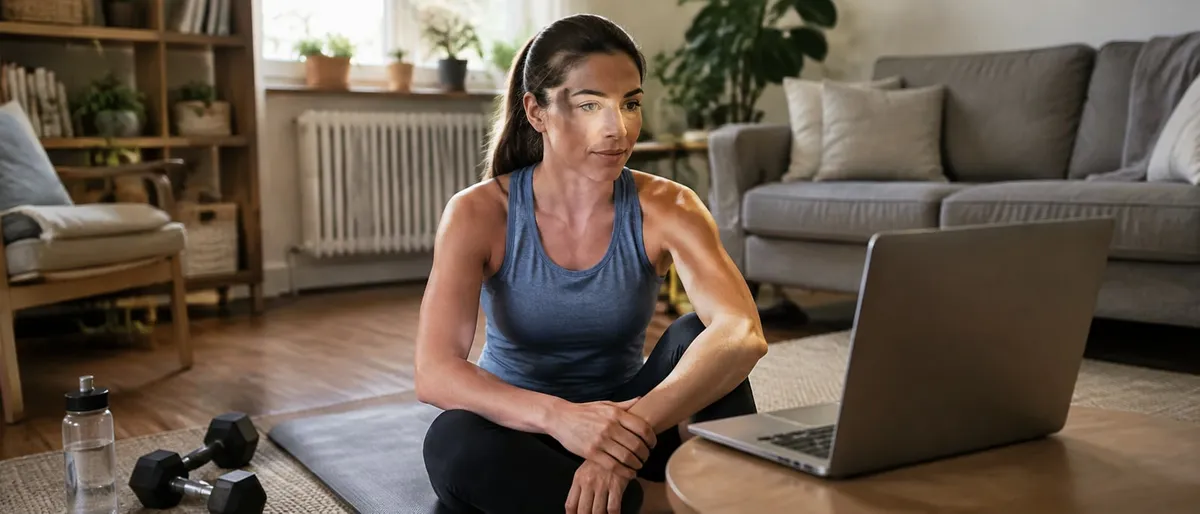
Follow-Along or Self-Paced Workouts?
Choose between a guided follow-along workout and a self-paced session using your time, attention, experience, and need to pause.
A follow-along workout gives you a moving timetable. Someone demonstrates the next exercise, counts an interval, and tells you when to switch. A self-paced workout gives you control over those decisions. You choose the exercise order, repetitions, rest, range, and speed, then stop when the planned task is complete.
The useful question is not which format wins in every situation. It is which format helps you perform today’s session with enough attention to make sensible decisions. If you have ten minutes and keep postponing the start, a guided sequence may remove friction. If the video moves faster than your balance or strength allows, a self-paced plan may be the safer and more productive choice. The format changes the way you manage the workout; it does not replace the need to choose an appropriate movement.
This article is for generally healthy adults choosing ordinary home exercise. It does not diagnose pain, dizziness, breathlessness, or a medical condition, and it does not turn a video into individualized coaching. Stop a movement that causes sharp or concerning symptoms. Get personal advice before following a plan if you are returning after an injury, surgery, a new health problem, or a period of unexplained symptoms.
Start with the decision the workout has to serve
Evidence for this section: WHO physical activity guidelines and the Physical Activity Guidelines for Americans.
The best starting point is the job of the session. Are you trying to complete a short movement break, learn a new exercise, train strength, accumulate moderate aerobic activity, or simply make exercise easier to begin? Each job creates a different need for pacing.
A follow-along format is useful when the main obstacle is starting. The video supplies a beginning, a sequence, and an endpoint. You do not have to decide what comes next while your attention is on the movement. That structure can make a short session feel concrete. It may also help when a class format gives you a reason to set aside the phone, clear the floor, and begin.
Self-paced work is useful when the main obstacle is mismatch. You may need more time to set up a chair, a narrower range of motion, an extra rest, or a quieter transition. A fixed interval can make a manageable exercise feel rushed. A self-paced plan lets you keep the movement recognizable while changing the clock.
Public-health guidelines describe activity by frequency, duration, and intensity, while also recognizing that relative effort differs between people. They do not require every minute to be delivered by a video or every session to be improvised. WHO guidance and the U.S. guidelines support choosing activity that can be repeated and adjusted to the person and context.
Write one sentence before you start: “Today I want to practice,” “Today I want to complete,” or “Today I want to explore.” If your aim is practice, the ability to pause matters more than matching the instructor. If your aim is a simple conditioning block, a timer may be helpful. If you cannot name the task, start with a short self-paced walk or mobility sequence and decide after you have paid attention to how you feel.
What a follow-along workout solves
Evidence for this section: the online exercise systematic review and meta-analysis and the video-guided home exercise trial.
A guided workout reduces the number of small choices between deciding to exercise and doing the first repetition. That matters for people who lose time searching for a routine, changing exercises, or wondering whether the session counts. A clear audio cue can also make transitions smoother when the next movement is already set up.
A video can show the shape of a movement and the order of a sequence. Demonstration is useful information, especially when the exercise is unfamiliar. It is still only a reference. The person on screen may have a different range of motion, floor surface, balance, training history, or room layout. Watch the key action, then choose a version you can control.
Research on online exercise in healthy adults found benefits compared with no exercise across several outcomes, but the review included different programmes and reported heterogeneity and low to moderate certainty for comparisons. That finding supports online exercise as one possible delivery method. It does not show that a particular influencer, interval length, or camera angle is best. Read the online exercise review with that boundary in mind.
A randomized trial in people recovering from stroke found higher reported adherence and some functional outcomes with a mobile video-guided programme than with a paper programme, while basic activities of daily living did not differ. The participants and rehabilitation setting were specific. You cannot transfer those results directly to healthy adults choosing a home strength video. The video-guided trial is useful evidence that delivery can affect experience in some settings, not proof that video always beats a written plan.
Use a follow-along session when the cues reduce hesitation without taking away your judgment. Keep the volume low enough that you can hear your breathing and the instructions. Place the screen where you can glance at it without turning your head during a balance task. If you need to stare at the display to understand the next step, pause and reset instead of walking blindly through the transition.
What a self-paced workout gives back to you
Evidence for this section: the systematic review of self-directed exercise and WHO physical activity guidance.
Self-paced exercise returns control of the clock to the person doing the work. You can take thirty seconds to adjust your stance, then take a longer break after a demanding set. You can repeat a familiar movement without waiting for a countdown and stop before technique becomes hurried. Those choices are especially useful when the session includes strength movements, balance tasks, or exercises that need a careful setup.
Control does not mean doing whatever feels hardest. A self-paced session still needs a defined task. Choose the movement, a repeatable range, a rough number of sets or minutes, and a stopping rule. For example, you might perform two controlled sets of a squat variation, resting until breathing settles and ending the set when the next repetition would change your shape. The exact number is a plan for today, not a promise that the same amount suits everyone.
A review of self-directed exercise in sedentary middle-aged adults included many different prescriptions and outcomes. It described benefits in several physical measures but did not identify one universal independent programme. That is a helpful answer to the temptation to search for the perfect self-paced routine. The review supports planned independence, while its variation reminds you to judge a programme by its purpose and population.
Self-paced work can also expose a weakness in planning. Without a start cue, you may spend the whole session choosing. Without an end cue, you may keep adding exercises because stopping feels unproductive. Use a short written menu: one lower-body task, one upper-body or trunk task, and a simple finish. Set a beginning and an endpoint before you put the phone away.
Self-paced does not mean unsupervised in every sense. You can use a mirror for one stationary check, record a short clip to review later, or ask a qualified professional to check a movement when the stakes are higher. Keep the tool in its role. A phone camera can show whether your feet stayed visible; it cannot diagnose a joint or certify readiness for a sport.
Compare the formats by attention, pace, and feedback
Evidence for this section: the supervised versus unsupervised exercise meta-analysis and the online exercise review.
Attention is the first comparison. A guided workout can hold your attention by giving you the next cue, but it can also pull your eyes toward the screen when your feet or surroundings need attention. A self-paced workout leaves more attention for the body and the room, but only if you prepared the plan before beginning.
Pace is the second comparison. A follow-along timer treats the interval as the same length for everyone watching. Your effort may not be the same. If the instructor’s ten repetitions take twenty seconds and yours take forty, copying the switch time changes the task. Pause, choose fewer repetitions, or move to a lower version. A self-paced session makes that adjustment explicit.
Feedback is the third comparison. A video can provide external cues such as “slow down,” “stand tall,” or “rest.” It cannot see whether your knee is comfortable or whether the surface is sliding. A self-paced routine can include a written check, but it cannot supply a qualified observer unless one is actually present. A format helps only when the feedback it offers matches the decision you need to make.
A meta-analysis comparing supervised and unsupervised exercise in older adults found both conditions could improve physical function and well-being, with some outcomes favoring supervision and a need for more high-quality research. Choose the format that leaves enough attention for the movement. If the screen makes you miss your foot placement, make the next block self-paced. If the written plan makes you wander from exercise to exercise, use a short follow-along segment. The population was older adults and the interventions were not identical to consumer workout videos. The meta-analysis supports taking supervision seriously when it is needed, while leaving room for independent exercise when the task is appropriate.
You can change format inside one session; the decision belongs to the task, not to an identity such as “video person” or “gym person.”
Use a follow-along video without surrendering control
Evidence for this section: Physical Activity Guidelines for Americans and the mobile video-guided trial.
Preview the video while standing still. Check the required equipment, floor space, exercise names, interval length, and intensity cues. If the session includes jumps, fast turns, floor transitions, or equipment you do not have, choose another session or plan your substitutions before pressing play. A preview prevents the most avoidable kind of rushing: discovering the problem halfway through an interval.
Set up the room before the countdown. Move cords and loose objects. Put a stable support within reach if the movement calls for balance. Keep water where you can reach it without crossing the active area. If you are training on carpet, check that the mat does not bunch; if you are on a hard floor, check that your footwear does not slide. These are practical checks, not guarantees of safety.
Use the video’s pace as a suggestion. You can pause after a demonstration, repeat a cue, or take a longer rest. When the instructor offers a harder option, stay with the basic version if it keeps the movement controlled. When a movement feels wrong, choose a known alternative or end that block. Completing the exact video is not the goal if the exact video makes you lose control.
Keep a simple pause rule visible: pause for confusion, uncontrolled form, unusual symptoms, breath that does not settle, a room hazard, or a needed modification. The guidelines describe moderate and vigorous effort in relation to the person. A pause can last long enough to make a decision. Resume only if the original task still fits. Otherwise, change the exercise or finish the session with an easier movement.
A fixed video cannot know your relative intensity. The U.S. guidelines explain why “moderate” is not one identical sensation for every adult. Use the instructor’s talk about effort as a cue, then judge your own breathing and control.
Build a self-paced session that does not drift
Evidence for this section: the self-directed exercise review and WHO guidance.
Start with a short menu rather than an empty page. Select one movement that uses the legs, one that challenges the upper body or trunk, and one easy movement to finish. If you are learning a new exercise, give it a separate practice block while you are fresh. The point is to make the next decision obvious.
Set a range rather than one rigid number. You might choose six to ten controlled repetitions, two or three sets, or five minutes of easy movement. Stop at the lower end if the next repetition changes the intended action. Continue toward the upper end only while the range and breathing remain manageable. These are planning examples, not a prescription derived from one study.
Rest by a rule you can recognize. You may wait until you can speak a full sentence, until your breathing has settled, or until you can set up the next movement without rushing. Do not use fatigue as proof that the session worked. The self-directed review found varied prescriptions across studies. The review is one reason a practical plan needs a purpose and an observation rather than a universal exhaustion target.
Write down one observation after each block: “left side needed support,” “breathing stayed easy,” or “the last two repetitions became hurried.” Use that note to choose the next adjustment. Change one feature at a time, such as range, repetitions, rest, or support. If you change everything together, you lose the information that would help you plan the next session.
A self-paced session can still have a clock. Use a timer for the start, a stop time for the whole block, or a gentle reminder to reassess. The timer should protect the boundary of the session, not force your body to match a number. If the plan ends at twelve minutes and you are moving well, you can decide whether another block fits. If the plan ends while you are struggling, stop and record why.
For a separate approach to forming a repeatable exercise habit, see our fitness habit guide. For practical observation of home exercise form, see our home-workout form-check guide. Those topics address consistency and observation; this article is about who controls the pace.
Know when to pause, modify, or stop
Evidence for this section: the WHO guidelines and the supervised versus unsupervised exercise review.
Pause when the instruction is unclear. Confusion is a useful signal because the next repetition would be built on a guess. Watch the demonstration again while still, reduce the range, or replace the exercise with one you know. A short delay protects the learning task.
Pause when the pace changes your movement. You might start lifting your shoulders, collapsing your trunk, holding your breath, landing noisily, or using momentum to finish. These signs do not identify a diagnosis. They tell you that the current combination of exercise and speed needs an adjustment. Slow down, take rest, reduce the range, or stop the block.
Pause when the environment changes. A pet enters the room, a child needs attention, a shoe loosens, or a chair shifts. A guided timer will keep running while the room is no longer ready. Stop the video and rebuild the setup. A self-paced plan makes the same request through your own stopping rule.
Stop rather than pushing through sharp pain, faintness, new numbness, chest pressure, unusual shortness of breath, or a concerning loss of coordination. Seek appropriate medical help for symptoms that warrant it. A workout article cannot tell you whether a symptom is harmless, and a video instructor cannot assess you through the screen.
Research on supervision does not mean that every person needs a live coach for every home session. It does mean that the need for feedback varies by task and person. The supervision review focused on older adults and physical function, so apply it carefully. If you have repeated uncertainty about a movement, a qualified assessment may be more useful than another video.
Create three labels for the session: continue, adjust, and stop. Continue when the planned movement remains recognizable and comfortable. Adjust when you can solve the mismatch by changing pace, range, rest, support, or exercise. Stop when the problem is a symptom, a hazard, or a question you cannot answer safely. The labels work with both formats.
Combine both formats across a normal week
Evidence for this section: the online exercise meta-analysis and the Physical Activity Guidelines.
You do not need to choose one format for every day. A mixed week can give each session a clear job. Use a short follow-along warm-up when you want a simple start. Pause and switch to a self-paced strength block when the exercise needs more rest. Finish with a guided stretch only if the pace remains comfortable and the movements are appropriate for you.
Here is an example structure rather than a required schedule. On Monday, use a ten-minute follow-along session and pause whenever the transition needs more setup. On Wednesday, choose three self-paced movements and write the stopping rule before you begin. On Saturday, use a guided aerobic block if you can keep the room clear, then take a self-paced cooldown. Leave room for ordinary walking and recovery between these sessions.
The example separates format from intensity. A follow-along workout can be easy or demanding. A self-paced workout can be easy or demanding. The clock does not tell you the effort by itself. The guidelines describe activity targets at population level; they do not certify that a particular online session meets your personal goal.
Online exercise research has found useful effects in some healthy-adult trials, but the interventions vary and the certainty is not uniform. The meta-analysis compared online exercise with no exercise or face-to-face exercise and does not test whether a follow-along format is superior to self-pacing. The meta-analysis supports reading those results inside that comparison boundary. Self-directed exercise research also includes varied programmes rather than one winning template. Let the evidence set the boundary, then let your actual attention and control guide the choice.
After two or three weeks, review the notes you made. Which format helped you start? Which format let you keep a controlled pace? Which one made you skip rest or ignore the room? Keep the format that answers the current problem, and change it when the problem changes.
Safety note before your next session
This article helps you choose a delivery format for ordinary home exercise. It is not a diagnosis, a rehab plan, or permission to push through sharp pain, faintness, chest pressure, new numbness, or unexplained breathlessness. If those symptoms appear, stop and seek appropriate care. For a generally healthy week, pick one short session, decide whether guidance or self-pacing fits the task, and keep the right to pause, modify, or end early.
A workout is complete when it served its planned purpose and you can recover from it. Stopping early can be the correct decision when the task no longer fits. Pausing can be the correct decision when you need more information. The useful skill is deciding deliberately, then returning to exercise another day with a clearer plan.
Frequently Asked Questions
5 questions answered
01
Is a follow-along workout better than a self-paced workout?
Neither format is always better. Choose the guided format when timing and exercise order help you start, and choose self-paced work when you need to adjust speed, range, rest, or exercise selection.
02
When should I pause a workout video?
Pause when you need to understand the next movement, restore controlled form, breathe normally, change the exercise, or clear a safety concern. A pause is part of managing the session, not a failure.
03
Are follow-along workouts good for beginners?
They can reduce decisions and demonstrate a sequence, but beginners still need to choose a suitable level and should not copy a movement they cannot control. Use a slower option or pause when the instructions move too quickly.
04
How long should a self-paced workout last?
Use a length you can complete with attention and controlled repetitions. A short session that fits your week is more useful than a longer session that makes you rush or skip recovery.
05
Can I combine guided and self-paced exercise?
Yes. You might follow a warm-up, pause for a self-paced strength block, and return to a guided cooldown. Combining formats lets the session match the task instead of forcing every movement into one tempo.
References
Sources
Expert perspective
Byrne, Caulfield, and De Vito describe self-directed exercise as a useful way to study independent exercise, while noting that the reviewed programmes and outcomes varied rather than yielding one ideal prescription.
Hugh Byrne, Brian Caulfield, and Giuseppe De Vito · Authors of a systematic review of self-directed exercise · University College Dublin · Source: https://pubmed.ncbi.nlm.nih.gov/30003896/