Do exercise snacks help sedentary adults at home?
What October 2026 evidence on exercise snacks means for sedentary adults at home: cardiorespiratory signals, metabolic limits, and a practical hallway plan.
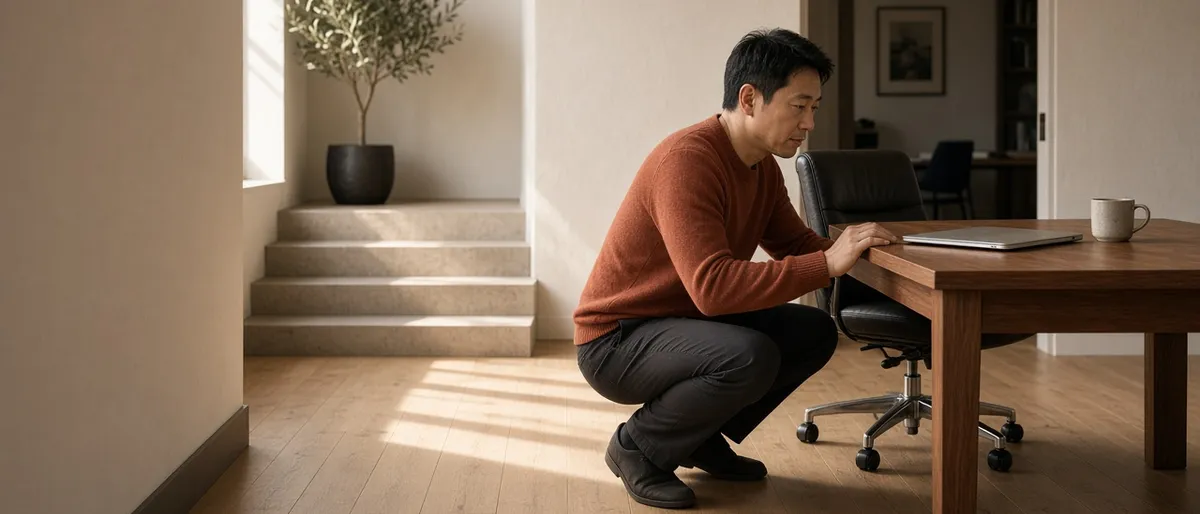
If you sit most of the workday, “exercise snacks” can sound like a loophole: a few minutes here and there, fitness without a real schedule. Coverage in early October 2026 made that pitch louder. The useful question is smaller. What did the new reviews actually measure in sedentary or inactive adults, and what does that change for a hallway, stairwell, or living-room plan?
Exercise snacks for sedentary adults are brief, intentional movement bouts repeated through the day. In the best current pooled evidence, they look more promising for cardiorespiratory fitness signals than for fat loss, muscle size, blood pressure, or a clean VO2max guarantee. They also do not replace the weekly targets in the Physical Activity Guidelines for Americans.
This page stays on that home decision. It is not clinical telerehabilitation for cancer or fibromyalgia. It is not a meal-glucose deep dive; that lives in Exercise Snacks for Blood Sugar. And it is not a claim that one squat set undoes eight hours of sitting; see Can a Workout Undo Sitting All Day?.
What the October 2026 evidence wave actually showed
Three research summaries landed close together, then moved through secondary outlets such as News-Medical’s 6 October write-up (News-Medical) and Medscape’s 2 October clinician commentary (Medscape). The numbers below come from the primary papers, not from the news paraphrases.
Qi, Wang, Xu, Kawczyński, and Chen published a systematic review and meta-analysis in Frontiers in Nutrition on sedentary individuals. They included 22 studies and 994 participants (Frontiers full text). In the unadjusted pooled analyses, exercise snacks were associated with higher VO2max (Hedges’ g = 1.24, 95% CI 0.53 to 1.95), higher VO2peak (g = 0.63, 95% CI 0.05 to 1.22), improved triglycerides (g = 1.05, 95% CI 0.05 to 2.06), and lower blood glucose (g = −0.83, 95% CI −1.51 to −0.15). They found no significant pooled effects on body fat, muscle mass, strength, or insulin (Frontiers full text).
The VO2max headline still needs the next sentence. The authors detected publication bias for VO2max. After trim-and-fill adjustment, the estimate was no longer significant (Hedges’ g = 0.62, 95% CI −0.59 to 1.83, p = 0.32) (Frontiers full text). That is why this page will not say VO2max “definitely rises.”
A separate British Journal of Sports Medicine systematic review and meta-analysis focused on physically inactive adults and older adults. It pooled 11 randomized trials with 414 participants (BJSM review via DOI). Exercise snacks were defined as structured bouts of five minutes or less, performed at least twice daily, on at least three days per week, for at least two weeks. Cardiorespiratory fitness improved in adults (g = 1.37, 95% CI 0.58 to 2.17). Muscular endurance improved in older adults (g = 0.40, 95% CI 0.06 to 0.75). There were no significant effects on lower-limb strength or on cardiometabolic outcomes such as body composition, blood pressure, and blood lipid profiles (BJSM review via DOI). Compliance and adherence were high in the included trials.
A third 2026 review in The Journal of Nutrition, Health and Aging looked across adult age strata rather than only at labeled sedentary cohorts. Twenty-one randomized trials (921 adults) contributed (JNHA age-group review). Overall, VO2max (g = 1.04, 95% CI 0.68 to 1.39) and peak power output (g = 0.68, 95% CI 0.25 to 1.10) improved. VO2max gains appeared in study-mean ages under 25 and 25–50, but not above 50. Peak power improved across those age bands. Body-fat percentage showed an overall increase in the pooled estimate (g = 0.51, 95% CI 0.01 to 1.02, low-certainty evidence), and lipids as a group did not move significantly (JNHA age-group review). The authors asked for individual-participant data to confirm the age patterns.
Fitness-related signals are the strongest story across these papers. Body recomposition is not. Lipid and blood-pressure packages are inconsistent or null depending on the review. Glucose and triglycerides look more interesting in the Frontiers sedentary pool than in the BJSM inactive-adult cardiometabolic package. Inclusion rules matter, and the reviews are not interchangeable.
What counts as an exercise snack in these reviews
“Snack” is marketing language until a paper defines the bout.
In the BJSM inactive-adult review, the operational definition is strict: five minutes or less, at least two bouts a day, at least three days a week, for at least two weeks. Intensities in the included trials ranged from moderate-to-vigorous to near-maximal. Intervention lengths ranged from about four to twelve weeks.
The Frontiers sedentary review used a broader definition: brief, structured, time-efficient bouts performed as an alternative to long continuous sessions, either as repeated daily snacks or as short-duration sessions aimed at raising activity. Modalities in the included studies included stair climbing, bodyweight work, sprint intervals, brisk walking, and mixed interval formats. Durations ranged from a single day to twelve weeks.
The JNHA age-group review likewise treated snacks as fragmented low-volume bouts accumulated across the day, without locking modality to one exercise family. Exploratory analyses suggested more daily bouts, four to five intervention days per week, and about seven to nine weeks of training may track with larger cardiorespiratory effects. Those are study-level patterns, not a home prescription to copy blindly.
For a home desk worker, the practical translation is deliberately dull:
- Keep a single bout short enough that you can start it between meetings.
- Prefer at least two bouts on snack days rather than one accidental 20-minute session labeled a snack.
- Use stairs, marching, sit-to-stands, wall push-ups, or easy step-ups before you invent a burpee festival.
- Treat intensity as scalable. Near-maximal sprints belong in research protocols and among people cleared for them, not as a week-one default after years of sitting.
Secondary commentary such as Medscape’s sedentary-time note often frames snacks as roughly five minutes each hour. That is clinical teaching shorthand, not the exact inclusion rule of every meta-analysis above. Use it as a reminder to interrupt sitting, not as a claim that hourly five-minute HIIT is required.
Fitness signals versus body composition and metabolic markers
Most readers want to feel less wrecked after sitting, get a bit fitter, or change how they look. The October reviews do not treat those hopes as equal.
Cardiorespiratory fitness is the clearest pooled positive in both the BJSM inactive-adult analysis and the JNHA age-stratified analysis. The Frontiers sedentary review also reported VO2peak improvement and an unadjusted VO2max signal that did not survive publication-bias correction. If you care about aerobic capacity language at home, keep expectations tied to that mixed VO2max picture. Use RazFit’s separate guide on VO2 max training at home when you want a structured session rather than snacks alone.
Body composition is where the marketing usually overreaches. Frontiers found no significant body-fat or muscle-mass change. BJSM found no significant body-composition effect. JNHA even pooled a body-fat percentage increase with low-certainty evidence. That is a reason to refuse fat-loss claims, not a reason to invent a paradox. None of these papers is a hypertrophy program.
Metabolic markers split by review. Frontiers reported triglyceride and glucose signals in sedentary cohorts, with no significant insulin change. BJSM reported no significant cardiometabolic package for lipids, blood pressure, or composition in inactive adults. JNHA found no significant overall lipid effects. If your question is specifically post-meal glucose timing, stay with the meal-focused snack article instead of forcing this fitness review to answer a different question.
Strength outcomes were weak in the sedentary Frontiers pool, and lower-limb strength did not improve in BJSM. Older-adult muscular endurance did improve in BJSM. That matters if an older relative is the real reader. It is still not a free pass for heavy loading without progression rules.
How to run exercise snacks at home without a lab protocol
You do not need a cycle ergometer in the kitchen. You need a repeatable trigger and a short menu that fits carpet, hardwood, or a quiet apartment.
A practical home menu
Use movements you can stop immediately if a call starts:
- Hallway or living-room marching in place, 60–180 seconds.
- Sit-to-stand from a sturdy chair, slow and controlled, 8–15 reps.
- Stair climbs: one to three flights if the stair is clear and dry.
- Counter-supported calf raises or wall push-ups if impact needs to stay low.
- Easy step-ups on the bottom stair only, holding a rail if balance is unsure.
If space is the bottleneck, the programmatic apartment workout page covers layout constraints. Snacks inherit the same space rules, just with shorter clocks.
A day template for sedentary adults
This is a home translation of the BJSM frequency idea (multiple short bouts), not a copy of any single trial arm:
| Anchor | Snack | Rough intensity |
|---|---|---|
| After the first long sitting block | 2 minutes marching + 8 sit-to-stands | Conversational pace |
| Mid-afternoon | 1–3 stair flights or step-ups | Slightly harder, still controlled |
| Optional evening | 2 minutes wall push-ups + calf raises | Easy finisher |
Two anchors on three weekdays is enough for week one. Add a third bout only after the first two stop feeling like a negotiation. The Frontiers sedentary literature includes stair climbing and bodyweight snacks among several modalities; pick the ones your floor, neighbors, and joints will tolerate.
Intensity without a lab heart-rate formula
Medscape’s commentary reminds clinicians that moderate intensity can contribute toward guideline activity when heart rate lands in a moderate zone. For home snacks, a simpler beginner rule is safer: you can speak a sentence, you are not dizzy, and form does not collapse. Save near-max efforts for later weeks and for people who already tolerate intervals.
Habit scaffolding from the October indoor-season context
Spanish rehabilitation messaging around October, including Marta Supervía speaking in the SERMEF-linked Cuidateplus piece, stresses planned behavior over motivation: pick days, times, and a backup when weather or schedule breaks (Cuidateplus / SERMEF context). That is context for starting an indoor habit, not a second scientific topic. Pair it with the snack template above. If the day collapses, keep one 90-second bout rather than declaring the week ruined.
Social posts that cheer “just move for a few minutes” can keep the conversation alive. They are not where you get effect sizes. Late-September clinician posts circulating the snack idea are conversation, not measurement.
How to decide between snacks, micro-workouts, and weekly guideline minutes
Keep three separate buckets so slogans cannot flatten them.
Sitting interrupters. These are true snacks. The goal is to break long sitting and accumulate brief stimulus. Match the spirit of the BJSM twice-daily short-bout definition and the sedentary focus of the Frontiers review.
Short planned sessions. These are micro-workouts: one block of 10–20 minutes with a start and finish. RazFit already covers why short sessions can work in Micro-Workouts: Why Short Exercise Works. Use that when you want progressive strength or a coherent interval set.
Weekly guideline minutes. Under the Physical Activity Guidelines for Americans, adults need at least 150 to 300 minutes of moderate-intensity aerobic activity a week, or 75 to 150 minutes of vigorous-intensity aerobic activity, plus muscle-strengthening involving major muscle groups on at least two days (ODPHP current guidelines). Snacks may contribute when intensity is high enough. They do not erase the weekly accounting.
Decision rules:
- If your only problem is unbroken sitting, start with sitting interrupters.
- If you also want strength progressions or a clear training stimulus, add a short planned session on separate days or later the same day.
- If your week still has almost no moderate-to-vigorous minutes after snacks, you are under-dosing the guideline bucket. Add walks or longer home sessions instead of stacking max-effort snacks until joints complain.
- If you are over 50 and your main hope is VO2max from snacks alone, read the JNHA age-stratum caution before promising yourself a lab-style VO2 bump.
Common objections from desk-bound adults
“I do not have five free minutes.” Then you also do not have a 45-minute gym block. The snack model exists because calendars are hostile. Start at 60–90 seconds. The Frontiers and BJSM literature is about brief bouts, not about finding a mythical empty hour.
“Snacks will burn the fat I gained at my desk.” Refuse that claim. Neither Frontiers nor BJSM supports a body-fat loss conclusion for snacks in these pools, and JNHA does not hand you a recomposition win either.
“If I snack, I can ignore the weekly guidelines.” No. Keep the ODPHP guideline page as the adult weekly target. Snacks are a bridge and a sitting interrupter.
“I already walk after meals, so snacks are redundant.” Meal-timed walking and snacks overlap, but they answer different questions. Meal glucose timing is covered in Exercise Snacks for Blood Sugar. This page is about sedentary-adult fitness evidence and home logistics.
“Near-max stair sprints are the only real snack.” Some trials used hard efforts. Many sedentary beginners need entry-level intensity first. High compliance in the BJSM pool is encouraging, but those were study participants under protocols, not proof that your knees want jump squats between video calls.
“October is for outdoor running, not hallway marches.” Seasonal habit advice such as the SERMEF-linked October indoor planning note actually supports having a home backup when weather or daylight fails. Snacks can be that backup.
Limits of the evidence and who should get clinical advice first
Heterogeneity is high in several Frontiers analyses, and certainty ratings in these reviews are often moderate, low, or very low depending on the outcome. Intervention recipes differ: stairs in one study, bodyweight circuits in another, sprints in a third lab. That makes “do exactly what Study X did” a weak home instruction.
Publication bias matters for VO2max in the sedentary Frontiers pool. Age strata in JNHA are study-level mean ages, not individual participant data. BJSM’s muscular-endurance signal in older adults rests on limited certainty. Secondary articles such as News-Medical and Medscape can help people notice the topic. They are not substitutes for the pooled estimates in BJSM.
This page does not cover exercise snacks as clinical telerehabilitation for cancer, fibromyalgia, or other specialty pathways. People with chest pain on exertion, uncontrolled hypertension, recent cardiac events, advanced osteoarthritis that flares with stairs, pregnancy complications, or dizziness with positional changes need individualized medical guidance before copying vigorous snack protocols.
Medical disclaimer
This article is general fitness education for adults interested in short home movement breaks. It is not medical advice, diagnosis, or a substitute for care from a physician or other qualified clinician. Do not start vigorous stair or interval snacks based only on this page if you have known cardiovascular disease, are recovering from surgery, have a condition that makes falls likely, or take medications that affect heart rate or blood pressure response to exercise. Stop and seek urgent care for chest pain, fainting, sudden severe shortness of breath, or one-sided weakness.
How to use RazFit with exercise snacks
Keep snacks outside the app if that is the only way they happen: timer, stairs, done. Use RazFit when you want a short planned session on other days so snacks do not become your only stimulus forever. Log a one-line note after snack days: how many bouts, which moves, and whether you still sat for huge unbroken blocks. Two weeks of those notes beat another argument about whether snacks “count.”
A concrete next-step plan for this week
- Define snack days: three weekdays with the worst sitting blocks.
- Place two anchors on each snack day, using the hallway menu above.
- Cap each bout at five minutes unless you intentionally switched into a micro-workout.
- Track only completion and unbroken sitting stretches, not scale weight.
- Keep one longer walk or home session on the calendar so weekly minutes still point at the Physical Activity Guidelines.
- Re-read the Frontiers VO2max caveat before telling yourself snacks guaranteed a VO2max bump: after trim-and-fill, that pooled VO2max effect was not significant in the sedentary meta-analysis.
- If strength is a goal, add a separate short session rather than expecting snacks to raise muscle mass; the same Frontiers pool did not find significant muscle-mass or strength effects, and BJSM did not find lower-limb strength gains.
Start with interruptions you can repeat tomorrow. Let fitness signals be a possible bonus. Leave fat-loss and hypertrophy claims off the snack label.
Related Articles
Frequently Asked Questions
6 questions answered
01 Do exercise snacks help sedentary adults?
They can help some fitness and metabolic markers in sedentary or inactive adults, especially when short bouts are repeated across the day. October 2026 reviews found clearer signals for cardiorespiratory outcomes than for fat loss, muscle size, or blood pressure. Snacks are a start, not a replacement for weekly Physical Activity Guidelines minutes.
02 How long should an exercise snack last at home?
In the British Journal of Sports Medicine definition used in one 2026 review, structured snacks lasted five minutes or less and were done at least twice daily on three or more days per week. At home, start with one to five minutes of stair climbs, sit-to-stands, or brisk marching, then add a second bout later rather than stretching one bout into a full workout by accident.
03 Can exercise snacks replace a full workout or the weekly guidelines?
No. U.S. adults still need at least 150 to 300 minutes of moderate-intensity aerobic activity a week, or the vigorous equivalent, plus muscle-strengthening on at least two days. Snacks can interrupt sitting and may improve fitness signals, but they do not rewrite those weekly targets.
04 Will exercise snacks lower my body fat or build muscle?
Do not plan on either as the main payoff. The Frontiers sedentary review found no significant pooled effects on body fat, muscle mass, or strength. The British Journal of Sports Medicine inactive-adult review likewise found no significant effects on body composition. Treat snacks as movement and fitness tools, not a fat-loss or hypertrophy program.
05 What is a safe first week of exercise snacks for a desk job?
Pick two to three weekdays. On each of those days, do two one-to-three-minute bouts: for example, hallway marches plus chair sit-to-stands after lunch, and stair climbs mid-afternoon. Keep intensity conversational at first. Stop for chest pain, fainting, or unusual shortness of breath, and get medical clearance first if you have uncontrolled cardiovascular disease or similar risks.
06 How do exercise snacks differ from micro-workouts?
Exercise snacks in the 2026 reviews are usually very short, repeated across the day, and aimed at breaking sedentary time or accumulating brief stimulus. Micro-workouts are often single short sessions with a clearer training structure. You can use both: snacks for sitting blocks, and a separate short home session when you want a planned workout.
References
Sources
Expert perspective
Qi and colleagues reported that exercise snacks were associated with higher VO2max in the unadjusted pooled analysis of sedentary adults, but after trim-and-fill adjustment for publication bias the VO2max estimate was no longer statistically significant (Hedges' g = 0.62, 95% CI -0.59 to 1.83, p = 0.32).
Kai Qi · Lead author of the 2026 Frontiers in Nutrition sedentary exercise-snacks meta-analysis · School of Sport and Brain Health, Nanjing Sport Institute · Source: https://www.frontiersin.org/journals/nutrition/articles/10.3389/fnut.2026.1883923/full