Low-Amplitude Jump Landing Practice for Beginners
Learn quiet two-foot landing practice at home with low-amplitude jumps, competency checks, and clear limits on what landing research actually shows.
Jump landing practice for beginners at home is a short skill session, not a highlight reel. You leave the ground only a little, land on both feet, and finish in a quiet stance you can actually hold. The work is the finish. Height, speed, and box jumps are a different conversation.
Search results often skip that step. Clips jump to depth drops, tuck jumps, and “ACL-proof” cue sheets. A beginner home session needs less theater: clear floor space, a small hop, and a stop rule when the landing gets loud or crooked. Public-health guidance still treats ordinary activity as something you adjust to the person, not a fixed sport drill everyone has to copy (Physical Activity Guidelines for Americans; WHO physical activity guidelines).
This article is for generally healthy adults practicing a basic two-foot landing. It is not a diagnosis, a rehab plan, or a promise that better landings prevent injuries. Knee problems have many causes, and a web page is not personal medical care (MedlinePlus knee injuries and disorders). If you have sharp pain, swelling, giving-way, recent surgery, or unexplained symptoms, stop and get advice that fits your situation.
What landing research measures, and what it does not
Evidence for this section: the BMJ Open Sport & Exercise Medicine landing review and MedlinePlus knee injuries and disorders.
Before you collect cues, ask what published papers mean by a “better landing.” In 2023, Bathe and colleagues reviewed training interventions aimed at biomechanical risk factors linked to lower-extremity landing injuries in adult athletes. They included 31 studies and 974 participants. Most outcomes were lab or field measures: knee flexion angle, ground reaction force, joint moments, or Landing Error Scoring System ratings. They were not long-term injury tallies from unsupervised beginners hopping in a hallway (Bathe et al.).
That gap is the whole topic in miniature. A larger knee-flexion angle on a drop landing is a surrogate. Surrogates can be useful. They are not automatic proof that a five-minute living-room drill will lower your future injury rate. The review’s significant knee-flexion meta-analysis used only four randomized controlled trials and reported a medium pooled effect. The authors also noted that about 65% of results came from female samples, measurement methods were inconsistent, bias risk was mostly moderate, and follow-up was limited, so it is unclear how long changes last after training stops (Bathe et al.).
People still want a cleaner slogan: soft knees equal safe knees. Joints are messier than that. Soft tissue status, old injuries, sport demands, fatigue, floor surface, shoes, and medical conditions all sit in the same room. MedlinePlus describes knee problems as common across ages and driven by different structures and diseases, which is why one landing tip cannot stand in for clinical judgment (MedlinePlus).
Read the research as a boundary. Technique instruction and some dynamic strengthening approaches can change landing mechanics in athletic samples under study conditions. That supports practicing quiet landings with attention. It does not underwrite injury-prevention guarantees for beginners practicing alone at home (Bathe et al.).
One more nuance from the same review helps keep expectations honest. The authors could not find a significant pooled effect on ground reaction force across the randomized trials they analyzed for that outcome, even while knee-flexion findings looked more promising. If someone sells you a home landing drill as if every impact metric will fall in lockstep, they are overselling the evidence (Bathe et al.).
Why low amplitude and two feet come first
Evidence for this section: the NSCA Landow session description and current concepts of plyometric exercise.
An NSCA education page for a 2016 Loren Landow session describes plyometric setup, execution, and landing mechanics as preparation for later joint stress. The visible summary identifies progressions based on competency and ability, moving from low-amplitude bilateral jumps toward single-leg deceleration drills (NSCA / Landow). That page description is enough to justify the beginner order here. It is not a transcript of every cue in the video, and it does not invent a safe home dosage.
A clinical commentary on plyometric exercise makes a similar point from rehab and performance practice: even lower-level plyometric work creates meaningful stress, so intensity should climb from low toward higher demands, with two-legged drills as a common entry for low-to-medium work (Davies, Riemann, and Manske). The same commentary favors quality over quantity and ending the plyometric block when movement quality falls apart.
For a home beginner, the translation is blunt. Use both feet. Keep the jump small. Stick the landing before you chase rebound speed, height, or single-leg work. A tiny hop that finishes quietly teaches the skill you came for. A tall jump that crashes mostly teaches noise and bravado.
This is also where landing practice parts ways with low-impact power training without jumping. No-jump power work solves a different problem: fast force without an airborne phase. Landing practice accepts a short flight and then asks for a controlled finish. If impact itself is currently off-limits, stay with no-jump options or get personal guidance before you add landings.
Think about weekly placement the same way. Landing skill fits better after a short warm-up and before you are exhausted from intervals. Fatigued landings get sloppy. Davies and colleagues treat technique decline as a reason to stop the plyometric portion rather than “push through” for contact counts (Davies et al.).
How to practice a quiet two-foot landing at home
Evidence for this section: Davies et al. on plyometric concepts, the NSCA Landow page, and the Physical Activity Guidelines for Americans.
Clear enough floor that a missed landing does not send you into a chair leg. Use a stable surface. Bare feet or shoes with reliable traction both work if the floor is not slick. Warm up with easy marching in place, a few hip hinges, and slow bodyweight squats until the legs feel awake. That is ordinary preparation, not a magic shield (Physical Activity Guidelines for Americans; for short-session setup ideas, see warm-ups for short workouts).
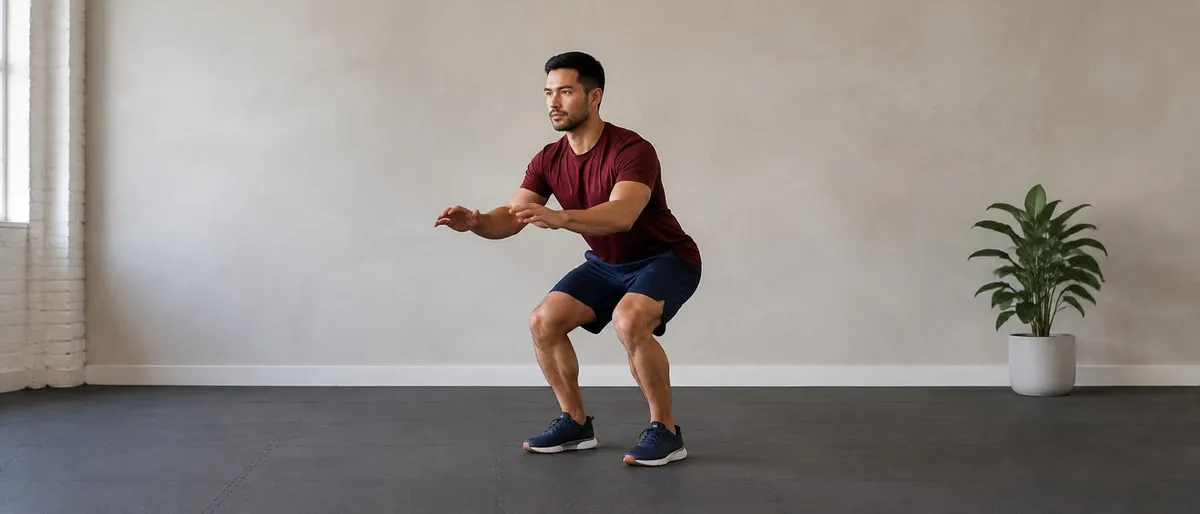
Stand with feet about hip-width. Soften the knees and hips a little before you leave the ground. Jump only a few centimeters. Land on both feet together, or as close as you can manage on that day. Let the ankles, knees, and hips flex enough to quiet the sound. Hold the finish for one or two breaths. Reset, then repeat.
External targets usually beat a long internal checklist. Aim for a quiet floor. Aim for a finish you could hold long enough for a still photo. The Landow session summary treats landing positions as part of competent progression, not an afterthought bolted on after the jump (NSCA / Landow). Davies and colleagues likewise treat landing quality as a gate before harder plyometric progressions (Davies et al.).
Keep volume honest. The plyometric commentary cites beginner athletic foot-contact ranges from the broader literature, but those numbers belong to structured athletic contexts. They are not a living-room mandate for someone learning the skill unsupervised (Davies et al.). At home, prefer short sets of stick landings where every repetition still looks like the first. If the fifth landing is louder or more crooked than the first, the set is over.
A few home details matter more than people admit:
- Face an open wall or clear line of sight so you are not twisting to watch a screen mid-air.
- Keep arms free enough to help balance; clutching a phone during the hop usually makes the landing worse.
- If upstairs neighbors or thin floors are an issue, lower the amplitude further or practice at a time when noise is acceptable. Quiet is part of the skill, not only etiquette.
Film one or two reps from the front and from the side if you want a later check. Look for both feet visible, a settled finish, and no last-second save step. A phone clip can show those basics. It cannot diagnose a joint. For broader observation habits, home workout form checks cover what a camera can and cannot do.
Competency progression without box jumps
Evidence for this section: the NSCA Landow description, Bathe et al., and Davies et al..
Progress by what you can repeat, not by what looks impressive online. The Landow page frames progressions from low-amplitude bilateral jumps toward single-leg deceleration as ability-based (NSCA / Landow). A practical home ladder can look like this:
- Quiet stick landings from a tiny two-foot hop.
- The same hop with a slightly longer hold in the finish.
- A small forward hop that still lands on two feet.
- Only later, and only if the two-foot finish stays reliable, carefully introduced single-leg deceleration work under coaching or a clear readiness plan.
Stay off boxes until the floor skill is boringly consistent. Boxes change height, fear, and impact all at once. Depth drops and reactive rebound drills shrink the time you have to organize the landing. Davies and colleagues note that a short amortization phase belongs to explosive plyometric intent, while also warning that poor technique should not be reinforced and that the session should stop when quality falls (Davies et al.). If the goal today is the landing itself, lengthen the stick. Do not chase rebound speed yet.
Bathe and colleagues found that technique training with instruction or feedback, and dynamic strengthening that includes plyometrics, can improve biomechanical risk factors in the adult athletic samples they reviewed. They also reported that static wobble-board balance training alone did not show a significant effect on the jump-landing risk factors analyzed in that review. A soft landing drill and a balance-board circuit are not the same task (Bathe et al.).
If knee sensitivity is the main constraint, compare this skill work with knee-friendly bodyweight options that remove jumping altogether. Landing practice is optional. Strength and control can still move forward without it.
A simple weekly pattern for many beginners is two short landing mini-blocks on nonconsecutive days, then leave the skill alone. That spacing respects recovery more than stuffing landings into every sweaty HIIT video. Exact frequency still depends on how you feel the next day and whether the finish stays clean (Davies et al.; WHO guidelines).
Decide when to stay, regress, or stop
Evidence for this section: Davies et al., MedlinePlus, and WHO activity guidance.
Use rules you can apply without a force plate.
Stay at the current level when both feet land together, the sound stays quiet, the torso does not tip sideways, and you can hold the finish without a save step. Progress only when those traits show up across a short set on more than one day.
Regress when landings get loud, one foot arrives late, the knees cave in a way you cannot organize, or you need a catch step. Regression can mean a smaller hop, fewer reps, more rest, or a return to no-jump strength for a while. WHO guidance frames activity volume and intensity as adjustable to the person and context, not as one fixed template (WHO guidelines).
Stop the session for sharp or worsening joint pain, new swelling, giving-way, dizziness, chest pain, or breathlessness that feels wrong for light practice. Davies and colleagues list pain, inflammation, acute or subacute sprain or strain, joint instability, and insufficient foundational readiness among reasons not to force plyometric work (Davies et al.). MedlinePlus likewise points people toward professional care for health questions instead of treating web content as individualized medical advice (MedlinePlus).
Match the task to the day. If you want power without impact, choose a no-jump option. If you want landing skill, keep amplitude low and judge the finish. If you mainly need general health activity, walking and ordinary strength work may cover more of the need than landing drills (Physical Activity Guidelines for Americans; WHO guidelines).
A quick comparison helps when two options feel similar:
- Stick landing practice: short flight, deliberate finish, low height, quality is the score.
- HIIT jumping jacks or burpees: often higher volume, less attention on the finish, fatigue arrives sooner.
- No-jump power: fast intent without leaving the ground.
- Knee-friendly strength: load and range management with impact removed.
Only the first one is the skill this article is teaching.
Common objections and failed cues
Evidence for this section: Bathe et al., the NSCA Landow page, and Davies et al..
“I need box jumps to learn landings.” You need a landing you can organize. Boxes add variables. Competency-based progression starts with low-amplitude bilateral work for a reason (NSCA / Landow).
“Soft landings prevent ACL tears.” Soft landings can change how a lab measures a landing. Bathe and colleagues studied biomechanical risk factors and were explicit about meta-analysis limits, population skew, and uncertain long-term retention after interventions stop. That is not a consumer injury-prevention warranty (Bathe et al.).
“Keep the knees behind the toes no matter what.” Blanket youth-team slogans do not travel cleanly into every adult home landing. A useful home check is whether the landing is quiet, balanced, and repeatable, not whether a camera angle matches an old poster. Technique instruction in the reviewed literature often targeted organized, softer landings and feedback, not one absolute shin-angle rule for every body (Bathe et al.).
“More contacts equal better practice.” Plyometric commentaries keep returning to quality and recovery. When technique declines, end the plyometric block (Davies et al.). Sloppy volume trains the wrong finish.
“If I can survive jump lunges in a video, I can skip this.” High effort and controlled landings are different skills. Music and speed can hide a noisy finish. Stick landings make the finish obvious.
“I will add a balance board because prevention programs always include balance.” In the Bathe review, static wobble-board balance training alone was not a significant solution for the jump-landing risk factors they analyzed. If your goal is landing, practice landing. Balance tools can have other uses; they are not a substitute for the skill (Bathe et al.).
Limits of this advice
Evidence for this section: Bathe et al., Davies et al., and MedlinePlus.
The Bathe review’s practical takeaways come from adult athletic samples, often with coaching or structured protocols, and from outcomes that are mostly biomechanical. The significant knee-flexion pooled effect used four RCTs. Many included studies had moderate risk of bias and limited follow-up. Applying that literature to an unsupervised beginner doing tiny hops at home is an interpretation, not a direct trial result (Bathe et al.).
The NSCA page used here is a session description, not a full cue script or a home program (NSCA / Landow). The plyometric clinical commentary mixes rehabilitation and performance contexts and includes readiness tests that go beyond ordinary home fitness (Davies et al.).
Public-health guidelines support being active and adjusting effort to the person. They do not prescribe jump-landing progressions (Physical Activity Guidelines for Americans; WHO guidelines). MedlinePlus remains the reminder that concerning knee symptoms need person-specific care (MedlinePlus).
None of those limits make quiet landing practice useless. They keep the claim size honest: you are practicing a controllable finish, not buying an injury-free future.
Try this next
Clear about two square meters. Warm up for a few minutes. Do three to five tiny two-foot hops, sticking each landing for a full breath. Rest until the next landing can be as quiet as the first. Stop while the finish still looks clean. Repeat that mini-block on another day before you add distance, height, or single-leg work.
Medical note
This article does not diagnose injury, clear you for sport, or replace physiotherapy or medical care. Stop landing practice if pain is sharp, swelling appears, the knee gives way, or symptoms feel wrong for light exercise. Seek personal advice before returning to impact after injury, surgery, or new unexplained symptoms (MedlinePlus; Davies et al.).
Frequently Asked Questions
5 questions answered
01
What is jump landing practice for beginners at home?
It is short, low-amplitude two-foot jump and stick-landing practice on a clear floor. The goal is a quiet, controlled finish, not height, speed, or box work.
02
Do soft landings prevent knee injuries?
Not as a proven guarantee. Landing research often measures biomechanical surrogates such as knee flexion angle. Changing those measures is not the same as proving lower injury rates from a short unsupervised home drill.
03
Should beginners start with box jumps?
No. Begin with tiny bilateral jumps and stick the landing. Box jumps and depth drops raise impact and complexity before the basic landing skill is reliable.
04
How many landing reps should a beginner do?
Keep the set short enough that every landing stays quiet and controlled. Stop when technique slips. There is no universal home foot-contact prescription that fits every beginner.
05
When should I stop landing practice?
Stop for sharp pain, swelling, giving-way, dizziness, chest pain, unexplained breathlessness, or a landing you cannot control. Recent injury or surgery needs personal clinical advice before you restart impact work.
References
Sources
Expert perspective
Bathe and colleagues conclude that technique training with instruction or feedback, and dynamic strengthening that includes plyometrics, can improve biomechanical risk factors during landing in adult amateur athletes, while noting that the significant knee-flexion meta-analysis drew on only four randomized trials and that longer-term durability remains unclear.
Chantal Bathe, Lara Fennen, Theresa Heering, Andreas Greif, and Rosemary Dubbeldam · Authors of a systematic review and meta-analysis on landing interventions · BMJ Open Sport & Exercise Medicine · Source: https://doi.org/10.1136/bmjsem-2022-001508