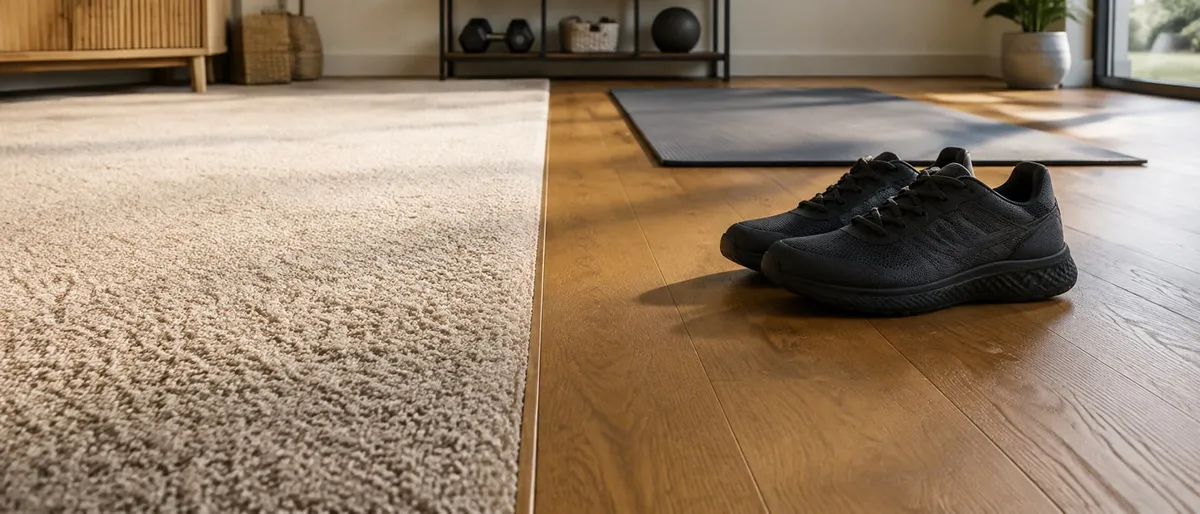
Choose carpet or hard floor by task, grip, and surface stability
Compare carpet and hard floors for home workouts by slip risk, contamination, mat stability, and whether the session stays stationary or needs pivots and jumps.
Neither carpet nor hard floor is the universally safest home-workout surface. Choose by the session in front of you: how much you stay put, whether you pivot or jump, whether a mat stays flat, and whether the floor is clear, dry, and stable under load. Softness alone is not a safety ranking. The HSE slip potential overview is one reason a single material ranking falls apart: flooring is only one factor among several.
Living-room advice often collapses into slogans. Carpet cushions landings. Hardwood is always more stable. Any yoga mat fixes the floor. Those lines skip the factors that actually change slip and trip risk in a short session: the floor itself, what is on the floor, footwear, leftover cleaning moisture, lighting, and how hard you push sideways or down. UK occupational slip guidance lists those factors together instead of crowning one material as safest. The HSE pages are written for workplaces. Borrow the mechanism. Do not import employer legal duties into a bedroom circuit.
Start with the task, not with a floor ranking
Evidence for this section: the HSE slip potential overview and HSE flooring guidance.
Name the session before you argue about carpet. Ten minutes of floor core and hip work is a different surface problem from lateral shuffles and half turns, and both differ from small jumps between strength sets. The HSE overview puts flooring inside a slip potential model that also includes contamination, cleaning, people, environment, and footwear. That multi-factor model is the useful starting point. Naming the material does not finish the decision.
HSE flooring guidance says a floor should be suitable for the activity on it, kept in good condition, and free from obstructions. Those suitability points come from workplace rules. For home training, keep the practical meaning and drop the compliance theater: if the surface fights the movement, change the movement or change the surface. Do not invent a friction coefficient to justify pushing through a bad setup.
A plain home version looks like this:
- Stationary strength or mobility on a mat: prioritize a flat, dry area and a mat that does not creep.
- Controlled step-outs or lunges: prioritize a surface that does not twist under the planted foot.
- Pivots, shuffles, or jumps: prioritize predictable push-off and landing, then ask whether carpet pile or a loose rug belongs in that plan at all.
If the honest answer is that this floor is wrong for this plan, switch the plan. A standing home workout that stays off the floor beats fake confidence on a sliding rug.
Trip potential gets less attention than slip talk, and it should not. The same HSE overview notes that most trips come from walkway obstructions, with the rest from uneven surfaces. See the HSE trip guidance in that overview. A coffee table corner, a charging cable, and a curled rug edge are part of the surface decision even when the carpet itself feels fine under quiet standing.
Contamination and damp floors beat slogans about carpet
Evidence for this section: HSE contamination guidance and HSE retail slips guidance.
People rarely slip on a clean, dry floor. HSE contamination guidance says contamination is involved in almost all slip accidents, and that even a tiny amount on a smooth surface such as vinyl, ceramic tile, or varnished wood can become a real slip problem. That contamination warning fits sweaty living-room workouts better than brand loyalty about flooring. Dust, lotion, spilled water, mop residue, and sweat under a sock can change the session before carpet versus hardwood becomes interesting.
Retail-sector HSE guidance points to wet or dirty floors, spills left in place, and cleaning that leaves damp smooth floors as common slip settings. Those retail notes also say a well-wrung mop can still leave a thin water film that is enough to create a slip risk on a smooth floor. Both points appear in the HSE retail slips guidance. Take that as a home maintenance cue. It is not a claim that you personally carry workplace legal duties. If you just mopped the hardwood, wait until it is dry. If a damp patch shows up mid-set, wipe it and reset rather than treating the skid as toughness.
Hard floors show the problem clearly because the surface is smooth and easy to leave glossy. Carpet can hide dust and trap grit while still creating a soft ridge where a mat edge meets deep pile. Neither material cancels the need to clear the work area. Footwear still matters, but it is a partner variable rather than the whole topic. For the shoe-versus-barefoot decision itself, use the barefoot or shoes home-workout guide. This page stays on the surface under those choices.
Practical checks before the first working set:
- Is the work area dry to the touch where your feet and hands will load?
- Did you remove loose objects, cords, and furniture corners from the movement path?
- If you cleaned recently, is the floor actually dry, or only mostly dry?
- Are socks, shoes, or bare feet consistent with the grip you need today?
If the answer to any of those is no, fix that first. A nicer carpet will not rescue a wet film under a sock during a reverse lunge.
Match carpet and hard floor to movement type
Evidence for this section: the HSE slip potential overview and the Birch 2025 hopping surface study.
Carpet often feels kinder for kneeling, side-lying work, and long floor holds. That comfort is real for many people. It is not proof that carpet reduces injury risk for every home session. Hard floors often feel more predictable for push-ups, plank variations, and short steps when a mat sits flat and stays put. Predictable contact helps. It still is not a universal ranking.
Separate demand levels instead of arguing materials in the abstract. The HSE model already treats the activity and the floor as linked. Your circuit should do the same.
Stationary or slow floor work. Planks, glute bridges, dead bugs, and many mobility drills care most about a stable contact patch and enough cushion that knees or elbows are willing to stay down. A hard floor plus a secured mat is often enough. Carpet can work if the mat does not create a soft trench or a rolling edge under one hand.
Controlled steps and lunges. The planted foot needs a surface that does not rotate by surprise. Short-pile carpet can feel fine. Deep pile, thick underlay, or a mat that creeps sideways can turn a lunge into a balance puzzle you did not program. Hard floor with a grippy mat usually makes the plant foot easier to trust, provided the mat is large enough for the step length you actually take when tired.
Pivots, shuffles, and jumps. These tasks punish surprise. Carpet can catch a turning foot. A hard floor can feel slick once sweat arrives. Laboratory hopping work on custom elastic and locked platforms shows that people change foot and ankle mechanics when surface stiffness changes. Softer elastic conditions altered joint work and muscle activation rather than acting as a free safety upgrade. Those Birch findings came from hopping platforms, not from living-room carpet versus oak plank, and they report mechanics rather than injury rates. Keep that boundary from the Birch 2025 hopping surface study. Softness changes how you move. It does not automatically make landings safer.
If your plan includes lateral change-of-direction practice, set the surface first and the drill second. Our lateral movement exercises at home guide is about patterning those steps. It still assumes you chose a surface that does not fight the plant foot.
One more local detail: transitions between surfaces matter. Stepping from thick carpet onto polished wood mid-circuit changes friction without warning. If the room has both, keep a whole set on one surface instead of straddling the boundary during a turn.
Treat a secured mat as equipment and a loose rug as a hazard
Evidence for this section: HSE flooring guidance and HSE contamination guidance.
A workout mat helps when it stays flat, covers the contact area you need, and does not introduce a new ridge or slide. On hard floors, that usually means enough length for the tallest position in the circuit and enough grip that hands and feet do not migrate. On carpet, the failure mode is different. The mat bunches, walks toward a doorway, or floats on pile so that push-ups feel like they are happening on a soft raft.
A loose area rug is a different object. It can slide on hard floor, fold at an edge, and hide uneven underlay. HSE flooring language about suitability and keeping floors free from obstructions is a blunt way to say the support surface should not become the hazard. That suitability framing is enough reason to roll the decorative rug away before a session that needs plant-foot trust. Contamination guidance also notes that footwear can bring material onto a floor. Sweaty socks on a slick rug combine two problems at once.
Use this mat-versus-rug check:
- Place the mat where the hardest contact will happen.
- Do one slow push-up, one slow lunge, or one slow kneel-to-stand on the exact spots you will load.
- Watch for bunching, sliding, or a soft edge under the heel or palm.
- If the surface moves, fix the setup before you add speed, load, or jump height.
Corner-tucking a mat under a sofa leg, using a high-friction mat on hardwood, or switching to a larger mat are ordinary fixes. Hoping the rug “settles” after the third burpee is not. If the mat only behaves on hard floor, move there. If the hard floor is slick and the carpet holds a secured mat better for today’s floor work, use the carpet. The decision belongs to the session, not to a permanent verdict about your favorite room.
What balance studies actually say about carpet
Evidence for this section: the Dickinson commercial-carpet balance study and the Redfern flooring balance study.
Claims that carpet destabilizes everyone do not survive the better-known static-balance paper on commercial carpet. Dickinson, Shroyer, and Elias tested 45 healthy older adults who had not fallen more than twice in the prior six months. Participants stood on a computerized balance system in carpeted and noncarpeted conditions under various sensory limitations. The selected commercial-grade carpet did not affect postural sway. Balance-strategy scores were lower on carpet, but the authors described the clinical meaning as questionable because the mean difference was small for practical purposes. Those Dickinson results push back against panic about ordinary carpet during quiet standing. They are not clearance for fast pivots, single-leg hops, or people with a frequent fall history.
An earlier flooring study by Redfern, Moore, and Yarsky compared hard tile and several carpet-and-pad combinations during quiet standing with eyes open, eyes closed, and a moving visual surround. Softer floors increased sway amplitude in older participants, with the largest effects during the moving visual condition. Those Redfern findings show that floor compliance can matter for standing balance in older adults, especially when vision is already challenging. They still do not establish a home-workout injury ranking, and they do not erase Dickinson’s null sway finding on a selected commercial carpet in a different protocol.
Hold both results without turning them into a scoreboard:
- Static standing on one commercial carpet in healthy older adults without frequent falls: no sway change in Dickinson.
- Softer floors across multiple carpet-and-pad conditions: more sway for older adults in Redfern, especially with destabilizing vision.
- Fast athletic tasks on domestic carpet versus hardwood: not what either study measured.
If balance is already a concern, pick the clearer surface for the task you can control and keep a support nearby when the plan calls for it. Neither paper diagnoses your living-room floor, and neither one tells you that deep residential pile behaves like the commercial carpet Dickinson selected.
Soft surfaces change mechanics; they do not guarantee safer landings
Evidence for this section: the Birch 2025 hopping surface study and the Physical Activity Guidelines current landing page.
Home advice often treats cushion as insurance. Laboratory hopping on elastic versus locked platforms shows a more interesting pattern. People adapt foot and ankle mechanics when the surface underfoot stores and returns energy differently. Birch, Kelly, and Farris found surface effects and surface-by-frequency interactions on joint mechanics and muscle activation during bilateral hopping. Preferred hopping frequency did not simply shift into a magical safe zone because the platform was elastic. The Birch paper is explicit about custom platforms and neuromechanical outcomes. It is not a carpet-versus-hardwood injury trial, and it does not measure domestic fall rates.
That boundary is the point for home training. A softer surface can change how hard the foot and ankle work. It can also feel unstable, grab during a turn, or delay the feedback you use to stop a messy landing. If your session needs rebound or quick plant-foot trust, a clearer hard-floor area with a secured mat may be the better tool. If your session is mostly floor strength and the hard floor leaves your knees complaining, carpet or a thicker mat may be the better tool. Neither choice replaces progression, clear space, or the option to remove jumps entirely.
For general adult activity targets, the Physical Activity Guidelines for Americans remain the normative U.S. reference for how much activity to accumulate. They do not rank household flooring products. Keep using the Physical Activity Guidelines current landing page for weekly activity framing while you make surface decisions from task demands and the slip factors already covered.
If a noisy upstairs neighbor or a small room already pushed you toward low-impact options, keep that constraint. A small-space HIIT plan without jumping often solves the surface problem by deleting the demand that made the floor feel risky. Deleting the jump is a legitimate surface strategy, not a failure of toughness.
Build a simple decision path for tonight’s session
Evidence for this section: the HSE slip potential overview and HSE contamination guidance.
Use a short path instead of a permanent house rule.
- Name the highest-demand movement in the session. Stationary floor work, controlled lunges, pivots, and jumps each ask different things of the surface.
- Inspect the candidate area for dryness, clutter, and uneven edges. Contamination and obstructions belong in the same scan as carpet versus hardwood, according to the HSE multi-factor slip model and contamination guidance.
- Place a mat only if it stays put through a slow rehearsal of the contact points you will load.
- Rehearse one slow rep of the riskiest move. If the foot twists, the mat walks, or the floor feels slick, change the surface or change the move.
- Keep a support within reach when balance is part of the plan, then start the working sets.
Decision cues that usually help:
- Floor work and kneeling: carpet or a cushioned mat on hard floor can both work if the contact patch is stable.
- Push-ups and planks: prefer a mat that does not sink into a soft trench.
- Lunges and step-backs: prefer a plant surface that does not rotate under the heel.
- Pivots and shuffles: prefer predictable friction and no grabby pile; move the rug out.
- Jumps: prefer a clear, dry, known surface, or replace the jumps.
Write the choice in one sentence if that helps you stick to it. Tonight is floor strength on the carpet with the blue mat held flat at the corners. Tonight is lateral steps on the dry hardwood with shoes. The sentence is more useful than a standing opinion about which room is the workout room.
Common failure modes are boring and fixable. Starting on a damp mopped floor. Keeping a runner rug because moving it feels like too much setup. Adding jumps after the mat already crept during warm-up. Treating carpet comfort during a plank as proof the same carpet is ready for 180-degree turns. Catch those early and the rest of the session gets simpler.
Medical and practical limits
This article is general surface-selection guidance for ordinary home exercise. It is not a fall-risk assessment, a workplace safety plan, or advice for recovering from injury. Occupational HSE pages describe employer responsibilities and workplace floors. They are cited here for mechanisms such as contamination and multi-factor slip risk, not as personal legal requirements. Balance studies in older adults used standing protocols and selected populations. They do not clear or forbid a specific carpet for your jump training. If you have recurrent falls, dizziness, unexplained imbalance, recent lower-limb injury, or a clinician-imposed movement limit, get individualized guidance before you test unstable surfaces alone.
Make the surface decision, then start
Evidence for this section: the Physical Activity Guidelines current landing page and the HSE slip potential overview.
Pick the surface that matches tonight’s highest-demand movement, confirm that it is clear and dry, and confirm that any mat stays put. Then do the session you can actually control. Regular activity still matters more than perfect flooring identity, which is why the Physical Activity Guidelines focus on accumulating movement rather than ranking household materials. The HSE slip model simply keeps you honest about the floor, the mess on the floor, and the way you load it.
If RazFit is already part of your short-session habit, keep using it on the surface that passes the slow rehearsal. Swap the room when the plan changes. The useful result is a session that starts on purpose, not a permanent verdict that carpet or hardwood is superior for fitness.
Frequently Asked Questions
6 questions answered
01
Is carpet safer than a hard floor for home workouts?
Neither surface wins as a universal safety ranking. Match the surface to the task, keep it clear and dry, and treat footwear and contamination as part of the same decision. A soft carpet can feel kinder for floor work and worse for pivots if the pile twists under your foot.
02
Should I put a yoga mat on carpet or on a hard floor?
Use a mat that stays put for the movements you will do. On hard floors, a mat often adds cushion and a clearer work area. On carpet, check that the mat does not bunch, creep, or create a soft ridge under your hands or feet. If it moves, change the setup before you add speed.
03
Are loose rugs okay for workouts?
Treat a loose rug as unstable equipment until it stays flat and does not slide. Secure it, roll it away, or move the session to a clear area. A rug that bunches mid-lunge is a trip and slip problem, not a soft landing feature.
04
Can I jump or pivot on carpet?
You can, but carpet is not automatically safer for landing or turning. Deep pile can catch a foot during a pivot, and soft surfaces change how the foot and ankle work in hopping research on laboratory platforms. If the carpet feels grabby or unstable, switch to lower-impact options or a clearer hard-floor area.
05
Does carpet ruin balance?
Not for everyone, and not for every task. In one study of healthy older adults, commercial carpet did not change postural sway during static standing. Softer floors have increased sway in other standing tests, especially with challenging visual conditions. Static standing results do not prove what happens during fast lateral steps or jumps.
06
What if my only floor feels slippery when I sweat?
Stop the sliding problem before you keep the same plan. Wipe damp spots, change footwear or socks, add a secured mat, or switch to a standing circuit that does not need aggressive push-offs. Contamination and wet smooth floors are classic slip conditions in occupational guidance.
References
Sources
Expert perspective
Dickinson, Shroyer, and Elias reported that a selected commercial-grade carpet did not change postural sway in healthy older adults during static balance testing, and that a small difference in balance-strategy scores was of questionable practical meaning.
Joan I. Dickinson, JoAnn L. Shroyer, and Jeffrey W. Elias · Authors of a 2002 commercial-carpet static-balance study · Texas Tech University · Source: https://pubmed.ncbi.nlm.nih.gov/12145383/