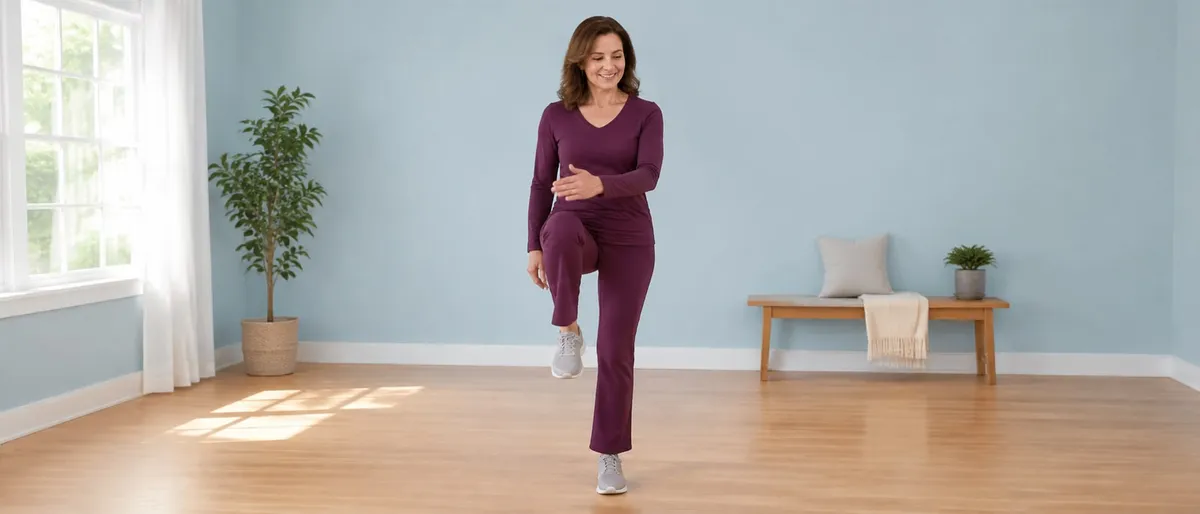
Coordination Practice at Home for Beginners
Learn beginner coordination at home: limb timing, light dual-task drills, and planned turns, with clear limits on the evidence.
Coordination practice at home for beginners is a short skill block. You time opposite limbs on purpose, add one light second demand, or change direction because you chose to. The finish should look a little boring. Cone drills, ladder clips, and athlete change-of-direction playlists belong somewhere else.
Online clips blur the difference. A cross-body knee lift gets sold as neuromuscular magic. A two-step turn becomes an ACL-proof agility fix. Public-health guidance still treats ordinary activity as something you scale to the person, with weekly aerobic and muscle-strengthening targets for adults and extra balance emphasis for older adults when that is the goal (Physical Activity Guidelines for Americans; WHO 2020 physical activity guidelines).
This article is for generally healthy adults who want beginner coordination practice in a clear room. It is not a diagnosis, a rehab protocol, or a promise that better timing prevents falls or sport injuries. If you have sharp pain, unexplained neurologic symptoms, recent surgery, or dizziness that worries you, stop and get advice that fits your situation (MedlinePlus dizziness and vertigo).
What beginner coordination practice is, and what it is not
Evidence for this section: the WHO 2020 physical activity guidelines and the Kümmel balance-specificity meta-analysis.
Here, beginner coordination practice means three home-friendly jobs. First, limb timing: opposite arm and leg move together in a pattern you can repeat, such as a slow marching reach toward the lifted knee. Second, dual-task practice: you keep a simple movement going while you add a light second demand, such as counting backward by ones or naming objects in the room. Third, planned change of direction: you take a few steps, turn on purpose, and stop without rushing. None of that needs a ladder, a clocked shuttle, or someone yelling “cut.”
WHO’s 2020 guideline paper defines balance training as static and dynamic exercises meant to help a person handle postural sway or destabilizing stimuli, and it defines multicomponent activity as sessions that combine aerobic work, muscle strengthening, and balance training (Bull et al.). That wording helps put coordination next to balance without treating them as clones. Standing still on one foot is mostly balance. Matching opposite limbs while you march is coordination with a balance demand stuck to it.
Neighboring RazFit pages already own nearby skills. Jump landing practice for beginners covers quiet two-foot landings after a small hop. Lateral movement exercises at home cover sideways step-and-stop patterns. Getting up from the floor covers sit-to-stand and floor get-up skill. Unilateral training at home covers single-limb strength. Coordination practice can share the room. It does not need to rewrite those theses.
Task specificity keeps the sales pitch from getting silly. In healthy people, balance training improved the trained tasks, while transfer to non-trained balance tasks was minor or absent in Kümmel and colleagues’ meta-analysis (Kümmel et al.). Practice a slow opposite-limb march and you get better at that march. You do not suddenly inherit elite cutting mechanics, ladder speed, or a medical clean bill of health.
A few nearby training ideas get confused with this one. Tempo work slows a strength rep to change load. Mind-muscle cueing asks you to notice a muscle. Calisthenics progression often raises complexity as overload once a pattern is already strong. Beginner coordination practice is earlier and narrower: can opposite limbs arrive on time, can you keep a light second demand without losing the feet, and can you turn because you chose to. If those answers are shaky, adding tempo counts or advanced leverage usually just hides the timing problem under more stress (Kümmel et al.; Bull et al.).
Why public-health guidance mentions balance and coordination
Evidence for this section: the Physical Activity Guidelines for Americans and CDC physical activity examples for older adults.
Adults still need a weekly activity base. ODPHP’s current Physical Activity Guidelines for Americans keep the familiar adult targets: at least 150 to 300 minutes of moderate-intensity aerobic activity each week, or the vigorous equivalent, plus muscle-strengthening activity on two or more days (Physical Activity Guidelines for Americans). Coordination drills do not replace that base. They sit beside it as skill work.
Older-adult guidance adds balance on purpose. CDC’s consumer page on what counts for adults 65 and older lists balance examples such as walking backward, standing on one leg, or using a wobble board, and it notes that some activities combine aerobic, strength, and balance elements (CDC). WHO’s 2020 guidelines likewise tell older adults to include varied multicomponent activity that emphasizes functional balance and strength on three or more days a week (Bull et al.).
If you came for a senior fall-prevention plan, use the dedicated seniors balance and strength guide instead of stretching beginner coordination into a medical program. If you came as a generally healthy adult who feels clumsy when opposite limbs have to cooperate, stay with short skill blocks and clear stop rules. Guideline language about falls is population guidance. It is not a certificate that five minutes of hallway marching will prevent a fall next month (Physical Activity Guidelines for Americans; CDC).
Dual-task and limb-timing practice without clinic cosplay
Evidence for this section: the Rieker combined cognitive-physical meta-analysis and the WHO 2020 physical activity guidelines.
Dual-task practice is simpler than the branding. Rieker and colleagues describe concurrent physical and cognitive work as combined, multidomain, or dual-task training: you ask the body to move while attention handles another demand (Rieker et al.). Their multilevel meta-analysis pooled 783 effect sizes from 50 intervention studies involving 6,164 healthy older adults. Simultaneous and interactive formats, including exergames and square stepping, produced the largest gains in several cognitive and physical outcomes in that corpus, and combined training showed higher balance gains than single physical training (Rieker et al.).
Treat that as permission to keep a second demand light at home, not as a reason to buy a console or copy a clinic sheet. A beginner version can look like this: march in place for eight slow cycles while saying the alphabet out loud, then rest. Or reach the opposite hand toward the lifted knee on each step, which is limb timing with a built-in attention demand. WHO’s glossary even uses “standing on one foot while doing an upper body muscle-strengthening activity” as an example inside multicomponent framing (Bull et al.). At home that can mean a planted foot, a slow reach, and a pause when the pattern frays.
Keep the second task honest. If the movement falls apart the moment you start counting, drop the cognitive add-on and clean the motor pattern first. Dual-task research in older-adult intervention samples does not entitle a younger beginner to stack puzzles, podcasts, and unstable surfaces on day one (Rieker et al.). Dual-task work is also not the same as mind-muscle cueing during a push-up. Noticing a muscle is a strength cue. Dual-task work is a divided-attention demand. Mixing those labels mostly creates fog.
Common beginner errors on the opposite-limb march are boring and fixable. Same-side arm and leg travel together. The standing hip dumps sideways. The reach becomes a torso twist that never arrives near the knee. The foot stamps instead of placing. Slow the cycle until you can name which hand should move before the knee leaves the floor. That is coordination practice. Speeding up a broken pattern is just rehearsal of the broken pattern, and specificity evidence gives you little reason to expect a different task to repair it for free (Kümmel et al.).
Planned change of direction without sport agility theater
Evidence for this section: the Kümmel balance-specificity meta-analysis and CDC physical activity examples for older adults.
Change of direction for a beginner can be three steps forward, a calm turn, and three steps back to the start line. You choose the turn. You see the finish. You stop on both feet. That is coordination and orientation practice. It is not a 5-10-5 test, a reactive cut off a defender, or a ladder pattern filmed for likes.
Specificity still rules. Kümmel and colleagues found meaningful improvement on trained balance tasks and little transfer to non-trained ones in healthy samples (Kümmel et al.). Practice the turn you want to own. If the goal is a controlled 180-degree turn in a hallway, practice that turn. Do not assume sideways ladder contacts will gift it to you. CDC’s balance examples include walking backward and standing on one leg, which are useful building blocks when you need them, not proof that every beginner must graduate to a wobble board (CDC).
Keep the approach short. A short approach lowers the chance you invent a panic plant. A pause after the turn lets you notice whether the feet landed where you meant. If you want dedicated sideways mechanics, use the lateral movement article rather than stuffing every plane into one coordination supersession. If you want landings after leaving the ground, use the jump-landing article. Coordination owns the timing and the decision to turn. It does not need to steal every neighboring skill.
How to structure a short home coordination block
Evidence for this section: the Physical Activity Guidelines for Americans and the Rieker combined cognitive-physical meta-analysis.
Clear a few square meters. Remove cords, toys, and slick rugs. Soft shoes or bare feet both work if the floor is trustworthy; you want traction you trust, not a brand story. A wall or chair nearby is fine early on. ODPHP’s adult guidance still starts with moving more and building toward weekly aerobic and strength targets, so treat coordination as a skill add-on rather than the whole fitness plan (Physical Activity Guidelines for Americans).
A practical block can run eight to twelve minutes after a short warm-up walk.
- Opposite-limb march: eight to twelve slow cycles. Lift one knee, reach the opposite hand toward that knee, plant, switch. Stay tall enough that you are not collapsing into the standing hip.
- Dual-task march: eight cycles while counting backward from twenty, or naming colors you can see. If footing gets noisy, drop the counting.
- Planned turns: three steps, turn, three steps back. Two to four rounds each direction. Stop fully between rounds.
- Optional easy add: a few backward steps inside your clear zone, then face forward again. Keep this optional and slow.
That sequence nods at combined practice without copying a lab protocol. Rieker’s review supports the general usefulness of pairing cognitive and physical demands in structured interventions for healthy older adults; it does not hand you a universal home dosage or a sports-transfer guarantee (Rieker et al.). Quality beats volume. End the block when the pattern frays, not when a timer shames you into sloppy reps.
Place the block when you are alert. Coordination after a hard interval session usually looks worse, not braver. If your week already includes strength and walking, this skill work can sit on an easier day or at the start of a session before fatigue stacks up (Physical Activity Guidelines for Americans).
Two or three short blocks in a week beat one long chaotic one. There is no universal unsupervised home dosage in the sources used here, so treat frequency as a practice habit rather than a medical prescription. Leave at least a day between harder dual-task attempts if your feet still feel noisy the next morning. Keep the rest of the week pointed at the adult activity base: walking or other aerobic minutes, plus muscle-strengthening work on two or more days when you can (Physical Activity Guidelines for Americans; Bull et al.).
Decision rules for progressing, regressing, or choosing another drill
Evidence for this section: the Kümmel balance-specificity meta-analysis and the Rieker combined cognitive-physical meta-analysis.
Choose the next step by the error you actually see. If opposite limbs keep arriving on the same side, stay with slow marching reaches and remove dual-task demands. If the march looks clean but counting wrecks foot placement, keep the dual-task lighter or shorter. If turns feel rushed, shorten the approach and demand a full stop. Specificity research on balance tasks argues for practicing the exact skill you care about rather than hoping for broad transfer (Kümmel et al.).
Progress only when two conditions hold. First, you can repeat the pattern without catching yourself. Second, adding a tiny challenge still leaves the finish quiet. Tiny challenges include a softer voice-count, one extra step before the turn, or a slightly higher knee without losing posture. Jumping to reactive cuts, unstable boards, or crowded obstacle courses is not a beginner requirement, and dual-task literature from older-adult trials does not authorize that leap for unsupervised home practice (Rieker et al.).
Regress without drama. Hold a chair. Shrink the knee lift. Face a wall for turns so the room feels smaller. Trade counting for a single spoken word on each foot contact. Those are coaching decisions, not personal failures. If the limiting factor is single-leg strength rather than timing, borrow ideas from unilateral training and return to coordination when the stance leg feels trustworthy.
Keep the drill that matches the skill you want to improve, because transfer is limited when the practiced task and the hoped-for task differ (Kümmel et al.). That pairing is the whole progression idea for this page.
A simple decision tree helps when motivation wants to skip ahead. Want cleaner opposite-limb timing? Stay with the march and reach. Want divided attention? Add counting only after the march is quiet. Want hallway turns? Practice hallway turns at walking pace. Want sideways stops? Open the lateral-movement page instead of inventing a hybrid scramble. Want soft landings after leaving the ground? Open the jump-landing page. Combined cognitive-physical research can justify keeping a second demand in the mix for some adults under structured conditions; it does not justify blending every neighboring skill into one unsupervised circus (Rieker et al.; Kümmel et al.).
Limitations, stop rules, and honest expectations
Evidence for this section: MedlinePlus dizziness and vertigo, the Physical Activity Guidelines for Americans, and the Rieker combined cognitive-physical meta-analysis.
This article cannot diagnose coordination disorders, concussion aftereffects, vestibular disease, or neuropathy. It cannot promise that home drills will transfer to a sport season. Rieker’s findings come from healthy older adults in intervention studies, often with supervised or structured formats, so effect sizes there are not a voucher for every living-room beginner (Rieker et al.). ODPHP guidance describes population health benefits from meeting activity guidelines over time; it does not certify a custom coordination circuit as injury insurance (Physical Activity Guidelines for Americans).
Stop the session if movement quality collapses into stumbling you cannot correct. Stop for sharp joint pain, chest pain, fainting, or unusual breathlessness, and contact local emergency services for those signs. MedlinePlus notes that dizziness can mean feeling lightheaded, woozy, or unsteady, and it advises emergency help for sudden or severe dizziness paired with vision problems, slurred speech, or weakness (MedlinePlus). Those are clinical red flags, not badges of a hard workout. After recent injury, surgery, or a new medication that affects balance, get personal guidance before you invent dual-task progressions.
Better timing on a practiced march is a fair goal. “Never feel clumsy again” is not. Broad athletic transfer is not. A quieter turn in your hallway is enough win for a beginner block.
Try a short coordination block this week
Pick one clear floor space. Run the opposite-limb march, one light dual-task round, and a few planned turns. Stop while the pattern still looks clean. If you use RazFit for short home sessions, park this skill block before fatigue work rather than after it, and keep the rest of the week honest about walking and strength.
Medical note
This page is general fitness education for generally healthy adults. It is not medical care, physical therapy, or advice for neurologic or vestibular conditions. Contact a clinician for personal guidance when pain, dizziness with warning signs, or recent injury or surgery changes what is safe for you (MedlinePlus dizziness and vertigo).
Frequently Asked Questions
5 questions answered
01
What is coordination practice for beginners at home?
It is short, deliberate practice of timing opposite limbs, adding a light second task, or changing direction on purpose at a controllable pace. The goal is cleaner timing and control, not sport agility scores or medical rehab.
02
Is dual-task training the same as mind-muscle focus?
No. Dual-task work asks you to do a movement and a second demand at the same time. Mind-muscle cues ask you to notice a muscle during a strength rep. They solve different problems.
03
Do home coordination drills prevent falls or injuries?
Not as a proven guarantee from a short unsupervised session. Public-health guidance links certain multicomponent and balance activities to fall-related benefits in older adults at the population level, which is not the same as promising prevention from living-room drills alone.
04
How fast should beginner change-of-direction practice be?
Slow enough that you choose the turn, place the feet, and finish tall without stumbling. Speed is optional later. Sport cutting research is a different demand set.
05
When should I stop a coordination session?
Stop for sharp pain, chest pain, unexplained breathlessness, fainting, or dizziness with warning signs such as vision changes, slurred speech, or weakness. Get personal clinical advice when those show up or after recent injury or surgery.
References
Sources
Expert perspective
Kümmel and colleagues conclude that in healthy populations, balance training can improve performance on the trained tasks, while effects on non-trained balance tasks may be minor or absent, so coaches and therapists should identify the tasks that need improvement and practice those tasks.
Jakob Kümmel, Andreas Kramer, Louis-Solal Giboin, and Markus Gruber · Authors of a systematic review and meta-analysis on balance-training specificity · Sports Medicine · Source: https://pubmed.ncbi.nlm.nih.gov/26993132/