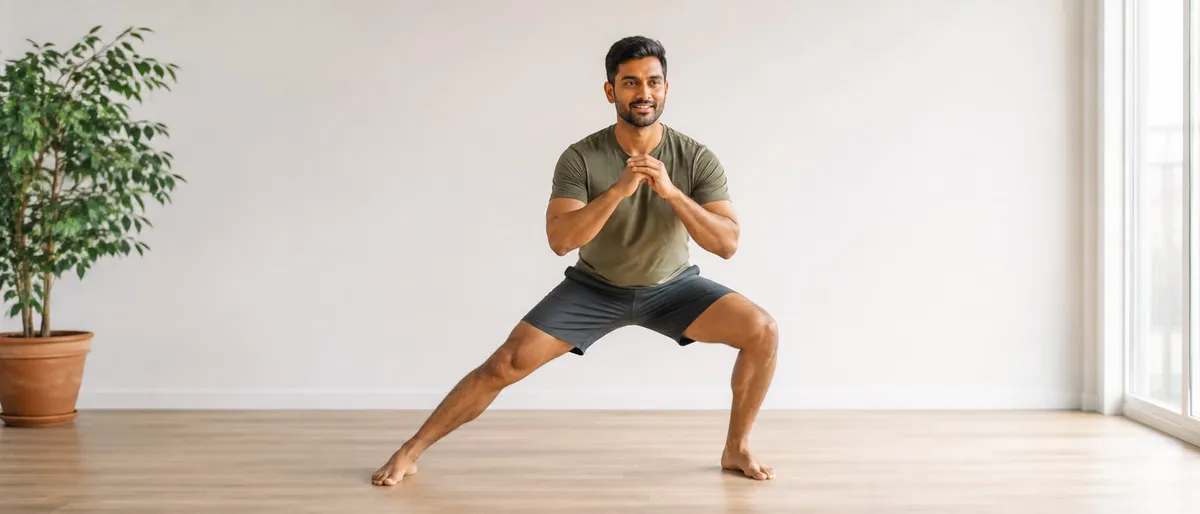
Lateral Movement Exercises at Home: Learn to Step and Stop
Learn lateral movement exercises at home through small weight transfers, sideways steps and deliberate stops, with clear space and gradual practice.
Lateral movement exercises at home can start with a small sideways step and a deliberate stop. You do not need to jump, race between markers, or stay in a low squat. Choose a clear space, move slowly enough to decide where your weight goes, and finish each attempt in a position you can hold comfortably. The NHS includes slow sideways walking in its home balance guidance, with one foot moving first and the other following. Its balance exercise page provides a useful starting point.
Watch what happens between the starting and finishing positions. Does your body travel with the step, or does one foot reach out while you remain behind? Can you stop before moving back? Can you repeat the same task in the other direction? Those questions give a short practice session a purpose beyond counting side steps.
This guide is for generally healthy adults learning comfortable, planned movement on a level floor. The sequence below is an editorial practice example, not a tested rehabilitation program. Its aim is to make sideways transfer and stopping easier to observe. Keep your usual strength and aerobic training separate from this particular learning task.
Understand the difference between reaching, transferring and stopping
Three movements can look similar in a short video. In a side tap, one foot reaches out and returns while most of your body stays near the supporting leg. In a weight transfer, your body moves toward the side that is taking more of your weight. In a traveling side step, your base of support moves across the floor. These are task descriptions for this guide, not a ranking from bad to good.
A tap can be exactly right when a routine asks for one. Here, however, you will sometimes ask for a transfer instead. Picture moving sideways to make room beside a kitchen counter: placing a foot farther away does not finish the job if your body never follows. Practice the action you intend rather than assuming all sideways leg movements are interchangeable.
A meta-analysis in healthy people found that balance training improved practiced tasks, with little or no improvement in the unpracticed task categories it examined. Kümmel and colleagues included only six studies, so this is a useful limit on broad claims rather than a complete explanation of every balance skill. Being better at holding one position does not establish that every sideways movement has improved.
Stopping adds another question: once you have started traveling, can you finish where you intended? Harper and colleagues describe horizontal deceleration in sport in terms of reducing whole-body momentum and managing the forces involved in braking. Their 2022 review concerns physically active people performing demanding running and turning tasks. The concept helps distinguish starting from stopping; the athletic loads and performance expectations are not targets for your living room.
Use a plain instruction for the first session: “Move a short distance to the side, then settle.” You are not trying to prove that you can stop in the fewest possible steps. If an attempt needs another step to regain a comfortable position, take it, stop the practice, and make the next attempt smaller. Do not hold an awkward position merely to satisfy the wording of a drill.
For a broader discussion of how one side contributes to an exercise, see our unilateral training guide. The task here is narrower: controlling a change in position across the floor.
Arrange the space around the stop, not just the first step
Walk through your proposed practice area before starting. You need room for your planned movement, a comfortable finish, and an ordinary extra step if you need one. A route that ends against a table, sofa arm or doorway is not a useful stopping challenge. Make the movement smaller or choose a different area.
Keep the whole path on one clear, level surface. Move loose objects, cords and rugs out of the route. Check that your footwear and floor work together during a slow trial: neither sliding unexpectedly nor catching your foot as you place it. This is a setup check for the movement you will actually do, not a recommendation for a particular floor material or shoe.
The NHS suggests doing balance exercises near a wall or stable chair in case support is needed. Use that support advice deliberately. For this practice, a fixed counter or clear wall is preferable to something you would have to chase or pull toward you. Check it before putting weight through your hand. If the support ends after one step, your practice route ends before that point too.
Face the same direction throughout the first attempts. Let your hands rest where they help you feel comfortable; there is no requirement to copy an athletic arm position. Keep your eyes open. Put a phone or written instructions where you can check them while stationary, then look toward your movement area before starting.
Choose the stopping area before moving. It can be a broad patch of floor you can identify without looking down continuously. Do not use a loose towel or raised object as a foot target. You do not need a taped grid, and you should not choose a smaller target just to make a successful stop harder.
A 2025 article on deceleration assessment emphasizes interpreting stopping performance in relation to approach velocity and a standardized task. Harper and colleagues’ assessment paper is about athletes and measurement protocols. At home, its relevant caution is simple: a longer run-up changes the task. You cannot judge a stop fairly after quietly changing how fast or how far you approach it.
Skip moving practice if you are currently dizzy. NHS dizziness advice recommends moving slowly and carefully and avoiding activities that could be dangerous while dizzy. That guidance is a reason to postpone the task, not to use sideways stepping as a home test of the symptom.
Begin with a weight shift while both feet stay down
Before traveling, find out what a small transfer feels like with the feet staying in place. Stand in a comfortable, slightly wider stance near your checked support. Keep both feet in contact with the floor. Move your pelvis and trunk a small distance toward the right, allowing a comfortable bend at the right hip and knee. Return to the middle, then try left.
The movement should be modest enough that you can reverse it without a push from the furniture or a sudden swing of your upper body. Keep breathing. You are not trying to reach a deep side-lunge position, stretch as far as possible, or lift the other foot. Reduce the range if the attempt becomes a balancing rescue.
Notice the difference between your head tilting sideways and your body moving over the supporting side. A head tilt alone does not answer the task. Think of moving your belt line a short distance, with the chest following comfortably. This is a coaching cue, not a rule about an exact trunk angle that every person must reproduce.
Next, compare two deliberate actions. First, make a small side tap and return, allowing the center of your body to remain near its starting point. Then place that foot down and let your body travel a little toward it. Label the first “reach” and the second “transfer.” Stop between them. The contrast is there to help you identify what you are doing, not to turn the tap into an error.
The NHS sideways-walking example uses slightly bent knees and asks for slow, controlled stepping. Its instructions do not require the deep position often shown in exercise photographs. Keep the range suitable for learning the transfer. The hero image shows a wider, lower position; you do not need to match its depth.
The balance-specificity review recommends identifying the task that needs improvement rather than treating one generic balance test as a measure of everything. That finding supports keeping your observation specific: did you move your body toward the foot, and could you return deliberately? It does not validate a home diagnosis based on which side felt unfamiliar.
If the two directions feel different, try the smaller comfortable range on both. Record the difference in plain language, such as “left transfer needed more hand support.” Do not label a muscle weak, a joint misaligned or a side injured from this observation. New pain or a concerning loss of function is a reason to stop and seek individualized advice, not a reason to add extra repetitions to that side.
Practice one sideways step followed by a pause
Start with your feet comfortably separated, close to your support if needed. Decide which way you will move. For a rightward attempt, take one short step with the right foot, place it fully, and allow your body to move toward that side. Keep the left foot down rather than crossing it behind you. Then pause in the wider stance.
Check the finish before you return. Are your feet where you meant to place them? Has your trunk settled, or is it still drifting? Can you breathe comfortably without immediately pushing off again? If the position is awkward, take the steps needed to stand comfortably and reset. A practice pause should never require you to freeze while falling.
Return slowly to the starting area rather than snapping straight into the opposite direction. You can step back in stages. Once you are comfortable, repeat to the left. Avoid adding a deep bend simply because the movement resembles a lateral lunge. A small bend and short distance are enough to make the placement and transfer visible.
Research on sporting changes of direction shows that approach speed and turn angle affect the mechanical demands of the task. Dos’Santos and colleagues’ review does not supply a universal home stepping angle or speed. That is why this version keeps the direction known and the return separate: you are choosing a simpler task, not copying a court cut at reduced scale.
Give the pause its own place in your instructions: step, transfer, settle, return. “Settle” means that the travel has ended before you choose the next action. It does not mean locking your knees, holding your breath or forcing all movement out of the body.
The 2022 deceleration review distinguishes the control of braking forces from the ability to absorb and distribute them. Read the review with its sporting context in mind. Feeling a hard foot strike is not evidence that you performed better braking practice. Choose an approach you can manage without slamming into the floor.
If you want a visual record, film a few ordinary attempts from a stationary position that keeps both feet visible. Review afterward. Look for the planned step and a recognizable pause rather than trying to estimate joint forces from the picture. Our home-workout form-check guide explains the broader observation process; this session needs only one clear question at a time.
Let the trailing foot follow before adding more travel
The next option is a short step-together movement. Move right with the right foot, allow your body to follow, and bring the left foot toward it without crossing. Finish in a comfortable stance; the feet do not need to strike each other. Stop there before deciding whether to repeat or return.
In the NHS sideways-walking sequence, the second foot follows the first rather than crossing over it. The source example also contains a separate crossing-step exercise. You do not need to add that crossing action to this particular practice. Keep the route and foot order easy to follow while learning the stop.
If the first step is so wide that the trailing foot has to drag or hurry, shorten it. Place each foot deliberately. You can practice only one step-together action each way; traveling the whole room is not a requirement. When your support or clear floor area runs out, stop and reset rather than reaching beyond it.
Once one action feels repeatable, try two short step-together actions in the same direction and then pause. Name the count before starting. Avoid bouncing immediately back because you reached the edge of the space. For the return, begin again from a settled position with the other foot leading.
The newer deceleration assessment paper treats the end of braking as a distinct endpoint and discusses the need to measure velocity rather than relying only on total task time. That assessment discussion explains why “I crossed the room faster” says little about the stop itself. Your slower practice can use an observable pause without pretending to produce a laboratory deceleration measurement.
Keep two choices separate: adding another step and moving the existing steps faster. The first changes the length of the sequence. The second changes how you approach the stop. If you alter both together, an overshoot gives you less useful information about what went wrong.
The angle-and-velocity review describes changing direction as a task whose demands vary with both the entry speed and the intended turn. Its findings are a reason to avoid treating a rapid reversal as the automatic next level of slow sideways walking. Keep the full stop between directions. A sharp cut, lateral bound or reactive chase belongs to a different session with its own preparation and space.
You can practice this sequence without adding speed. There is no requirement to graduate from a careful step to a skater jump. Decide whether a more demanding version serves your actual goal before changing the exercise.
Use a short practice block with a clear stopping rule
Choose a point when you can pay attention and are not already struggling with tired legs. Walk around comfortably first, then rehearse the smallest transfer. Set aside a few minutes rather than a timed work interval you must fill. The numbers below are an example of how to organize observations, not an evidence-based minimum dose.
The NHS advises building balance exercise gradually. That general guidance supports a restrained start, but it does not validate the sample counts in this list. Choose fewer attempts whenever that gives you a clearer, more comfortable rehearsal.
-
Practice choice: Feet-planted transfer
Example amount: A few slow transfers each way
What ends the attempt: Return to a comfortable middle position
-
Practice choice: One side step and pause
Example amount: Three attempts each direction
What ends the attempt: Settle before choosing the return
-
Practice choice: One step-together and pause
Example amount: Three attempts each direction, if appropriate
What ends the attempt: Both feet arrive in a comfortable stance
-
Practice choice: Optional two-step sequence
Example amount: One or two attempts each way
What ends the attempt: Stop in the planned area without rushing back
You do not have to complete every option. If the single step already gives you something useful to practice, stay there. Pause between attempts long enough to reset the feet and read the next instruction without rushing. End the block when you are no longer placing the feet deliberately or when you want to stop; there is no need to turn declining accuracy into extra conditioning.
Use the problem you observe to select the next adjustment:
-
What you notice: The foot reaches but the body stays behind
A practical change to try: Return to the feet-planted transfer and compare the two tasks
-
What you notice: The first step leaves you stretched out
A practical change to try: Shorten the distance rather than pulling yourself across
-
What you notice: You keep drifting after you meant to stop
A practical change to try: Reduce approach speed and leave more clear space
-
What you notice: The feet cross unintentionally
A practical change to try: Rehearse one lead-foot step and one following step, with a pause
-
What you notice: You keep looking down to find a tiny target
A practical change to try: Use a larger clear stopping area
-
What you notice: Support becomes unreachable
A practical change to try: Shorten the route or choose stationary practice
These are task adjustments, not explanations of a medical cause. The balance meta-analysis found a low number of eligible studies and noted methodological diversity. Its limitations matter when someone tries to sell one short drill as a universal solution. The sequence gives you a way to practice a specific movement without promising changes in falls, pain or sports injuries.
If you use RazFit for a separate workout, keep this practice optional and easy to pause. Do not let a timer or completion target override the planned stop. Finish the learning block before deciding whether to continue with other exercise.
Progress the task you can actually observe
Keep a simple record of the setup: direction, number of steps, approximate step size, support and whether you paused where intended. You can write “one step right, counter support, comfortable stop” rather than giving the attempt a score. Repeat the same setup another day before deciding that you need a harder variation.
When you do change something, make it one obvious feature. You might use a slightly larger comfortable transfer, add the trailing foot, or link two steps. Keep the same slow approach while learning the new sequence. If the result is less predictable, return to the previous version and check the setup again.
The 2025 assessment article emphasizes standardized approach conditions when comparing deceleration performance. That principle helps keep your own notes interpretable, even though you are not running a formal athletic test. A shorter stopping distance after taking a slower first step is not proof of improved braking capacity.
Watch both directions without requiring them to feel identical. Use support when it helps you practice the intended action. Do not remove it merely to make the movement look more advanced. You can make the sequence clearer while retaining the same hand contact.
The specificity review cautions against assuming that gains in a practiced balance task will carry over to unrelated balance tasks. Read that evidence as a boundary for your conclusion: “I can repeat this sideways step more comfortably” is useful. “My fall risk is fixed” or “I am ready for tennis” is not established by the same observation.
The 2022 braking review focuses on physically active participants performing straight-line deceleration or substantial changes of direction. Its evidence base does not turn a few slow domestic steps into a sport-conditioning program. If your goal is high-speed stopping, reactive movement or returning after injury, the demands and appropriate assessment need separate attention.
Start with one deliberate transfer
Clear the route, check your support, and choose the smallest version that lets you notice where your weight goes. Try both directions. End with a comfortable stop and one plain observation about the attempt. The next useful change should come from that observation, not from a need to make every session faster.
When this guide is not the right starting point
This is general exercise education, not rehabilitation or a test for the cause of unsteadiness. Stop a painful or concerning attempt. If you have unexplained falls, new difficulty walking, or an existing condition that affects safe movement, get individualized guidance rather than using this sequence to assess yourself. The NHS advises seeking medical advice for dizziness that persists, keeps returning or causes concern. Its dizziness guidance also warns against self-diagnosis. Follow the movement advice given for your own circumstances.
Frequently Asked Questions
5 questions answered
01
What are simple lateral movement exercises at home?
Start with a small feet-planted weight transfer, then try one short sideways step followed by a comfortable pause. If that feels manageable, let the trailing foot follow and stop again. This is a learning sequence, not a tested exercise dose or rehabilitation plan.
02
Is a side tap the same as transferring weight?
They are different tasks. A tap can reach outward while most of your body remains near the supporting leg. A transfer moves your body toward the side taking more weight. Neither is automatically wrong; choose the action the session intends.
03
Do I need to jump or move quickly?
No. A slow planned step lets you notice foot placement, body travel and the finish. Sporting deceleration research concerns substantially different demands. It does not establish that a fast cut or lateral jump is the required next step for home practice.
04
How much space do I need for sideways stepping?
Use enough clear, level floor for the planned step, a comfortable finish and an ordinary extra step if needed. There is no universal distance in this guide. Shorten the task when the route approaches furniture or when support becomes unreachable.
05
Can these exercises prevent falls or treat unsteadiness?
This sequence does not establish either result. Balance training can be specific to the practiced task, and a home observation cannot diagnose unsteadiness. Seek individualized advice for unexplained falls, new walking difficulty or concerning symptoms; postpone moving practice while dizzy.
References
Sources
Expert perspective
Harper and colleagues distinguish controlling braking forces from absorbing and distributing them, in the context of demanding athletic deceleration.
Damian J. Harper · Lead review author and sport science researcher · University of Central Lancashire at the time of publication · Source: https://link.springer.com/article/10.1007/s40279-022-01693-0