Learn the Hip Hinge at Home With Clear Feedback
Learn a hip hinge at home with a wall target, simple feedback and clear checks. Understand knee bend, useful range and when to change the cue.
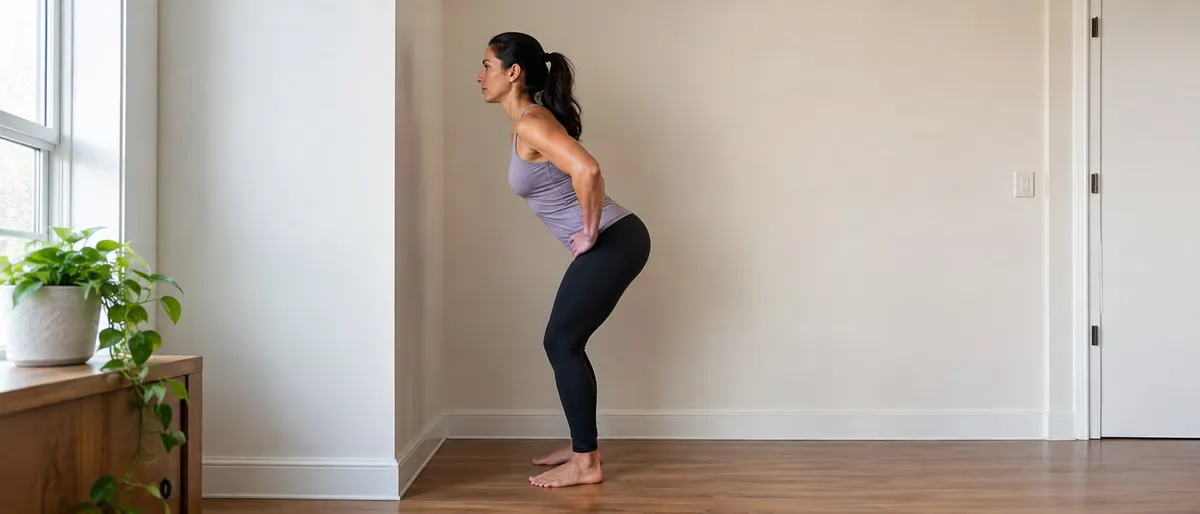
To learn a hip hinge at home, start without a weight and give your hips a destination behind you. A hip hinge is a movement that bends at the hips; the wall version asks you to move your hips back toward a surface behind you. University of Florida Extension’s instructions describe that simple starting task. Keep your knees unlocked, move through a comfortable range, and return to standing. Reaching the floor is not the first assignment.
The difficult part is often understanding what “hips back” means while you are already moving. You may bend your knees into a squat, drop your chest without much hip movement, or keep searching for a stretch that never feels quite right. A target gives you something to reach; checking afterward helps you decide what to change. This guide walks through that learning process, including what to change when the first cue does not work.
Know what you are trying to move
Picture the crease where your thigh meets your trunk. As you hinge, that angle closes and your trunk inclines. Your hips move behind your feet; then you reverse the movement to stand. ACE describes the basic standing hinge as hip flexion during lowering and hip extension on the return. Its Romanian deadlift teaching article explains the movement that underlies the loaded exercise. You can explore that movement before deciding whether a deadlift belongs in your training.
Try saying the task aloud: “Move my hips back, then stand up.” That is enough for an initial attempt. You do not need to recite the names of every muscle involved. If the instruction still feels abstract, place your fingertips lightly at the front of your hip creases and notice where the fold occurs. Your hands are a reminder of the location, not something to press hard into your body.
A squat and a hinge share some joint movement, so the difference is not that one uses the hips and the other does not. The NSCA’s teaching examples distinguish a squat that bends the knees, hips and ankles from a hinge practiced with the knees unlocked and the hips moving back. The illustrated movement progressions show both. For this lesson, watch the direction of your hips rather than trying to freeze every other joint.
-
What you notice: Your hips descend as your knees keep bending
Question to ask on the next attempt: Am I sitting down when the task is to reach backward?
-
What you notice: Your shoulders drop but your hips barely travel
Question to ask on the next attempt: Can I begin with a smaller backward hip movement?
-
What you notice: You stiffen your legs completely
Question to ask on the next attempt: Can I start again with my knees comfortably unlocked?
-
What you notice: You keep reaching lower with your hands
Question to ask on the next attempt: Can I let my hands follow rather than make them the target?
These observations describe a mismatch with the current practice task. They are not a diagnosis of a weak muscle, a tight joint or a damaged back. A squat remains a useful movement in its own right; it is simply a different answer to the instruction you are practicing today.
It can help to compare the motions while standing comfortably: make a small squat, reset fully, then attempt a small backward hinge. Keep the two attempts separate. Trying to morph one into the other halfway down makes it harder to identify what changed. You are learning to choose a movement deliberately, not to prove that one everyday way of bending is always superior.
Use the wall as a destination
Choose a clear wall with no radiator, sharp edge, shelf or loose object behind you. Use a floor and footwear combination in which your feet stay put. The wall is a light contact target, not something to fall against. If standing or reaching backward is uncertain for you, get personal help choosing an appropriate setup rather than using this drill as a balance test.
The NSCA describes the back-to-wall hinge with feet between hip and shoulder width, knees unlocked, and the hips moving back to touch the wall before returning upright. Its teaching sequence provides the basis for the following home practice. Choose a nearby target that you can reach without lunging or tipping; the distance is adjustable, not a test score.
- Stand with your back toward the wall and a small space behind your hips. Settle into a comfortable stance.
- Unlock your knees. Keep your feet resting on the floor rather than deliberately lifting your toes.
- Send your hips toward the wall. Allow your trunk to incline as you make that backward movement.
- Touch lightly, then return to your ordinary standing position. Do not push away from the wall or lean backward at the finish.
- Pause and decide whether your hips actually reached back. Reset before another attempt.
University of Florida Extension also uses a wall behind the exerciser to cue the start of the hinge. Its wall-practice explanation makes the contact a way to understand direction. The useful result is recognizing how you got there. Merely touching the wall after several compensating movements tells you less.
Suppose you miss the wall and feel tempted to reach farther with your head. Stand up first. Move your feet slightly closer to the target and try a smaller motion. You have changed the task so that success is easier to recognize. There is no requirement to keep the original distance because a video used it.
If your hips hit the wall immediately, check your starting space. You may need only a little more room to notice the movement, but make that adjustment while upright. Do not shuffle your feet during the hinge. If contact requires you to lose your footing, abandon that distance and reset.
For the first few attempts, ask just one question: did my hips move back to meet the target? Save questions about deeper range or exercise progression for later. Once the backward reach makes sense, you can try it away from the wall.
Add feedback only when it answers a question
A wall answers “Did my hips travel backward?” It does not tell you everything about the movement. A different cue may help when you cannot tell whether your trunk is changing shape while you bend. ACE uses a dowel along the back to provide touch feedback while teaching movement through the hips. The dowel example is a teaching aid, not a measurement of spinal health.
The University of Florida guide describes three contact points for a dowel: the back of the head, upper back and buttocks. Its illustrated instructions show the general arrangement. Use a light, smooth stick only if you can hold it comfortably. Start upright, find gentle contact, then make a small hinge while noticing whether the contact changes. Do not force your head backward or flatten your back to satisfy the stick. If holding it makes your shoulders uncomfortable, leave it out.
Touch can change how people perform a movement, but that does not make every touch cue interchangeable. In a lifting study, tape on the lower back reduced lumbar flexion, with more movement occurring at the hips and knees; explicit attention to the tape increased the effect. Pinto and colleagues’ experiment studied that particular feedback arrangement. It did not establish that a broomstick or wall tap prevents injuries. You do not need to tape your back to use the practical idea of noticing a contact cue.
You can also record a short side view and watch it after standing up. Put the phone securely outside your movement area and include your feet, hips and upper body in the frame. Make an ordinary attempt rather than performing for the camera. On playback, follow the hip movement first. A clip that cuts off the hips cannot answer the main question, however clear the picture of your shoulders is.
Choose one observation before pressing record. For example: “I want to see whether I bend my knees more and more as I lower.” After watching, write a plain description rather than grading your whole body. “My hips move down first” is more actionable than “My form is terrible.” Our broader home workout form-check guide explains how to organize a useful review.
Avoid turning your head sideways to watch a mirror while you hinge. ACE’s teaching guidance advises looking toward the floor during the hinge instead of turning to inspect a mirror. That coaching advice fits an easier home option: perform the movement, stand up, then review the recording. You can concentrate on the task while it happens and inspect the result afterward.
Change the cue when the attempt stays confusing
If several tries produce the same confusing result, adding more instructions is rarely the clearest next step. Choose one visible problem and make one change. The examples below are options for this unloaded lesson, not treatment for an underlying condition.
If you keep sitting down, bring the wall closer and make the backward reach smaller. Think about touching the target with your hips rather than lowering toward a chair. If your chest drops first, reset and begin by moving your hips before you chase any depth. If your feet become unsteady, stop and restore a comfortable starting position rather than trying to rescue the repetition.
The NSCA explains that an environmental target can narrow the movement options available to a learner. Its wall-hinge example gives context for adjusting the task itself. A clearer target may be easier to use than a longer explanation of joint angles. It is still reasonable to choose another cue if that particular target does not help you.
If a dowel makes you rigid, return to the wall or an unloaded attempt without equipment. If a video leaves you studying tiny details you cannot confidently interpret, choose a simpler question or ask a qualified coach to review it. Use feedback that tells you what to try next. A wall and one clear question may be enough.
A pilot study of 20 adults found that tactile and auditory feedback changed lumbar movement during a repeated box-lifting task. Oppici and colleagues also found differences in how those changes were achieved. The participants came from a university student population, and the task used a box rather than an unloaded home wall drill. That is a reason to treat the findings as evidence about feedback, not a prescription for your exact practice.
Try describing your next attempt in a single sentence. “I will move closer to the wall and reach back gently” tells you both the change and what you will observe. “I will fix my posture, engage everything and use better technique” leaves too many decisions unresolved. You can always add another observation after the first one becomes understandable.
A partner can help by reporting something specific after you finish: whether contact happened, whether you shuffled a foot, or whether the camera captured the intended view. Ask them to observe rather than push your hips into position. If their instruction conflicts with yours, pause and agree which task you are trying. Several people shouting different cues can make a simple movement surprisingly hard to learn.
Choose a range you can repeat without forcing it
The hand position at the bottom is not the definition of a hinge. For this lesson, choose an endpoint that lets you recognize the backward hip movement and return smoothly. You can make a useful attempt without reaching your knees, shins or the floor. Comparing yourself with a flexible demonstrator adds a target that this practice does not need.
ACE’s Romanian deadlift guidance uses a slight knee bend and an endpoint influenced by tension at the back of the thighs. That exercise description does not require every person to lower to the same landmark. Here, with no external load, let the endpoint remain modest while you learn the direction. Do not repeatedly push farther just to manufacture a stronger stretching sensation.
You may hear “neutral spine” as a coaching cue. In this drill, use it to mean keeping a comfortable, fairly consistent trunk position while the hips do the intended movement. Avoid turning it into a demand to freeze yourself rigidly or a belief that any visible rounding proves damage. A systematic review found low-quality evidence that greater lumbar flexion during lifting was not a risk factor for low back pain onset or persistence. Saraceni and colleagues explicitly rated the evidence as low quality. It supports caution about blanket claims linking a visible bend to pain; it does not prove that every load or technique is suitable for everyone.
This distinction matters when you review a clip. You might decide that your trunk changed more than you intended and choose a smaller practice range. That is a task adjustment. You cannot conclude from the same clip that you have injured a disc, identified the cause of pain or discovered the one posture you must use for all daily activities.
If a familiar instruction from your clinician differs from this general lesson, follow the guidance given for your situation. The NHS advises stopping exercises if back pain gets worse and seeking medical advice. Its back-pain guidance is a more appropriate reference for symptoms than a movement tutorial. Do not keep trying new hinge cues to push through worsening pain.
A useful endpoint can change between attempts as you understand the task. That is different from chasing the deepest possible position. When you find a comfortable range that you can explain and repeat, stay there long enough to notice what the movement feels like. More depth can wait until it serves an actual exercise you intend to do.
Check what remains when you remove the target
Once wall contact makes sense, step away and try a small unloaded hinge without it. Keep the task similar: hips back, comfortable range, return to standing. You are checking whether the direction is still recognizable. This is not a pass-or-fail examination or permission to lift something heavy.
The box-lifting pilot included a short retention check without feedback, but its authors said the brief follow-up could not establish long-term learning. The study’s limitations are useful here. A good attempt with a cue and a good attempt later without it answer different questions. Neither supplies a universal number of practice repetitions that everyone needs.
Use a small comparison of your own. Make an attempt with the wall, stand and reset, then make one away from it. If the second attempt turns into a squat again, return to the wall and choose the same clear destination. If both feel understandable, record a brief note such as “I could reach back without the wall today.” That note is specific enough to revisit next time.
In the tape-feedback study, participants retained the movement change after tape removal when told to lift as if the tape were still present. That immediate result shows why the instruction accompanying a cue matters. It is not evidence that your movement has become permanent after one successful practice. You may need the same reminder when you practice again.
Keep this learning check separate from a demanding workout. ACE distinguishes movement-skill practice from conditioning and describes controlled movement, limited repetitions and adequate rest when skill is the emphasis. Its bodyweight training framework supports giving yourself time to reset. You do not need a racing timer, a burn in the hamstrings or a target amount of sweat to make this lesson worthwhile.
Stop the practice when you are repeating attempts without knowing what you are trying to improve. Save the last useful cue and return to it another time. If the movement remains confusing despite a simpler target and comfortable range, a coach can watch the whole attempt and help you choose a more suitable instruction. That is often a clearer next step than collecting another dozen online cues.
Decide what the hinge is for next
Learning the pattern gives you an option to use in a chosen exercise. It does not decide your training load, weekly sets or rehabilitation plan. ACE recommends learning a standing hip hinge without weight before progressing to external resistance. Its teaching progression separates those stages. Treat the first loaded exercise as a new task with its own setup, range and instructions.
A wall tap is therefore not a substitute for a full posterior-chain program. If your next question is how to train those muscles, our hamstring exercises at home guide covers that separate topic. If you are following a workout today, preview the actual movement being requested. An unloaded rehearsal does not mean you should improvise a heavy deadlift with an awkward household object.
Keep the same boundary around pain claims. The lumbar-flexion review does not establish one universally protective lifting posture. Its findings and evidence limits leave room for context, load and individual needs. Use this lesson to learn a movement, not to promise yourself that back pain will disappear once a wall tap looks tidy.
Your next practice
Choose one clear target and one question. Try the wall version, reset, and decide whether your hips traveled backward. If they did, try a small attempt without the wall. If they did not, make the task easier to understand before adding another cue. When using RazFit for your workout, keep this practice separate from the planned exercise dose and follow the instructions for the movement you actually selected.
When a tutorial is not enough
This guide is for adults learning a general exercise pattern, not for diagnosing or treating back or hip problems. The NHS recommends medical advice when back pain interferes with everyday activities, and urgent assessment for severe pain that starts suddenly or worsens quickly. Its current guidance also identifies emergency symptoms. Back pain with new bladder or bowel changes, loss of sensation around the genitals or anus, or pain, tingling, weakness or numbness in both legs needs emergency assessment. Use your local emergency service if those symptoms occur. A different hinge cue is not the next step in that situation.
Frequently Asked Questions
5 questions answered
01
How is a hip hinge different from a squat?
Both involve the hips. In this hinge lesson, the task is to move the hips backward with the knees unlocked. A squat involves more deliberate lowering through the knees, hips and ankles. Compare small, separate attempts rather than trying to eliminate all knee movement.
02
How far should I stand from the wall?
Start close enough to make a gentle backward hip touch without losing your footing. Adjust the distance while standing upright. The wall is a direction cue, so reaching farther is not automatically better and there is no universal distance to pass.
03
Do I need a dowel to learn the hip hinge?
No. Start with a clear wall target or a small unloaded movement. A dowel can provide contact feedback if holding it is comfortable, but it should not force your neck or shoulders into an awkward position. Leave it out if it makes the task harder to understand.
04
Should I feel a strong hamstring stretch?
Do not chase a strong stretch. Practice a comfortable range in which you can recognize the hip movement and return smoothly. The endpoint is not a fixed hand height. Stop if pain worsens and seek advice instead of forcing a deeper attempt.
05
Does a good hip hinge prevent back pain?
This tutorial does not establish that. Learning a movement and preventing or treating pain are different outcomes. Evidence linking lumbar flexion during lifting to back pain is limited and low quality. Persistent or worsening symptoms need appropriate assessment, not a promise about perfect form.
References
Sources
Expert perspective
Oppici and colleagues distinguish movement performance with feedback from learning assessed after feedback is removed; their pilot study could not establish long-term retention.
Luca Oppici · Lead author of the lifting-feedback pilot study · Technische Universität Dresden at publication · Source: https://www.frontiersin.org/journals/sports-and-active-living/articles/10.3389/fspor.2021.746142/full