Strength Training for Cyclists at Home
Build a two-day home strength plan around cycling, with exercise choices, scheduling rules, progressions, and honest limits.
Strength training for cyclists at home works best as two small, deliberate sessions that support the riding you already care about. Start with a knee-dominant movement, a hip-dominant movement, calf work, an upper-body push or pull, and trunk work. Put the hardest lower-body work far enough from your key ride that you can still pedal well. Then make one part of the plan harder over time. That is the whole idea.
The important qualification is that off-bike strength does not duplicate pedaling. Easy spinning, hill repeats, and low-cadence work can all be useful cycling sessions, but none automatically provides the same external resistance, range, or progression as a strength movement. A home plan can be a strong entry point, especially with unilateral variations, but bodyweight has a ceiling. When every set becomes long and easy, a backpack, dumbbell, or suitable band is a more honest progression than adding endless fatigue. ACSM position stand
This article is for generally healthy recreational cyclists. It does not diagnose knee, back, hip, or tendon problems, and it does not promise injury prevention. Stop a movement that causes sharp pain, dizziness, numbness, new weakness, or symptoms that spread. If you are returning after surgery, a significant injury, or an unassessed health problem, get individual guidance before using a training plan.
What off-bike strength can and cannot do
Evidence for this section: Cycling strength review; ACSM position stand.
Cycling is highly specific. It asks you to repeat the same circular motion for a long time, often while seated, and it rewards technical skill, aerobic development, pacing, and durable fuelling. Strength work does not replace those adaptations. A split squat will not teach you to corner, hold a wheel, or pace a climb. It gives you a separate opportunity to produce force through a larger range than the pedal stroke and to expose one leg at a time to a demanding task.
That separation is useful because it keeps expectations sensible. Research reviews of strength training in cycling and running report potential endurance-performance benefits, but the programs commonly involve heavy resistance, plyometrics, or carefully planned sessions. A no-gym routine is not automatically equivalent to those interventions. It may build general strength or movement tolerance, particularly for a novice, yet it should not be marketed as a guaranteed watt increase. Rønnestad and Mujika, 2014
The public-health case is broader. The U.S. Physical Activity Guidelines recommend muscle-strengthening activity at moderate or greater intensity involving all major muscle groups on two or more days each week. Cycling contributes valuable aerobic work, but it does not remove that general recommendation. The Guidelines name the back, hips, legs, chest, shoulders, abdomen, and arms as major muscle groups, which is one reason a cyclist’s strength plan should not be only squats and calf raises. Physical Activity Guidelines
Choose movements by job, not by cycling-themed names
Evidence for this section: Cycling Canada training basics; Physical Activity Guidelines.
You do not need a special “cyclist exercise” for every part of the body. You need a few jobs covered well enough that the session remains repeatable.
| Movement job | Home option | What to watch |
|---|---|---|
| Knee-dominant leg strength | Split squat, reverse lunge, controlled step-up on a stable purpose-built step | Keep the whole foot planted and use a range you control. |
| Hip-dominant strength | Single-leg hip hinge, bridge, hamstring walkout | Keep the task in the hips rather than forcing the low back to do the work. |
| Calf work | Straight-knee and bent-knee calf raise | Use a steady pause and a comfortable full range. |
| Upper body | Incline push-up, push-up, band row if you have a verified anchor | Do not turn pushing into a substitute for pulling. |
| Trunk control | Dead bug, side plank, bear-plank shoulder tap | Keep breathing; do not chase a dramatic brace. |
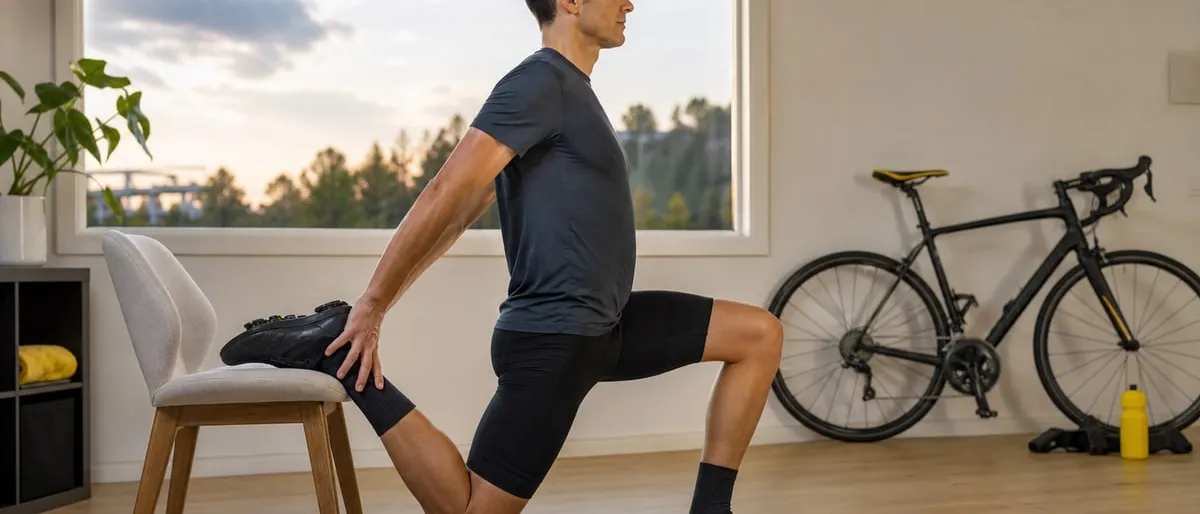
The split squat earns a place because it lets one leg carry more of your body mass without a barbell. Use light fingertip support from a wall if balance stops the leg from working. Balance can be trained, but shaking through a set is not a strength progression. A single-leg hip hinge can follow the same rule: start with a hand on a wall, keep the pelvis level, and make the working leg do the task.
For step-ups, use only a surface designed and stable enough for stepping. A chair, table, loose bench, or stacked object is not automatically safe because it is in a workout video. If you do not have a stable step, use reverse lunges. The plan loses nothing important.
The two-day no-gym plan
Evidence for this section: ACSM position stand; Cycling Canada training basics.
Start with two non-consecutive sessions each week. For the first two weeks, leave about two clean repetitions in reserve on most sets. That is a practical starting point, not a laboratory threshold. If your knee caves inward, your trunk twists to finish a repetition, or you have to rush the hardest part, end the set.
Day A: controlled lower-body strength
| Exercise | Sets and reps | Next progression |
|---|---|---|
| Split squat | 3 × 6–10 per side | Add range, then load a closed backpack. |
| Single-leg hip hinge | 3 × 6–10 per side | Reduce hand support, then add load. |
| Straight-knee calf raise | 3 × 8–15 per side | Add a pause at the top and lower slowly. |
| Incline push-up or push-up | 2–3 × 6–15 | Lower the support or add a pause. |
| Side plank | 2 × 20–40 seconds per side | Increase lever length with control. |
Rest until the next set can be controlled. For many people, that means roughly one to two minutes after split squats rather than hustling into a breathless circuit. If breathing is the main limiting factor, you have changed the session from strength practice into conditioning.
Day B: unilateral work and trunk control
| Exercise | Sets and reps | Next progression |
|---|---|---|
| Reverse lunge | 3 × 6–10 per side | Use a slower lowering phase or add load. |
| Single-leg bridge | 3 × 8–15 per side | Elevate the foot only if the pelvis stays level. |
| Bent-knee calf raise | 3 × 10–20 per side | Add a pause and slow lowering. |
| Band row, if a verified anchor exists | 2–3 × 8–15 | Increase band resistance gradually. |
| Dead bug | 2–3 × 5–8 per side | Use a longer lever without arching. |
If you have no purpose-built pulling option, do not improvise a row from a door, a towel, cabinet hardware, or furniture. Keep the upper-body pushing work and add safe pulling when you can use equipment designed and installed for it. For a broader home upper-body plan, see upper-body training at home.
Put strength sessions around the rides that matter
Evidence for this section: Huiberts et al., 2024; ACSM position stand.
The calendar is more important than an ideal-looking exercise list. Strength and cycling are concurrent training: you are asking for more than one adaptation from the same week. A 2024 meta-analysis of 59 studies found that concurrent training effects differed by outcome, sex, and training status; the authors also noted limits in the available evidence. That is a reason to monitor your own response rather than to assume strength work will either ruin endurance or work perfectly beside every ride. Huiberts et al., 2024
Use a simple priority rule. Do lower-body strength after an easy ride, or after the key ride on a hard day when the following day can be easy. Avoid introducing a demanding new leg session the day before intervals, a long group ride, a race, or the hill session you most want to execute well. This does not mean there is one universally superior arrangement. It means you should not hide new fatigue immediately before the session that gives your week its purpose.
Three workable examples:
| Week shape | Strength placement |
|---|---|
| Two easy rides plus a long ride | Day A after the first easy ride; Day B after the second easy ride; long ride stays separate. |
| Intervals Tuesday and long ride Saturday | Day A Tuesday after intervals or later that day; Day B Thursday after an easy ride. |
| High-volume week | Keep one normal session and make the second a shorter maintenance session. |
Do not make every lower-body session hard simply because cycling is leg-dominant. In a recovery week, reduce sets first. Keep a familiar variation at a comfortable effort if it helps you retain the habit, but do not add jumps, new unilateral drills, and a heavy backpack at the same time.
For timing inside a day, use this as an editorial planning heuristic, not an evidence-backed directive: if the ride is the workout that matters, ride first and keep the later strength session short. If general strength is the current priority, strength can come first and the ride should be genuinely easy. The concurrent-training evidence gives context that training effects vary by outcome and training status; it does not establish this sequence. Huiberts et al., 2024 The related cardio-before-or-after-strength guide explains that decision without pretending there is one answer for every goal.
Progress with a log, not with bravado
Evidence for this section: ACSM position stand; Huiberts et al., 2024.
Record the variation, sets, repetitions, and one note about control. If you completed three sets of eight split squats per side with the same depth and tempo, add a repetition next time. When you reach the top of the range on every set, make one change: add a small amount of load, increase the comfortable range, or choose a harder variation. Then return to the lower end of the range.
ACSM’s position stand describes progressive resistance as necessary for further adaptation and recommends that programming reflect the trainee’s goal, capacity, and status. That principle matters more than chasing a fixed rep number. ACSM position stand
Bodyweight gives you several honest early progressions: unilateral work, more range, a pause, a slower eccentric, and more repetitions. It does not give you unlimited resistance. Once a cyclist can do high-repetition split squats and calf raises with little muscular challenge, longer sets may be a poor trade for someone who also wants fresh legs for riding. Add a closed backpack, dumbbell, or appropriate band if the aim is continued strength development. The home progressive-overload guide has a fuller decision tree.
Read the signals without treating soreness as a verdict
Evidence for this section: Huiberts et al., 2024; Physical Activity Guidelines.
Mild soreness after a new movement is information, not a performance score. Look for patterns instead: does the next easy ride feel unusually awkward, do planned intervals repeatedly lose quality, or does the same session require worse form each week? If so, reduce the number of sets, remove the newest progression, or place the session farther from the key ride. Do not solve it by adding another recovery gadget while leaving the training load unchanged.
Use the same restraint with readiness. A poor night of sleep, an unusually demanding workday, heat, travel, or a hard ride can change what is sensible that evening. You can shorten the plan to two movements, keep the work easy, or skip it. That is not a missed character test. It is normal autoregulation. Workout readiness signs offers a practical screen for those decisions.
Pain is different from ordinary training effort. Sharp joint pain, swelling, instability, numbness, tingling, chest symptoms, unusual shortness of breath, or symptoms that worsen after the session are reasons to stop and seek appropriate medical advice. This plan does not diagnose why those symptoms occur and should not be used to work around them.
What to do in the off-season, in-season, and busy weeks
Evidence for this section: ACSM position stand; Huiberts et al., 2024. These sources do not test this exact home plan.
The labels are less important than the riding load. When rides are shorter or less demanding, you can spend a few weeks building the home movements with more sets or added resistance. When cycling volume and intensity rise, keep the exercises familiar and reduce the dose that creates lingering fatigue. In a race-focused week, one short session can preserve practice better than a second ambitious session that interferes with the event.
This is not a promise that strength training prevents overuse problems or guarantees better climbing. It is a way to make room for more than one training goal. If the primary goal is cycling performance, the bike remains the specific practice. Strength work should earn its place by being repeatable, progressive, and proportionate to the rest of the week.
If you also run or hike, do not copy the same lower-body session onto every sport day. Choose one or two strength sessions for the whole week, then use the sport-specific articles—strength training for runners at home, unilateral training at home, and home workout for hiking—to adjust the exercise choice without multiplying fatigue.
The practical answer
Evidence for this section: Physical Activity Guidelines; Cycling Canada training basics.
For most recreational cyclists, two short home strength sessions are enough to start: split squat or lunge, hip-dominant work, calf raises, an upper-body movement, and trunk control. Place them after easy or key riding days so the following day can recover, record what gets harder, and change only one main training variable at a time.
Keep the limits in view. As an editorial interpretation of progressive-resistance principles, pedaling is not the same as a progressively loadable strength exercise, and a very long bodyweight set shifts emphasis toward local endurance. Add safe external resistance when the work stops being challenging. That is not abandoning cycling-specific training; it is choosing a tool for the adaptation you want. ACSM position stand
A four-week start without chasing a result
Evidence for this section: ACSM position stand; Huiberts et al., 2024. The weeks below are an editorial example, not a tested cycling protocol.
Week one is a rehearsal. Use the low end of every range, write down the variations, and leave the session feeling as though you could have done a little more. Week two adds one or two repetitions only where the previous work stayed controlled. In week three, add one set to a single lower-body movement if the next key ride was unaffected. Week four is a review: repeat the plan if it remains demanding, reduce it if cycling fatigue is accumulating, or add a small amount of external resistance if the repetitions have become easy.
That sequence is intentionally unglamorous. It gives you enough exposure to learn whether a split squat, hinge, or calf raise belongs in your week without assuming a short block will transform your riding. If a movement never feels comfortable, replace it with another exercise that has the same job rather than forcing a named variation. If the whole plan consistently makes your priority rides worse, reduce the strength dose before deciding that strength work itself is the problem.
When a small amount of equipment changes the plan
A loaded backpack is often the first useful addition because it can make split squats, hinges, bridges, and calf raises demanding without turning each set into a very long endurance effort. Close it securely, keep the load compact against your body, and start lighter than you think you need. A resistance band can add pulling work only when the anchor is purpose-built, correctly installed, and rated for that direction of force. If you cannot verify the anchor, do not use it for rows.
Equipment is optional, not a test of commitment. The decision is simple: use it when a familiar movement has become easy at the top of its range and you still want a clearer strength stimulus. Keep the same scheduling rules around hard rides. More load does not justify squeezing a hard lower-body session before an event, and it does not turn a tired technique into good technique. ACSM position stand
Sources
References
Sources
Expert perspective
The Office of Disease Prevention and Health Promotion presents the Physical Activity Guidelines for Americans as evidence-based guidance to help Americans maintain or improve health through physical activity.
U.S. Department of Health and Human Services · Federal public-health guidance · Office of Disease Prevention and Health Promotion · Source: https://odphp.health.gov/our-work/nutrition-physical-activity/physical-activity-guidelines/current-guidelines